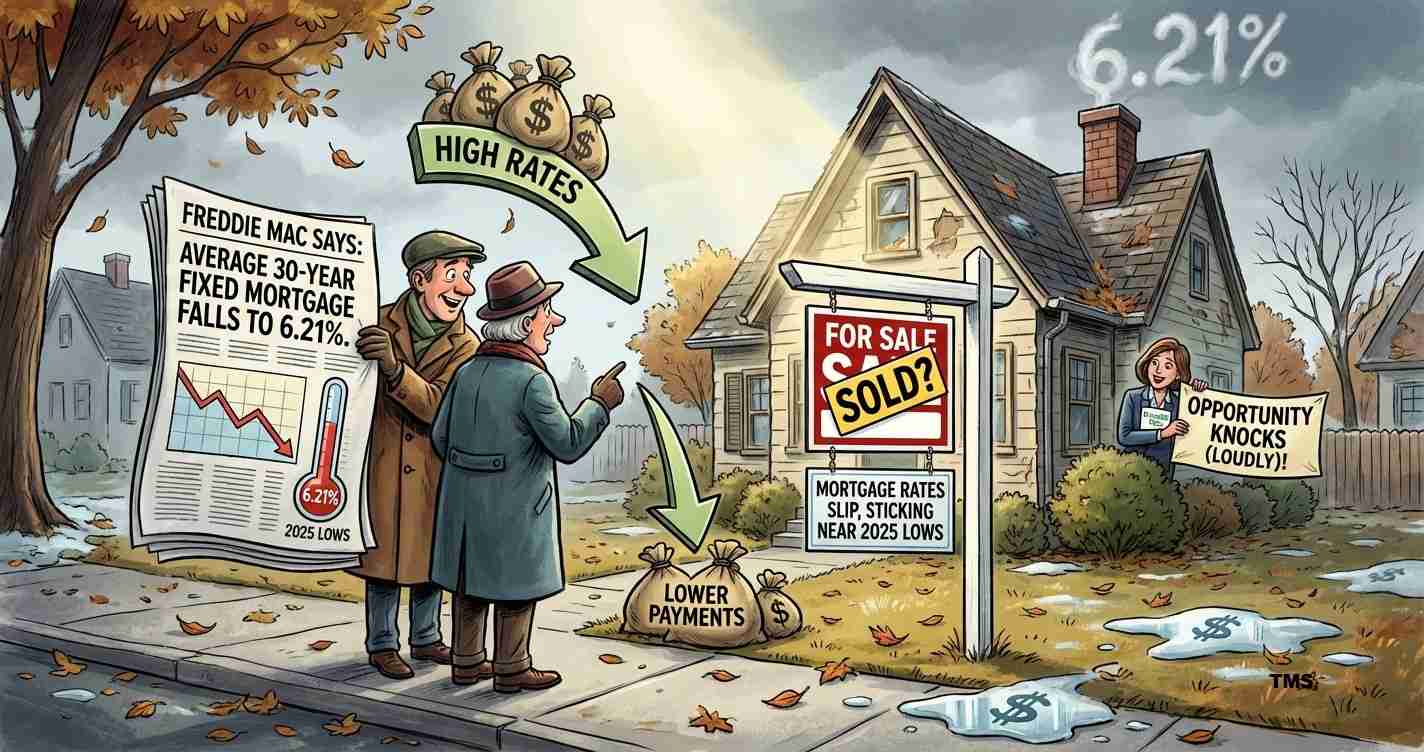
Mortgage rates slip, holding near 2025 lows as 30‑year fixed average falls to 6.21%, Freddie Mac says
Mortgage rates eased and are holding near 2025 lows, with Freddie Mac reporting the average 30‑year fixed rate at 6.21% for the week ending Dec. 18, 2025 — offering potential relief for buyers and refinancers today.
Key takeaways
- Freddie Mac shows the 30‑year fixed average at 6.21% for the week of Dec. 18, 2025 (0.00 points).
- Rates are down about 0.39 percentage point from 6.60% a year earlier, easing borrower costs year‑over‑year.
- Mortgage moves are tracking the 10‑year Treasury (around 4.12%) more than the Fed’s short‑term policy rate.
- Local impact: Fresno may see modest demand gains if lower rates combine with available inventory and down‑payment support.
What Freddie Mac’s weekly survey shows
Freddie Mac’s weekly mortgage market survey — widely cited by lenders and housing analysts — put the average rate for a 30‑year fixed mortgage at 6.21% for the week ending Dec. 18, 2025. That reading showed 0.00 points in origination fees and sits near the lowest weekly averages of the year.
Multiple data feeds confirm the national 30‑year fixed remained in the low‑6% range through mid‑December, a clear shift from the higher rates that dominated much of 2025. See coverage from Mortgage News Daily and the St. Louis Fed’s FRED (MORTGAGE30US).
Why this matters: “near 2025 lows”
Describing rates as “near 2025 lows” is supported by the pattern of weekly readings. Freddie Mac recorded low‑6% averages in early and mid‑December — including 6.19% (Dec. 4) and repeated 6.21%–6.22% weeks — which are among the lowest weekly averages this year.
Context: other daily trackers showed similar levels in mid‑December, reinforcing that these readings sit toward the bottom of the year’s range.
Fed cut, but not the direct driver
The Federal Reserve cut its benchmark federal funds rate by 25 basis points to a 3.50%–3.75% range roughly a week before Freddie Mac’s reading. While the Fed’s move can influence market sentiment, mortgage rates are long‑term instruments that track market yields rather than the overnight fed funds rate directly. See the Federal Reserve’s market release: Federal Reserve H.15, and coverage from Mortgage News Daily.
The link to the 10‑year Treasury
Long‑term borrowing costs for mortgages follow the 10‑year Treasury yield. In mid‑December the 10‑year hovered near 4.12%, a level that supported the easing of mortgage rates into the low‑6% range. Treasury moves reflect inflation expectations, investor demand and growth outlooks — not solely Fed policy. Source: Federal Reserve H.15 and Mortgage News Daily.
How much relief for borrowers?
Moving into the low‑6% range means borrowing costs are materially lower than much of the year and noticeably less than peaks above 7% seen in late 2024 and early 2025. Year‑over‑year, Freddie Mac’s average fell from 6.60% to 6.21%. For buyers and homeowners who locked higher rates earlier, current levels could present opportunities to refinance or to qualify for a larger loan — depending on credit profile and fees.
Daily trackers reported similar averages: Mortgage News Daily, The Mortgage Reports, and Bankrate all showed mid‑December averages around 6.22%–6.25%.
What could push rates next?
Mortgage rates will likely follow the 10‑year Treasury and market expectations. Key drivers include:
- Inflation reports: higher inflation typically lifts yields and mortgage rates.
- Economic growth data: strong growth can push yields up; weak growth can pull them down.
- Future Fed guidance: additional cuts or hawkish hints shift expectations for longer‑term yields.
- Global shocks or safe‑haven flows: sudden demand for Treasuries can move yields abruptly.
Analysts note that while the Fed’s cut matters for expectations, incoming data will determine how far and how fast mortgage rates move. See reporting on market reaction: Fox Business and Mortgage News Daily.
Housing market implications
Lower mortgage rates can boost affordability, help sales activity, and spur refinancing — but they remain far above the ultra‑low levels of the pre‑2022 era. The drop into the low‑6% range may nudge some buyers off the sidelines and lower monthly payments for homeowners who refinance, yet inventory, prices and lending standards will shape whether lower rates translate into stronger sales.
Implications for Fresno, California
Economic impact
Mortgage rates near 2025 lows could modestly boost housing demand in Fresno by lowering monthly payments for new buyers and for homeowners who refinance. In a market where affordability is a key concern, even modest rate relief may increase buyer interest if inventory remains steady.
Political consequences
Local officials and policymakers focused on affordability may point to easing rates as an opportunity to expand down‑payment assistance and access to affordable mortgages. However, structural affordability challenges in Fresno and the Central Valley persist.
Social effects
For Fresno households carrying higher mortgage costs, lower rates can free up monthly cash for essentials or savings. For many first‑time buyers, modest rate relief can be the difference that allows qualification — though lower rates alone won’t resolve supply shortages or rising prices in desirable neighborhoods.
Practical applications for residents
Homeowners in Fresno should:
- Compare offers from local banks and credit unions.
- Run the math on refinancing costs and break‑even timelines.
- Consider timing by watching inflation and jobs data that move the 10‑year Treasury.
- Consult a trusted lender or housing counselor to evaluate local options.
Reporting and sources
This analysis draws on Freddie Mac’s weekly survey and national mortgage rate trackers, and on official Treasury and Federal Reserve market data. Key sources cited in the story:
What borrowers should do now
Practical steps:
- Shop and compare: get rate quotes from multiple local and national lenders.
- Run the refinance math: check closing costs and time to break even before locking.
- Watch data: monitor incoming inflation and jobs reports that may move the 10‑year Treasury and mortgage rates.
- Get advice: talk to a trusted lender or housing counselor for options tailored to your finances and Fresno’s market.
Reporting by Times Media Service. Sources: Freddie Mac weekly survey data as reported by Mortgage News Daily and FRED (St. Louis Fed); The Mortgage Reports; Bankrate; Federal Reserve H.15; Fox Business.