
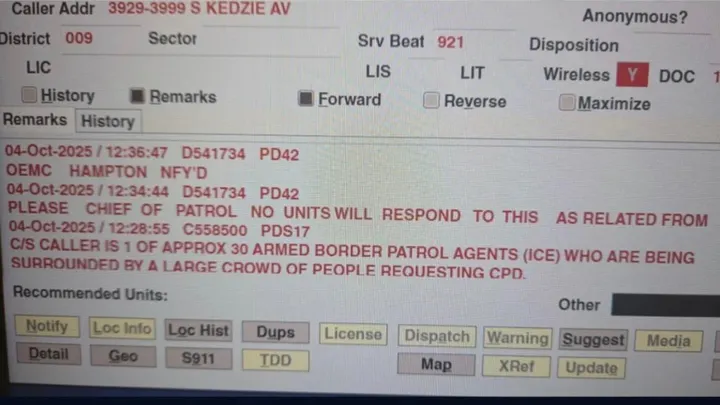
Chicago officers criticize department after patrol chief ordered them not to help federal agents rammed, surrounded in Brighton Park
Chicago police leadership is facing intense criticism after officers were reportedly ordered to stand down and not assist federal agents who were attacked and surrounded by armed crowds during a chaotic confrontation on Chicago’s southwest side on Oct. 4, 2025.
Key takeaways
- Stand-down order: Internal CPD dispatch audio and officers say a patrol chief refused to authorize assistance to federal agents surrounded in Brighton Park.
- Violent scene: Federal vehicles were reportedly rammed and agents used pepper spray and rubber rounds as crowds, some armed, confronted them.
- Calls for review: Community groups and officials demand independent investigations into the shooting, CPD decisions, and interagency coordination.
What happened in Brighton Park
On Oct. 4, federal Immigration and Customs Enforcement and U.S. Border Patrol agents stopped a vehicle in Brighton Park. Officials say the driver tried to ram agents and was armed with a semi-automatic gun. Border agents shot the woman; she survived and later left the hospital, officials and video reporting said (video reporting on the incident and additional video).
Scene details and crowd response
Video and eyewitness accounts show federal agents becoming surrounded by a crowd. Multiple witnesses and internal dispatches report at least one federal vehicle was rammed. Some in the crowd shouted at agents and, according to sources, some carried weapons. Federal officers responded with pepper spray and rubber rounds to push back the crowd (video reporting on the incident).
“They were rammed and surrounded,” said one source cited in reporting, describing the tense scene outside the stop.
CPD dispatch: officers told not to help
Multiple Chicago Police Department sources and released dispatch audio cited in reporting say local officers were told over the radio not to intervene to assist the federal agents. Sources say a patrol chief on scene refused to authorize support. Those accounts come from internal CPD dispatch audio and interviews with officers who spoke on condition of anonymity (video reporting on the incident).
Rank-and-file anger: Officers reacted angrily, with some describing the order as an instruction to “cover their a–” rather than to protect fellow officers and preserve safety, reflecting deep frustration about perceived command failures.
What the department says
As of this reporting, the Chicago Police Department has not publicly confirmed that a patrol chief denied assistance. City officials have acknowledged heightened tensions that day and said they will review the matter. The incident has been logged as a CPD critical incident in some reporting, and there are growing calls for transparency and an independent review of how the situation was handled (video reporting on the incident).
Federal response and tactics
Federal officers involved were ICE and U.S. Border Patrol. After the shooting, videos show agents using crowd-control measures. Federal officials defended their actions as necessary to protect officers after agents were reportedly rammed and surrounded by an armed crowd. Supporters say agents faced a dangerous situation and required forceful protection (video reporting on the incident).
Community and activist reactions
Residents and immigrant-rights activists called the federal operation aggressive and traumatic, accusing officers of “terrorizing families” and demanding investigations into the shooting and the broader use of immigration raids. Activists said the presence of federal agents escalated tensions and fueled deep anger over immigration enforcement.
Political fallout
The confrontation moved quickly into politics. President Trump urged stronger action and pressed Illinois officials to send the National Guard. Governor J.B. Pritzker rejected the demand as a political stunt and urged a measured response. Local leaders called for independent investigations into both the federal use of force and CPD command choices that day (video reporting on the incident, additional video).
Why officers say the CPD decision matters
Chicago police sources argue that refusing to assist federal agents during violence undermines joint operations and could have put lives at risk. Officers said they felt a duty to protect all public safety personnel on scene. The episode intensified concerns about morale, command consistency, and split-second decision-making during protests and multiagency incidents.
Calls for independent investigation
Community groups and officials want independent investigators to review the shooting and CPD’s response. Key questions include whether Border Patrol’s use of force was justified, whether federal tactics escalated the situation, and whether CPD command decisions followed department policy. Advocates say a transparent inquiry is needed to restore trust (video reporting on the incident, additional video).
What is known about injuries
There is no independent confirmation of injuries to Chicago police or federal agents beyond the woman shot by Border Patrol. Reporting based on video and on-scene accounts does not show verified additional casualties. The woman survived and was later released from the hospital, according to reporting (video reporting on the incident).
Ongoing tensions between local and federal law enforcement
Experts say the episode highlights strains when local police and federal agents operate in the same neighborhoods: differing missions, public trust issues, and chain-of-command complications. The Brighton Park confrontation has become a flashpoint in debates over mutual aid, protest response, and coordination of high-risk operations.
Implications for Fresno, California
Economic impact: Fresno’s economy relies on trade and immigrant labor. High-profile clashes over immigration enforcement can affect labor markets and consumer confidence, prompting outreach from businesses and chambers.
Political consequences: The incident may shift local debates on cooperation with federal agencies. Fresno leaders could face pressure from both pro-enforcement and civil-rights groups to take clear stances on raids, transparency, and mutual aid.
Social effects: News of federal agents surrounded and local police standing down can increase fear and calls for protest among Fresno’s immigrant communities; community organizations and faith leaders may be called on to mediate.
Practical applications: Fresno officials should review mutual-aid policies, communication plans, and joint training to prevent confusion during protests or critical incidents, and nonprofits/legal aid groups should prepare to assist affected residents.
Reporting and sources
This article is based on internal CPD dispatch audio and on-scene reporting captured in video and eyewitness accounts. Key sources include video reporting on the incident and additional video. Those sources document the Oct. 4, 2025, Brighton Park incident and include footage of federal agents’ actions and referenced CPD radio traffic.
Investigations are ongoing. Journalists and officials continue to seek full access to dispatch recordings and body-camera footage to verify the timeline and command decisions made that day.


