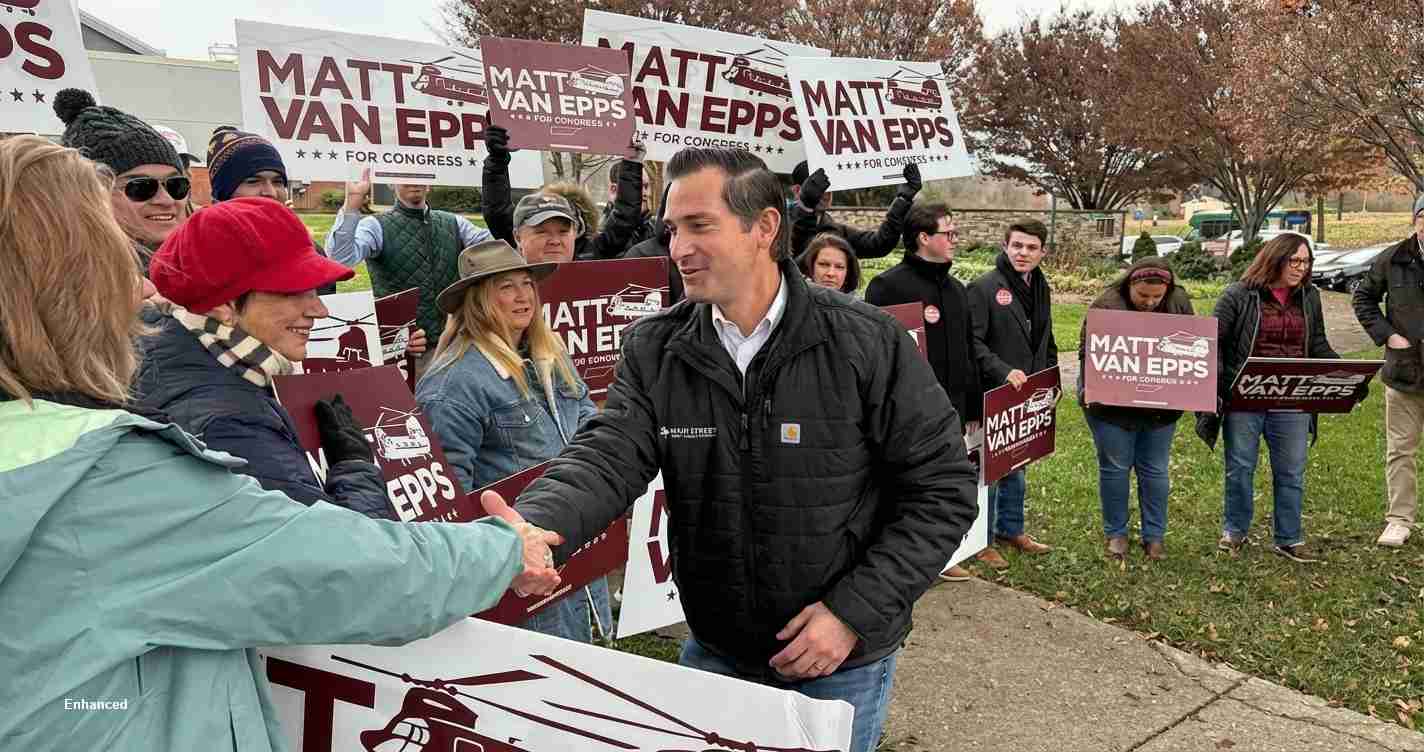
Trump-backed Republican Matt Van Epps holds Tennessee seat in special election, seen as early test for 2026
Republican Matt Van Epps won Tennessee’s 7th District special election on December 2, 2025, with 53.9% of the vote, holding the seat after Mark Green’s resignation and serving in the U.S. House through January 2027.
Key takeaways
- Van Epps secured 53.9% (96,988) to Aftyn Behn’s 45.0% (81,044), an 8.9-point margin, per official tallies (Wikipedia election page).
- The vacancy followed Mark Green’s July 20, 2025 resignation, prompting the special election (Wikipedia election page).
- Race viewed as an early barometer for 2026 — Republicans held the seat while Democrats improved in populous counties.
Main content
Key information and results
Final vote totals: Matt Van Epps — 53.9% (96,988 votes); Aftyn Behn — 45.0% (81,044 votes). The margin stood at 8.9 points according to official returns compiled after the December 2 special election (Wikipedia election page).
Primary context: Van Epps won a crowded Republican primary on October 7 with 51.56% and carried 12 of the district’s 14 counties, a result that helped build general-election momentum (Wikipedia election page).
Fundraising: Campaign finance figures show Van Epps raised roughly $992,716 during the primary phase while Behn raised about $1,230,629 in her primary — indicating strong fundraising on both sides (Wikipedia election page).
Background and what the win means
The Tennessee 7th District special election drew national attention as one of the early high-profile contests following a series of congressional departures. The district, historically Republican, was a test of whether Democrats could expand beyond urban centers.
Van Epps’ profile: A Trump-aligned Republican, Van Epps emphasized conservative priorities and leveraged experience in state government — including serving as commissioner of Tennessee’s Department of General Services (2024–25) — and key endorsements that helped him dominate the GOP primary (Wikipedia election page).
Behn’s challenge: Aftyn Behn, a state representative since 2023, ran a well-funded campaign focused on healthcare, education and local infrastructure; Democrats improved margins in several counties compared with 2024 even as they fell short of flipping the seat (Wikipedia election page).
Tactical snapshots: messaging, money and turnout
- Messaging: Van Epps emphasized economic growth, limits on federal spending and tougher immigration policies; Behn targeted suburban and urban voters on healthcare affordability and education.
- Money: Despite Behn’s higher primary fundraising, Van Epps’ name recognition and endorsements helped translate resources into field organization and turnout.
- Turnout: County-level shifts showed Democratic gains in populous areas while Van Epps held much of the district’s rural base.
“The result signals Republicans can defend competitive districts, but Democratic improvements point to potential 2026 opportunities,” analysts said.
Polling and how predictions held up
Late-November Emerson College polling showed Van Epps leading 48% to Behn’s 46% with 5% undecided. The final margin — 53.9% to 45.0% — suggests Van Epps either closed strongly in the final week or undecided voters largely broke for him (Wikipedia election page).
Why the race mattered nationally
Political strategists framed the race as an early barometer for the 2026 midterms. A Democratic flip would have suggested broader suburban shifts; instead, the Republican hold gives conservatives a headline showing they can defend competitive districts. Still, Democratic gains in several counties show areas for potential future investment.
Official timeline and next steps
Swearing-in and term: Van Epps will be sworn into the U.S. House to serve the remainder of the 119th Congress and hold the seat until the term expires on January 3, 2027. The seat will be on the ballot again in the regular 2026 cycle (Wikipedia election page).
Source attribution
Details on vote totals, primary results, fundraising and the circumstances of the vacancy are summarized in public election records and compiled reporting (Wikipedia election page). The Associated Press also reported early returns confirming Van Epps’ victory.
Implications for Fresno, California
Economic impact
Federal policy decisions shaped by House control affect agriculture, disaster relief and farm programs critical to Fresno and the Central Valley. A Republican hold maintains GOP influence over House committees and appropriations that shape farm bill language, water infrastructure funding and trade policy — all important to local exporters and ag businesses.
Political consequences
For moderate Fresno voters, the Tennessee result is a reminder that national races influence local politics. Van Epps’ win may encourage Republican donors to target competitive suburban areas, while Democrats will analyze county-level gains for 2026 strategy adjustments.
Social effects
Issues highlighted in the 7th District — healthcare, education and economic security — resonate in Fresno neighborhoods. Shifts in the national conversation could shape local advocacy priorities and funding debates for safety-net programs and community health investments.
Cultural relevance
Fresno voters prioritize practical outcomes like water reliability, roads, schools and small-business support. The Tennessee race underscores how regional contests reverberate nationally and shape messaging that parties use across diverse geographies.
Practical applications for residents
- Voter engagement: Local groups can study turnout and messaging strategies used in the Tennessee race to inform 2026 mobilization.
- Federal funding vigilance: City and county officials should track appropriations and committee activity tied to transportation, water and agriculture to position Fresno for grants and disaster aid.
- Issue framing: Advocates on healthcare, education and water policy can adapt messages where Democrats improved vote shares to build cross-party coalitions.
Additional reporting and analysis
Journalists and voters should watch Van Epps’ House positioning, committee assignments and legislative priorities as indicators of how similar districts may behave in 2026. The race offers lessons on campaigning in mixed suburban-rural districts, early fundraising advantages and how late polling can shift.
For more details on vote totals, candidate backgrounds and the special election timeline, see the election summary and sources compiled here.