
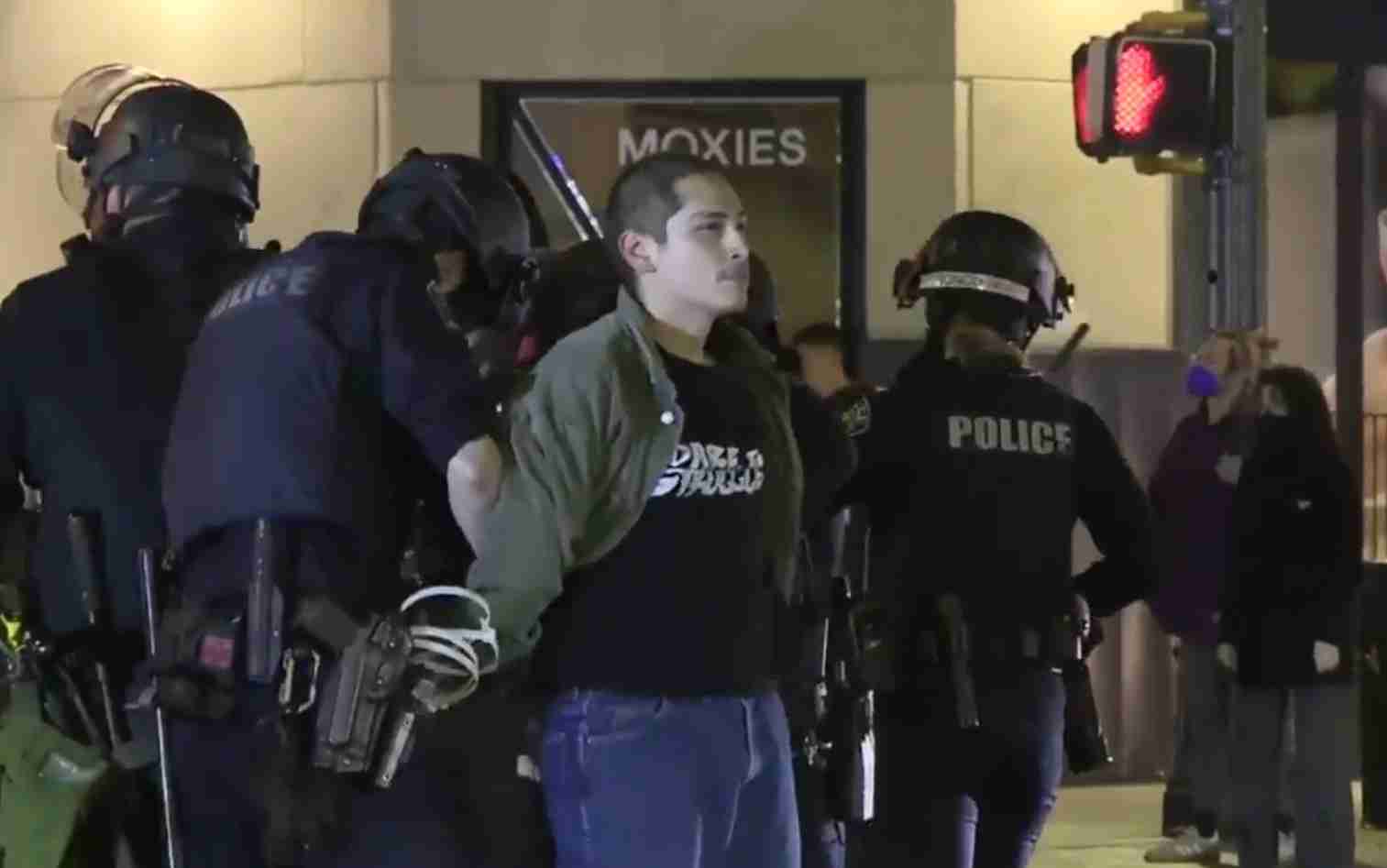
Austin police, DPS officers charge into crowd at anti‑ICE protest; multiple detained as pepper balls fired
About 8 p.m. Saturday in downtown Austin, police and Texas DPS troopers moved into an anti‑ICE protest tied to the fatal shooting of Renee Nicole Good, detaining multiple people as pepper balls and other non‑lethal rounds were fired.
- Downtown clash: Officers and troopers charged crowds near J.J. Pickle Federal Building (300 E. 8th St.) and S. Congress & E. 6th St.
- Use of force: Witnesses and an APD spokesperson confirmed pepper balls and other non‑lethal rounds were fired to disperse parts of the crowd — multiple outlets documented the deployments (news4sanantonio, CBS Austin).
- Differing counts: APD reported at least five arrests; organizers and reporters said multiple detentions, and some groups reported higher totals (KUT, CBS Austin).
What happened Saturday night
Protesters gathered at the J.J. Pickle Federal Building (300 E. 8th St.) and marched through downtown Austin as part of an “End ICE Terror” action demanding accountability after the death of Renee Nicole Good. Demonstrators repeatedly returned to the federal building, moved south toward S. Congress Ave. and E. 6th St., blocked traffic, burned flags and hurled shoes covered in red paint at a sign bearing former President Donald Trump’s name (CBS Austin; Fox San Antonio).
Local TV reporters and eyewitnesses described police and Texas Department of Public Safety troopers moving into the crowd on bicycles and on foot. Witnesses said several people were detained when officers charged the crowd near S. Congress and E. 6th St., and that the scene became tense as law enforcement advanced (news4sanantonio; CBS Austin).
Law enforcement response and use of pepper balls
State troopers and APD officers deployed non‑lethal rounds described by witnesses as pepper balls to disperse parts of the crowd. An APD spokesperson later confirmed pepper balls were used, though officials did not immediately specify which agency fired the rounds or made particular arrests (KUT; news4sanantonio).
Witnesses reported a tense and chaotic scene when rounds were fired. Some demonstrators described the response as heavy‑handed, saying officers charged quickly and detained people before they could move away. Organizers called the tactics “brutal” and “excessive,” and alleged some arrests appeared retaliatory (CBS Austin — protest-against-ICE).
Arrests, detentions and differing tallies
Counts of people taken into custody varied. An APD spokesperson told reporters there were at least five arrests that night around the federal building and during the downtown march (KUT).
Other outlets reported multiple detentions downtown, noting four people detained when APD charged into a crowd at Congress and Sixth (CBS Austin; news4sanantonio).
Organizers from Dare to Struggle Austin put the number higher, saying at least seven people were arrested in total, including one person detained after the protest while walking to their car (CBS Austin — arrests and claims).
Why protesters were in the streets
The demonstrations followed the fatal shooting last week of 37‑year‑old Renee Nicole Good by an ICE officer, Jonathan Ross, during an encounter in Minneapolis. Organizers demanded swift justice and called for murder charges against the ICE officer and others involved, urged ICE to end operations in Austin and criticized federal immigration enforcement practices more broadly (CBS Austin; KUT).
Protesters framed the shooting as part of a pattern of force used by immigration enforcement and said Austin’s actions were one of several national demonstrations responding to outrage over Good’s death and similar incidents (CBS Austin).
Official statements and political fallout
Texas DPS spokesperson Lt. Chris Olivarez said the agency supports the public’s First Amendment right to peacefully assemble but warned that “violence, threats to the public or law enforcement, obstruction of roadways, and damage to property will not be tolerated” (CBS Austin).
An APD spokesperson said officers and state troopers aimed to clear blocked roads and respond to escalating tensions that included flag burning and thrown objects (CBS Austin; KUT).
Gov. Greg Abbott posted that “Texas is not Minnesota,” asserting DPS would not tolerate defiant protesters and blaming “reckless and dangerous rhetoric” from national Democratic leaders for unrest; he emphasized law enforcement’s right to defend itself (CBS Austin; Fox San Antonio).
Media and witness accounts
Local television crews and reporters captured video of officers advancing on crowds and detaining people. Federal officers near the J.J. Pickle building reportedly warned media the situation could get “spicy” if protesters stayed in the street, according to on‑scene accounts (CBS Austin; Fox San Antonio).
Organizers say activists remained outside Travis County Jail into Sunday, awaiting releases and holding a news conference to demand charges against officers and for detained protesters to be freed. Their demands included dropping charges against protesters, launching criminal investigations into officers they say used excessive force, and pushing for ICE to leave Austin (CBS Austin — demands).
Context: national protests and local tensions
The Austin demonstrations are part of a wave of national protests following Renee Nicole Good’s death. The actions in Austin lasted into a third day, with repeated returns to the federal building and marches through downtown; protesters’ tactics — including blocking roads and demonstrating in front of federal buildings — heightened tensions and prompted law enforcement to cite public safety concerns for intervention (CBS Austin; KUT).
Implications for Fresno, California
Economic and business impact
Fresno residents and businesses that interact with Texas firms may watch how protests and law enforcement responses affect commerce and tourism. A high‑profile downtown confrontation can influence local security planning and raise costs for organizers and venues hosting large events.
Political consequences
Fresno voters are moderately pragmatic; coverage of the Austin protest and police response could shape local debate on public safety, policing tactics and limits on civil disobedience, and may pressure officials to clarify protest permits and crowd‑control policies.
Social effects
With a large immigrant community and active advocacy networks, Fresno may see solidarity actions, community meetings and increased civic engagement — but also heightened tensions between activists and police.
Cultural relevance
Coverage of claims of excessive force and calls for ICE to leave will resonate across Fresno’s civic conversations, balancing concerns for civil liberties with demands for public safety.
Practical applications for residents
City leaders and organizers in Fresno should review crowd‑control plans, communications strategies and guidelines for non‑lethal tools like pepper balls. Residents attending demonstrations may want clear information on permitted locations, timing and safe tactics to avoid detention; legal aid groups should prepare to advise those facing charges.
Reporting and next steps
This report draws on local Texas outlets and public radio that covered the Austin anti‑ICE protest and law enforcement response, including video and eyewitness accounts (CBS Austin — protesters gather; CBS Austin — protest-against-ICE; news4sanantonio; Fox San Antonio; KUT).
Reporters reached out to the Austin Police Department and the Texas Department of Public Safety for further comment; Lt. Chris Olivarez’s statement on X was cited in earlier reporting. Records, clearer arrest tallies and any body‑camera or surveillance footage may become available in coming days as journalists and legal teams pursue documentation of the incident.
“We reached out to Austin Police Department and the Texas Department of Public Safety for additional comment,” the reporting notes, and further details are expected as records and footage are reviewed.


