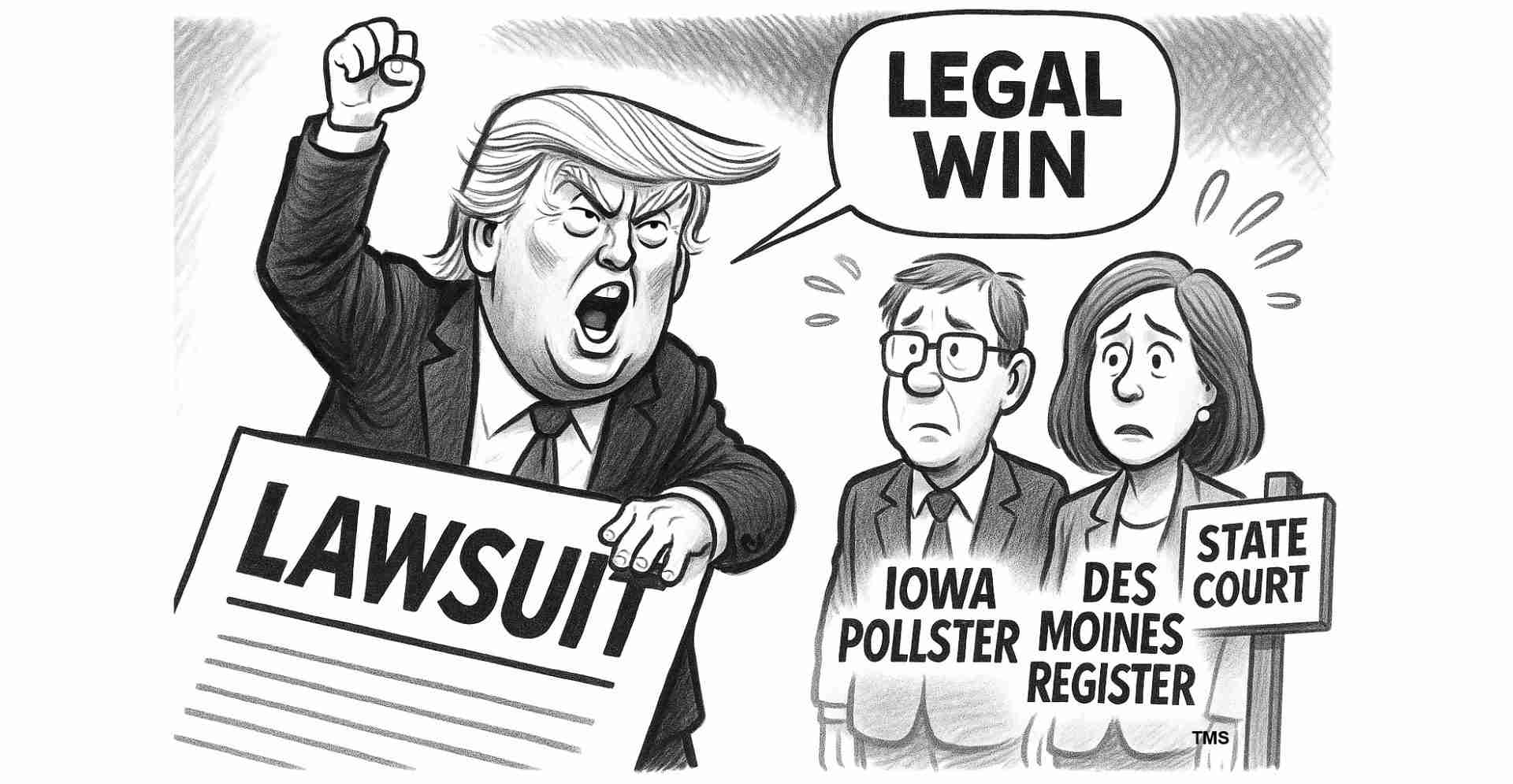
Trump wins procedural ruling in fight over Iowa poll; case sent back to state court in latest turn of Trump Iowa poll lawsuit
The U.S. Court of Appeals for the Eighth Circuit ordered that former President Donald Trump’s lawsuit over a disputed Iowa pre‑election poll be dismissed from federal court without prejudice so it can be refiled in Iowa state court.
- Mandamus order: The Eighth Circuit granted a writ directing dismissal without prejudice so Trump may refile in Iowa state court — Fox News.
- Claims at issue: The suit accuses veteran pollster J. Ann Selzer and The Des Moines Register of publishing a late pre‑election poll intended to influence voters.
- First Amendment fight: The Foundation for Individual Rights and Expression (FIRE) is defending Selzer pro bono and says the case raises major free‑speech concerns — FIRE.
What the Eighth Circuit ordered
In a rare procedural move, the Eighth Circuit issued a writ of mandamus — an extraordinary judicial remedy used when a higher court finds clear error that must be corrected. The appeals court directed the federal district judge to treat the case as dismissed without prejudice, enabling Trump to refile in Iowa state court if he chooses. That action reverses the earlier federal decision that had kept the lawsuit in federal court. For reporting on the immediate ruling see Fox News.
Background of the lawsuit
Trump initially filed the suit in Polk County, Iowa, in December 2024. The complaint centers on J. Ann Selzer’s final pre‑election poll, released Nov. 2, 2024, which showed Vice President Kamala Harris leading Trump by three points in Iowa — a swing of seven points from September polling when Trump led by four. Selzer’s long record of accurate Iowa polling made the result notable and controversial.
Trump’s theory contends the late poll was not merely mistaken but intentionally designed to influence the outcome of the presidential election. The complaint seeks monetary damages and an injunction barring future publication of polls the suit calls “deceptive.” The lawsuit’s claims and goals are laid out in court filings highlighted by press coverage and legal observers; background reporting is available via Fox News.
How the case got to federal court
Shortly after the Polk County filing, defendants J. Ann Selzer and The Des Moines Register (owned by Gannett) removed the suit to federal court. Trump’s team later asked the federal judge to remand the case back to state court; that request was denied, keeping the case in federal court until the Eighth Circuit’s recent mandamus order reversed that portion of the fight.
Reactions from the parties
Trump’s legal team: A spokesman applauded the appeals court move, saying it “ensures that President Trump’s powerhouse case… will be litigated in Iowa State Court where it belongs” and accusing defendants of trying to avoid state court.
Gannett and The Des Moines Register: Company representatives said they were disappointed by the jurisdictional ruling and continue to believe federal court was appropriate given the national profile of the plaintiff, while expressing trust in Iowa courts to handle the matter fairly — see reporting at Fox News.
“This ensures that President Trump’s powerhouse case… will be litigated in Iowa State Court where it belongs,” a spokesman said.
First Amendment concerns and defense strategy
Selzer is being defended pro bono by the Foundation for Individual Rights and Expression. FIRE emphasizes the Eighth Circuit’s decision addressed procedure, not the merits, and calls the underlying lawsuit weak. Bob Corn‑Revere, FIRE’s chief counsel, said the ruling “was focused entirely on a technical point of civil procedure and said nothing about the merits of the case.” Read FIRE’s statements at Foundation for Individual Rights and Expression (FIRE).
Free‑speech defenders warn that allowing civil liability for poll reporting could chill journalistic and scholarly expression. FIRE attorneys have characterized the suit as a potential SLAPP (Strategic Lawsuit Against Public Participation) intended to punish speech and increase legal costs for pollsters and news outlets. FIRE attorney Adam Steinbaugh warned: “If you have to pay lawyers and spend time in court to defend your free speech, then you don’t have free speech.”
Selzer’s record, response and aftermath
J. Ann Selzer has been regarded as one of Iowa’s most reliable pollsters, with past polls correctly predicting Trump’s 2016 and 2020 performances in Iowa using the same methods. After the 2024 final poll diverged from the election result, Selzer said the appropriate response is reflection and analysis — not litigation. She announced she would stop doing election polling and focus on other projects, saying, “My final poll of the 2024 general election missed the mark… I should be devoting my time to thoughtful analysis and introspection, not to a vengeful lawsuit.” FIRE coverage and reaction are available at FIRE, with concurrent reporting at Fox News.
Legal issues at stake beyond jurisdiction
Beyond the jurisdictional fight, the case raises novel legal questions about the application of Iowa’s Consumer Fraud Act to election polling. Critics note that consumer‑protection laws historically target commercial misrepresentations, not political speech or predictions. If the suit proceeds in Iowa courts, judges will confront whether poll reporting can be constrained or penalized under state consumer‑protection rules and how such restrictions intersect with the First Amendment. FIRE commentary on these issues is available at FIRE.
Implications for Fresno, California
Economic impact: Fresno’s regional newsrooms, polling vendors and local campaigns rely on public surveys. A trend of litigation against pollsters could increase legal costs for community papers and independent poll firms, potentially raising the price of polling and pressuring local media budgets. (Contextual reporting: Fox News.)
Political consequences: As a swing‑influenced region, Fresno watches national trends closely. If courts allow restrictions on poll reporting, campaign strategists may alter how they commission and use local polling, and parties could try to shape timing and framing of releases — potentially changing how voters receive information in tight races.
Social effects: Residents rely on polling to track candidate and issue trends. Increased legal risk for pollsters could slow the flow of local polling data, hampering voters, community groups and civic outreach that depend on timely surveys.
Cultural relevance: Fresno’s local press plays an accountability role; a rise in litigation against pollsters or outlets may chill investigative work and prompt newsrooms to increase transparency about methods and invest more in legal review.
Practical applications for residents
- Community leaders and voters should watch for changes in how local polls are conducted and released.
- Civic groups might preserve independent polling and diversify information sources, such as public records, town halls and local research partnerships.
- Media consumers should check poll methodology disclosures and compare multiple polls before drawing conclusions.