
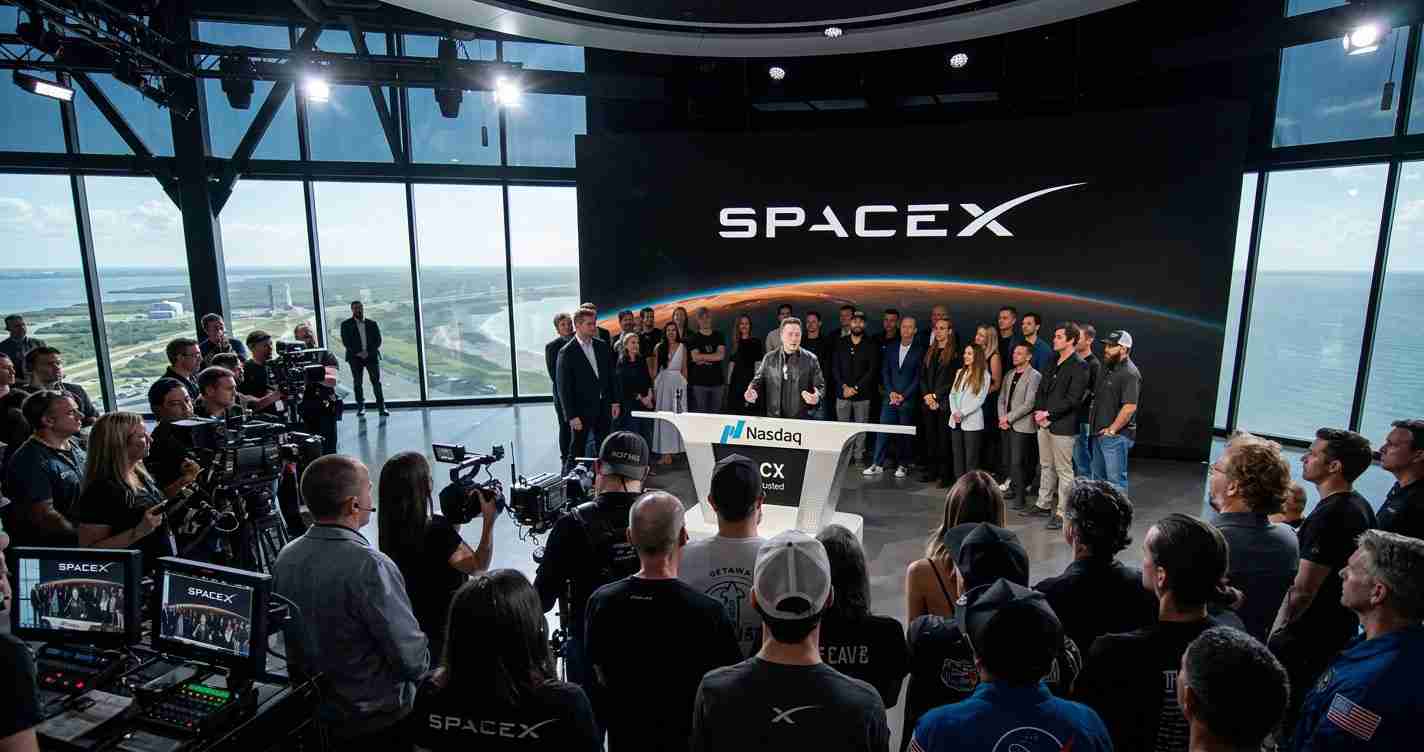
NEW YORK, June 13 (Our New York News) — SpaceX’s first day as a Nasdaq-listed company turned one of the world’s most closely watched private companies into a public-market valuation test — and, by the close of trading, wealth estimates from Forbes and Bloomberg placed Elon Musk above $1 trillion in net worth.
The business record behind that finding is clear on the central market action. SpaceX began trading June 12, 2026, on Nasdaq under the ticker SPCX. The company’s initial public offering was priced at $135 a share and raised $75 billion, according to offering terms attributed to SpaceX. Nasdaq trading data showed the stock opened around $150, rose as high as about $176.50 during the session and closed near $161.
That first-day close implied a market value above $2 trillion for the rocket and satellite company, compared with an IPO valuation reported around $1.77 trillion to $1.8 trillion. The gap between the IPO price and the first-day trading price created immediate paper gains for early holders and set the price now faced by public investors buying into SpaceX on the open market.
The trading also changed the public estimate of Musk’s fortune. Forbes and Bloomberg wealth calculations placed his net worth in a range of roughly $1.05 trillion to $1.11 trillion after the debut. Those estimates depend on public share prices, assumptions about Musk’s SpaceX holdings and the value of his other assets, including Tesla-related wealth. They do not mean Musk received $1 trillion in cash.
Musk’s SpaceX stake alone was estimated at about $688 billion to $690 billion at the IPO price. At higher first-day trading prices, estimates of the stake rose into the mid-$700 billions and, in some calculations, near $800 billion. The differences reflect timing and method: IPO price, opening trade, intraday high, closing price, and whether options or special share classes are included.
SpaceX was founded in 2002. Musk said the company was going public now to fund plans for satellites and data centers in space and, eventually, a human settlement on Mars, according to AP’s account of his statement. PBS NewsHour, citing the trading event, reported that Musk marked the start of trading with a ceremonial bell-ringing from Starbase in South Texas, while the company’s shares listed on Nasdaq in the U.S. public markets.
For New York City’s financial markets, the SpaceX listing created a rare test: whether public investors would pay a price far above what some independent analysts said the company was worth. Morningstar analysts, described by AP and PBS as independent of investment-banking fees, estimated SpaceX’s value at about $780 billion before the debut and called the IPO “significantly overvalued.”
That Morningstar figure was far below the IPO valuation and even farther below the market capitalization implied by SpaceX’s first-day close. The contrast is important for investors because the IPO price was not the only valuation point. Public buyers who purchased after the open paid prices above the $135 offering price, and those buying near the intraday high paid still more.
The record is less settled on Musk’s exact control after the IPO. Several accounts citing offering-related materials describe a dual-class or special share structure that left Musk with outsized voting power. But the figures conflict, and the underlying prospectus or official share-count document was not included in the records available for this report. For that reason, this article does not state a single verified ownership or voting-control percentage.
What the market data does show is that SpaceX’s first public session reset the company’s valuation in real time. The $135 IPO price established the offering valuation. The roughly $150 opening trade showed immediate demand above that price. The intraday high near $176.50 showed how far buyers pushed the stock during the session. The close near $161 left the company with an implied valuation above $2 trillion and placed Musk’s paper fortune, by Forbes and Bloomberg estimates, above the trillion-dollar mark.



