
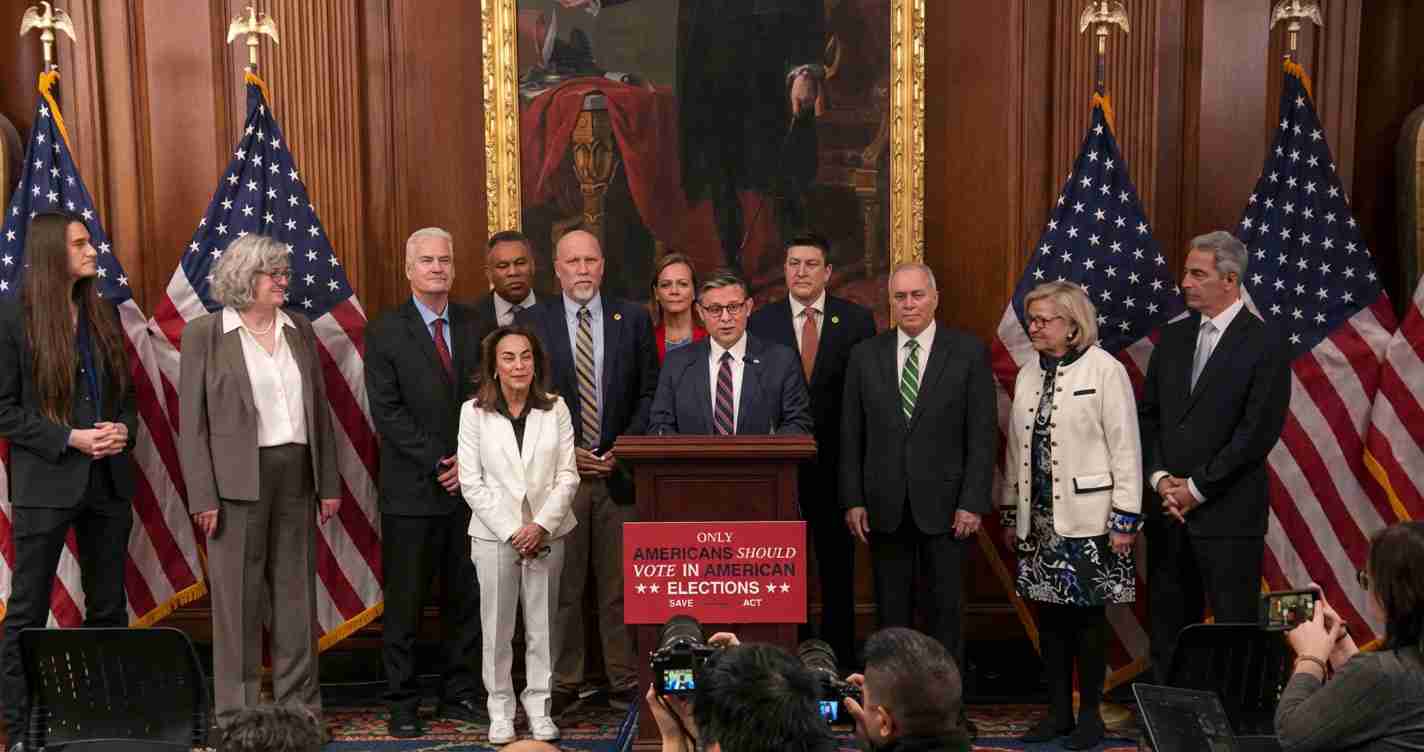
House passes SAVE America Act in close vote, advancing federal election safeguards and new voter ID requirement
The House approved the SAVE America Act (S. 1383) on February 11, 2026, in a 218–213 vote, introducing federal proof-of-citizenship registration requirements and a new photo ID mandate for voters in federal elections, supporters said.
- Narrow passage: The measure passed 218–213 with only one Democrat joining Republicans — Vote: 218–213; only Rep. Henry Cuellar (D‑Texas) joined Republicans.
- New federal requirements: The bill adds federal proof-of-citizenship for registration and a national photo ID requirement for federal elections, measures supporters say strengthen integrity.
- State-federal data sharing: The measure expands information sharing with federal agencies, including authorizing Department of Homeland Security involvement where non‑citizens are identified on rolls.
- Uncertain Senate path: Procedural hurdles and GOP divisions make Senate passage unlikely without major changes.
Background
The SAVE America Act (S. 1383) builds on an earlier House effort. It was offered using procedural maneuvers tied to a Senate-passed shell bill to speed floor consideration and separate the measure from spending fights.
The House action referenced the bill base H.R. 7296 and updated the original SAVE Act that previously passed the House as H.R. 22 in April 2025 but stalled in the Senate.
What the bill would do
Supporters argue the legislation creates stronger federal safeguards to prevent non‑citizen voting. The updated SAVE America Act would require states to collect documentary proof of U.S. citizenship when processing voter registration applications for federal elections — examples cited include REAL ID–compliant documents and other official papers, per Rep. Chip Roy’s office: Rep. Roy press release.
A new element in this version is a national photo ID requirement: voters would need to present an eligible photo ID to cast a ballot in any federal election, a provision described during the House debate and reported in live coverage: Politico live updates.
The measure also pushes states to scrub rolls of non‑citizens and to use federal data sources for ongoing verification, and it would require expanded information sharing between state election officials and federal agencies, including the Department of Homeland Security, which the bill would authorize to pursue immigration enforcement if non‑citizens are found on voter rolls (Fox News coverage).
How the House moved the bill
House Republicans used a legislative strategy relying on a Senate-passed shell bill to fast‑track the updated SAVE Act, a move intended to detach the measure from funding negotiations and shutdown threats and bring it to a floor vote quickly (Politico live updates).
Rep. Chip Roy framed the bill as a response to perceived threats to election integrity, calling passage “a critical step toward restoring election integrity” and urging the Senate to take it up (Roy press release).
Vote breakdown and party dynamics
The House vote was nearly party‑line: all House Republicans present voted yes, joined by one Democrat — Rep. Henry Cuellar (D‑Texas) — producing the 218–213 margin. That contrasted with the April 2025 House vote on the original SAVE Act when four Democrats supported passage.
Within the GOP there were also concerns about federal overreach. Senator Lisa Murkowski (R‑Alaska) publicly opposed a federal mandate of this type, saying it intrudes on state control of elections — a split that complicates the bill’s Senate prospects (Politico live updates).
Democratic criticism and legal questions
Democrats labeled the measure as tantamount to voter suppression, arguing it imposes new obstacles that could disproportionately affect people of color, the elderly, low‑income residents, and students who may lack required documents. They also noted that non‑citizen voting is already illegal and considered rare under existing law, such as the Illegal Immigration Reform and Immigrant Responsibility Act of 1996 (Fox News).
Implementation logistics are a major concern: state registration and roll maintenance systems would require months or years of changes and substantial costs. Critics point out the bill lacks matching federal funds to help states meet new verification and ID requirements, raising fairness and feasibility questions (Bipartisan Policy Center summary).
Legal analysts expect challenges if the bill becomes law; federal mandates on voter ID and registration processes have been litigated before, and new federal controls over state‑run elections would likely be tested in court.
Pressure from outside politics
The push for the bill intensified after public pressure from national conservative figures and former President Donald Trump, with reports that he and other conservative influencers urged House GOP leadership to move the measure separate from shutdown negotiations. Tech CEO Elon Musk was also cited among those pushing for quick action (Politico).
Senate outlook
The bill faces long odds in the Senate: there is no clear path to bypass the Democratic filibuster and Senate rules require broad bipartisan support or procedural changes. Senate Majority Leader John Thune has resisted filibuster changes, and some Republican senators, including Sen. Lisa Murkowski, oppose this federal mandate as overreach — making final passage uncertain (Politico live updates).
Sources and official text
- House press release from Rep. Chip Roy’s office on SAVE America Act passage
- Politico live updates on House passage
- Fox News coverage of the vote and Democratic opposition
- Text and status of earlier SAVE Act (H.R. 22)
- Text and status of the bill base used (H.R. 7296)
- Bipartisan Policy Center summary and analysis
Implications for Fresno, California
Economic impact
If enacted, Fresno County and California could face new costs to update voter registration systems, train election staff, and run public outreach. Software changes and new verification steps may be required to comply with a federal proof‑of‑citizenship mandate and a national voter ID requirement. Local election administrators would likely press for federal funding; absent that, counties such as Fresno might shift local funds or reduce other services (Bipartisan Policy Center).
Political consequences
Fresno is a swing area within a deep‑blue state. Changes to registration and ID rules could alter turnout patterns: some moderates may view safeguards as sensible, while many residents could see new requirements as hurdles that discourage participation. Local leaders and county registrars will likely weigh in, and the issue may become a campaign topic in upcoming races (Politico).
Social effects
People lacking ready access to photo IDs or proof of citizenship could face barriers in Fresno — including some elderly residents, immigrants legally present but lacking specific documents, students, and low‑income residents. Community groups that assist with IDs and registration may see higher demand. If federal rules require in‑person documentary proof, remote and mail‑in registration programs common in California would need new safeguards, complicating outreach efforts (Bipartisan Policy Center).
Cultural relevance
Fresno’s diverse population — including Latino, Asian, and immigrant communities — may view a federally imposed photo ID requirement through lenses of trust and access. Local cultural organizations and faith groups often play key roles in voter education; their response could shape whether new safeguards are seen as protective or exclusionary (Politico).
Practical applications for residents
If implemented, Fresno voters may need to bring eligible photo ID to polling places for federal elections and could face additional paperwork when registering. County election offices would need to run outreach explaining required documents and how to obtain them. Voters who use mail ballots would need to confirm whether new verification steps change processing. Local officials must provide clear guidance well before rules take effect to avoid confusion on election day (Roy press release).
Legal and administrative outlook locally
California officials have historically resisted federal mandates they view as interfering with state elections. If the SAVE America Act became law, California could challenge parts of it in court or seek waivers. Fresno County’s registrar would likely coordinate with the state secretary of state on compliance plans; legal action could delay implementation and create a patchwork of standards across states, confusing voters who move or live near state borders (Politico).
Bottom line: The House passage advances a high‑stakes, narrowly approved plan to federalize certain voter verification and ID requirements; its implementation, cost, legal viability, and political fallout — especially in places like Fresno — remain deeply uncertain.



