
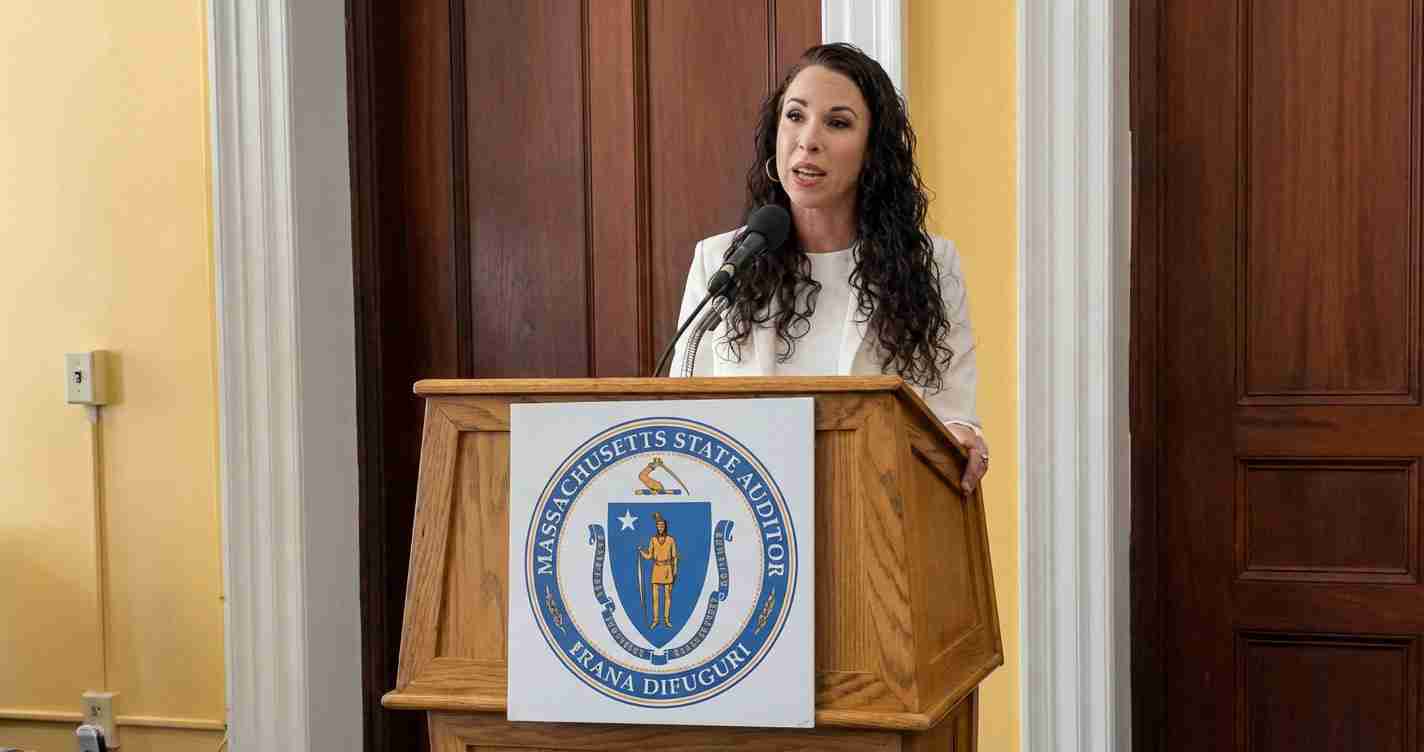
Massachusetts state auditor sues legislative leaders to force voter-approved audit after $12M fraud finding
Massachusetts State Auditor Diana DiZoglio sued legislative leaders on Feb. 10, 2026, asking the Supreme Judicial Court to enforce a 2024 voter-approved audit law after her office reported nearly $12 million in alleged fraud in public assistance programs.
- Auditor files suit: Diana DiZoglio asked the Massachusetts Supreme Judicial Court to order the House and Senate to turn over financial records for a performance audit.
- Fraud finding drives push: Her office reported nearly $12 million in alleged fraud in fiscal 2025 public assistance programs, which she says necessitates legislative transparency.
- Separation-of-powers clash: Speaker Ron Mariano and Senate President Karen Spilka cite constitutional protections to resist document requests.
- Legal and political stakes: The case tests whether a 2024 ballot measure that passed with about 72% of the vote can overcome traditional legislative immunity.
Background and ballot measure
The dispute stems from a long-running disagreement over whether the State Auditor may audit the Legislature. In 2023 legislative leaders told the auditor’s office that state law and constitutional doctrine barred such audits. Voters responded in 2024 by approving a ballot question — often called the Massachusetts voter audit law — that explicitly expanded the auditor’s authority; the measure passed with roughly 72% of the vote (WGBH, Fox News).
DiZoglio’s legal filing and rationale
On Feb. 10, 2026, State Auditor Diana DiZoglio filed suit in the Massachusetts Supreme Judicial Court seeking orders to compel the House and Senate to produce budgets, past audits, transaction records and settlement agreements for a performance audit (WGBH).
DiZoglio has emphasized that her office’s report identifying about nearly $12 million in alleged fraud tied to public assistance programs in fiscal year 2025 underscores the need to examine not only agencies but also how legislative actions and settlements may affect spending. She framed the fight as a matter of taxpayer accountability, asking, “What are they hiding? If there’s nothing to hide, open up the doors, let the sun shine in. Let’s do this audit.” (Fox News, Boston 25 News).
What lawmakers say
House Speaker Ron Mariano and Senate President Karen Spilka — both Democrats — have declined to provide the requested documents. Their offices point to long-standing constitutional protections tied to the separation of powers that they say prevent some audits and public-record demands. Legislative leaders have described those protections as nearly 250 years old and fundamental to Beacon Hill’s operation (WBUR, WGBH).
Legal questions now before the Supreme Judicial Court
DiZoglio’s complaint asks the Massachusetts Supreme Judicial Court (SJC) to order legislative leaders to produce the records and to permit the auditor to appoint a special assistant attorney general for litigation tied to the audit. Her filing names three outside attorneys to serve as special counsel; those lawyers are being paid by a GOP gubernatorial donor, a detail that has drawn scrutiny (Massachusetts Lawyers Weekly).
The matter is being handled as a separation-of-powers case before SJC Justice Frank M. Gaziano. Legal watchers say the court’s decision could set a strong precedent on how much access auditors have to legislative records and whether a voter-approved change can override traditional separation-of-powers protections (WGBH, WBUR).
The attorney general’s position
Attorney General Andrea Campbell has not sided with DiZoglio. Her office described the auditor’s move as a potential attempt to sidestep the AG’s oversight and has asked DiZoglio for more detail about the audit plan and its constitutional impacts before agreeing to intervene or authorize outside counsel. Campbell’s office has asked for additional information on scope and consequences, and some legal observers have highlighted the political and ethical questions raised by outside funding for counsel (Massachusetts Lawyers Weekly, WBUR).
DiZoglio publicly urged the AG to act in January, writing that the AG should “sue me, sue the General Court, or authorize litigation,” and accusing inaction of amounting to obstruction (WBUR).
Support, pushback and political context
DiZoglio notes the ballot question drew broad, bipartisan backing — both progressive and conservative voters supported expanding auditing authority — and she frames the matter as nonpartisan oversight. At the same time, Republican figures have joined related legal challenges: Republican U.S. Senate candidate John Deaton filed a separate suit alleging misuse of public funds to resist audits and seeking federal intervention. The dispute thus mixes legal doctrine with political strategy and public pressure (WGBH, Fox News).
What the auditor’s office has found so far
DiZoglio’s report identified about $12 million in alleged fraud tied to public assistance programs in fiscal year 2025. Public summaries did not name granular details of specific programs, but the auditor argues the scale of the finding supports a broader review of legislative records and settlements that may affect spending. The full scope of any alleged wrongdoing and whether legislative records reveal additional problems remains to be demonstrated in court (Fox News, WFMD).
Public hearings and media outreach
The dispute has surfaced in budget hearings, press conferences and media interviews. DiZoglio has appeared on national and local programs to press her case while legislative leaders defend the separation-of-powers protections. Observers note that public attention may increase pressure on both sides as the SJC weighs constitutional issues (Commonwealth Beacon, Boston 25 News, YouTube).
Implications for Fresno, California
Though this is a Massachusetts case, watchers say the SJC’s decision could have broader effects. For Fresno residents and officials:
- Fiscal accountability: A precedent allowing broader legislative audits could inspire calls for stronger oversight of state and county spending in California.
- Policy and funding links: High-profile fraud findings can prompt federal and state reviews of grant rules and reporting that affect how counties document and spend funds.
- Political consequences: A voter-driven audit law that passed with wide support shows ballot measures can expand oversight powers across party lines.
- Practical steps: Fresno residents should ask local officials about audit policies, request public spending reports and follow county meetings on budgets and settlements.
What to watch next
Key items to monitor as the case moves through the SJC:
- Whether the court orders production of legislative records.
- If the SJC allows appointment of a special assistant attorney general named by DiZoglio.
- How the decision frames the balance between voter-approved law and separation-of-powers doctrine.
- Potential ripple effects on state and local auditing practices nationwide.
Sources and further reading
Reporting compiled from Times Media Service sources and public filings. For original reporting and documents, see:


