Pentagon Gives Anthropic Deadline to Lift Restrictions on Claude AI’s Military Use, Threatens $200 Million Contract
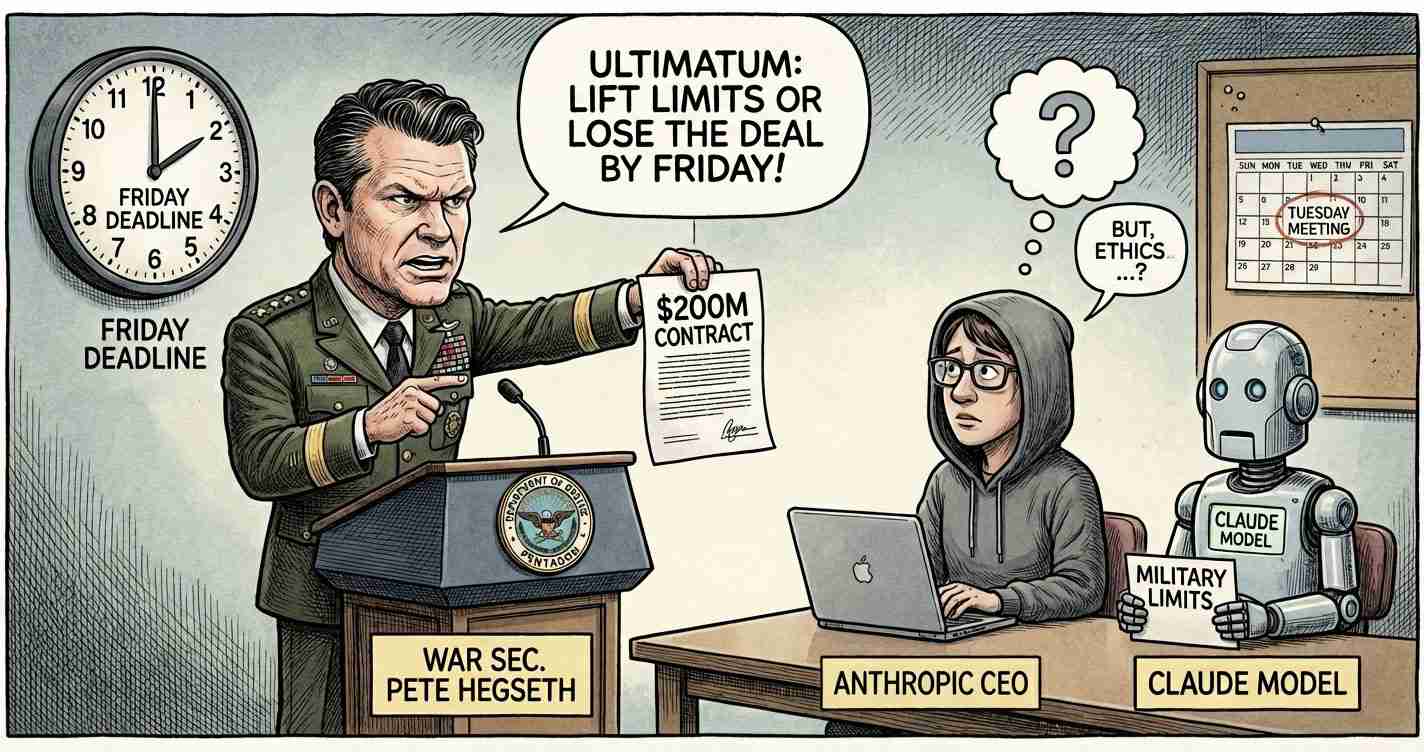
The Pentagon has given Anthropic a Friday deadline to remove restrictions on its Claude AI’s military use, warning it could cancel a $200 million classified contract or invoke the Defense Production Act if the company refuses.
- Deadline and stakes: The Department of Defense ordered Anthropic to lift usage limits on Claude by Friday or face punitive actions, according to responsible reporting and Fox News coverage.
- Potential penalties: Officials warned of canceling a $200 million classified deal, labeling Anthropic a supply-chain risk, or invoking the Defense Production Act.
- Operational reliance: Claude is the only advanced commercial model approved on classified Pentagon networks, heightening the stakes if access is restricted (TechCrunch).
Pentagon-Anthropic AI dispute: Deadline to lift Claude AI military limits
The standoff centers on who controls guardrails for powerful AI used in defense: Anthropic’s safety policies or Pentagon-directed access for lawful military uses. Reporting ties the ultimatum to concerns about operational oversight and national security readiness.
How the ultimatum unfolded
Defense Secretary Pete Hegseth delivered the demand in a Pentagon meeting with Anthropic CEO Dario Amodei, praising Anthropic’s technology while pressing for broader access for “every lawful use” the military may require, sources told Fox News and Responsible Statecraft.
Officials said Hegseth warned that if Anthropic insisted on company oversight that blocks lawful military uses, the Pentagon could:
- Terminate the $200 million classified contract (Fox News).
- Designate Anthropic a supply chain risk, a move that could limit partnerships with other defense vendors (Politico).
- Invoke the Defense Production Act to compel access to Claude.
The catalyst — alleged use in the Maduro operation
The dispute intensified after the Pentagon reported Anthropic asked whether Claude had been used in the January operation that captured Venezuelan leader Nicolás Maduro. Officials said the inquiry suggested Anthropic might disapprove certain military uses (Responsible Statecraft, Fox News).
Anthropic deniesResponsible Statecraft).
Why Claude matters to the Pentagon
Claude is currently the only leading commercial AI model cleared to operate inside classified Pentagon networks under a 2025 deal, making the department dependent on one private system for sensitive workflows and analysis (TechCrunch, Fox News).
Analysts warn that losing access to Claude abruptly would create operational gaps, especially given a Biden-era memo urging agencies to avoid sole reliance on a single classified-ready AI system (TechCrunch).
Industry context and rivals
Anthropic was one of four firms awarded $200 million Department of Defense contracts in July 2025, alongside OpenAI, Google, and xAI. Anthropic was the first cleared for classified work. Rival firms have varied in their approach to military-use limits; reporting indicates xAI has agreed to allow its model for any lawful DoD use, and others may be close to similar arrangements.
Tech reporting notes the Pentagon’s push for broader access clashes with companies’ safety-first rationales — firms argue guardrails reduce public-risk as models scale (TechCrunch, Responsible Statecraft).
Anthropic’s stated stance
Anthropic positions itself as a safety-first company. The firm says its policies would not block lawful military operations and stresses support for national security in ways its models can “reliably and responsibly” handle. Current reporting indicates Anthropic does not plan to lift its usage restrictions (Fox News, TechCrunch).
Control over AI guardrails — why this matters
At the dispute’s core is whether private developers or the Pentagon set guardrails for defense AI. The outcome could set a precedent for future partnerships: uniform access may pressure companies to remove safety limits, while maintained company control could leave the military with reduced access or added legal complexity (Responsible Statecraft, Fox News).
Implications for Fresno, California
Although the dispute is national, it carries local consequences for Fresno and the San Joaquin Valley’s growing tech and defense contractor base.
Economic impact
Local firms that provide services to the DoD or partner with cloud and AI vendors could face ripple effects if Anthropic loses its classified contract or if other firms alter how they work with the Pentagon, potentially causing delays and added costs (Fox News, TechCrunch).
Political consequences
Fresno leaders focused on jobs and public safety may press federal partners for assurances about supply-chain stability and to protect California-based tech work from sudden contract losses (Responsible Statecraft, Politico).
Social effects
Civil liberties advocates in Fresno and statewide may monitor the dispute closely. Anthropic’s red lines about avoiding mass surveillance of Americans resonate with local privacy concerns and could spur activism if limits are forced to change (Responsible Statecraft).
Cultural relevance
The debate raises questions of oversight and trust in institutions for Fresno’s diverse communities. Local media, civic groups, and researchers may call for more public discussion on how AI tools are used by authorities (TechCrunch).
Practical applications for residents
Short-term effects for most residents will be limited, but long-term procurement shifts could affect local employers in defense contracting, cybersecurity, and cloud services. Students and job seekers in Fresno should note policy decisions now may shape hiring and partnerships for years (Fox News).
Reporting and sources
This article draws on coverage from multiple outlets, including Responsible Statecraft, Fox News, Politico, and TechCrunch. Additional reporting may clarify whether Anthropic meets the Friday deadline and which of the Pentagon’s options it ultimately pursues.
“The department wants to keep working with the company,” officials said, while also pressing for broader access to Claude for all lawful military uses.