Sea of Silent Cars: How Victorville’s Mojave ‘Car Graveyard’ Became a Lasting Symbol of Volkswagen’s Dieselgate
After Volkswagen’s 2015 Dieselgate revelations, U.S. settlements forced massive buybacks, producing sprawling storage lots in the Mojave near Victorville where tens of thousands of VW and Audi vehicles were parked, maintained, and later repaired, sold, or scrapped.
- Dieselgate forced nearly 500,000 U.S. buybacks after VW admitted to defeat devices that massively increased NOx emissions.
- The Victorville lots in the Mojave held tens of thousands of cars by design—dry climate slowed corrosion and preserved resale value.
- Managed, not abandoned: Volkswagen staffed crews to maintain, charge, move and prepare vehicles for repair, resale or scrapping.
- Costs were huge: Volkswagen’s global fallout reached tens of billions, with about $14.7 billion tied to the U.S. settlement.
Background: What happened in 2015
In September 2015, U.S. regulators issued a Notice of Violation after finding Volkswagen had installed defeat devices — software that detected emissions tests and activated full pollution controls only under test conditions. On the road, the cars emitted far higher levels of nitrogen oxides (NOx) than allowed, in some cases up to 40 times legal limits. The discovery triggered wide-ranging civil and criminal probes; VW executives later acknowledged the wrongdoing. (See Wikipedia — Volkswagen emissions scandal.)
“Defeat devices” changed emissions output depending on whether the vehicle was undergoing laboratory testing or normal driving, undermining regulatory safeguards and public trust.
The buyback program and the storage problem
U.S. settlements required Volkswagen to offer owners options including buybacks, lease terminations, or approved fixes. Many owners chose buybacks, creating an immediate need for large, inexpensive storage. Volkswagen sought sites ranging from old stadium lots to industrial yards — and ultimately large sun‑baked lots in the Mojave Desert near Victorville became the most visible solution. (See U.S. Department of Justice — Volkswagen settlement and costs.)
Why the Mojave?
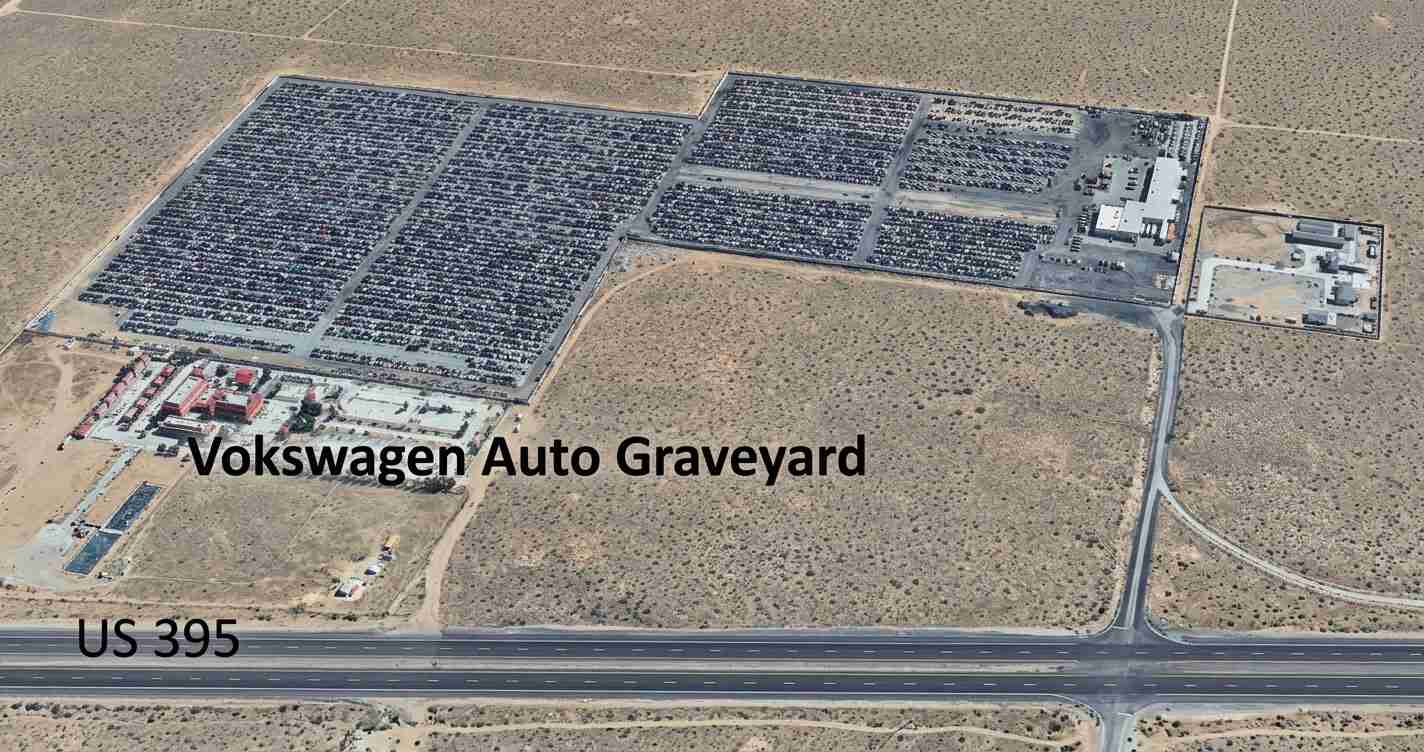
The Mojave’s dry climate was chosen deliberately. Low humidity and minimal rain reduce rust and corrosion, helping preserve metal and paint on cars that otherwise would deteriorate faster in wetter climates. From the air, the Victorville lots resembled a gray sea of parked Volkswagens and Audis stretching for miles. Importantly, the scene was not one of abandonment: Volkswagen employed crews to keep vehicles in saleable condition by starting engines, charging batteries, moving cars and performing checks.
The scale and cost
The numbers were large. Roughly half a million U.S. 2.0-liter diesel cars were affected; owners were offered buybacks or repairs under settlement terms. By mid‑2019, Volkswagen’s global tab for fines, buybacks, mitigation and related costs topped $32 billion, with about $14.7 billion allocated to the U.S. settlement package. The company also faced criminal charges and paid substantial sums to environmental programs and consumers. (See Wikipedia — Volkswagen emissions scandal and U.S. Department of Justice — Volkswagen settlement and costs.)
Maintenance, resale and scrapping
Despite their eerie appearance, the Victorville parking areas were organized operations. Mechanics and logistics teams kept cars moving, checked fluids and batteries, and prepared vehicles either for approved retrofits or for buyback processing. Some were repaired and returned to the used‑car market once regulators approved fixes; others were too damaged or otherwise unsuitable and were sent to salvage and recycling.
Consumer compensation included buyback payments, termination of leases without penalty, and settlement funds directed to environmental programs and affected owners. (For owner guidance, see Consumer Reports — guide to Dieselgate recalls and owner options.)
Current status and what remains
Public records and reporting indicate most affected vehicles were either modified and resold or dismantled and recycled. Recent public-source searches do not reveal detailed 2025–2026 updates on Victorville specifically; given repair and resale timelines, it is likely the largest inventory challenges have been resolved and many parking fields largely cleared. Nonetheless, Victorville images remain a striking visual reminder of the scandal’s scale.
Implications for Fresno, California
Economic impact
- Used-car market: The influx of repaired and bought-back VWs and Audis temporarily affected prices and listings nationwide, including Fresno, by increasing supply once fixes were approved.
- Dealers and repair shops: Certified fixes and resales created demand for technicians, diagnostics, towing and inspections—offering a short-term boost to local businesses.
- Salvage and recycling: Cars deemed irreparable were sent to scrapyards, increasing activity for Central Valley recyclers and salvage operations.
Political and social effects
- Consumer protection oversight: Dieselgate underlined the importance of federal and state regulators (including the California Air Resources Board) in protecting consumers and air quality.
- Trust and consumer education: The scandal weakened trust in affected brands, encouraged more rigorous VIN checks, recall monitoring and buyer awareness.
- Regional values: The Victorville imagery reinforced calls for corporate transparency and environmental responsibility among Fresno residents and officials.
Practical applications for residents
If you bought a used VW or Audi from the Dieselgate era, verify your vehicle’s status using official settlement and recall resources. Local mechanics and dealerships can confirm whether required repairs were completed and whether paperwork for emissions compliance is in order. Homeowners and officials should monitor large storage or industrial activities and ask about potential long‑term air or soil impacts—even for temporary operations.
For owner support and verification, consult official guidance: Consumer Reports — guide to Dieselgate recalls and owner options and U.S. Department of Justice — Volkswagen settlement and costs.