Deadly collision at LaGuardia: Air Canada Express CRJ-900 hits Port Authority fire truck in “LaGuardia Air Canada crash,” NTSB probes runway incursion
New York’s LaGuardia Airport suffered a deadly runway incursion on March 22, 2026, when an Air Canada Express CRJ‑900 struck a Port Authority fire truck on Runway 4, killing both pilots and injuring dozens; the NTSB has opened an investigation.
Key takeaways
- Flight: Air Canada Express flight reported as 8646 (also cited as AC4686), a Bombardier CRJ‑900 operated by Jazz Aviation, registration C‑GNJZ — sources include Fox News, Business Insider and Airlineratings.
- Casualties: Both pilots were killed; 72 passengers and 4 crew were aboard; dozens injured and 39–43 people taken to hospitals, per Fox News and Business Insider.
- Airport impact: LaGuardia closed after a ground stop; about 600 flights canceled and operations limited the following day (Fox News, ABC News).
- NTSB probe: Investigators recovered the CVR and FDR; the CVR was reported intact and sent to the NTSB lab for analysis (Fox News, The Jerusalem Post).
Key information
Flight and aircraft: The jet involved is identified as Air Canada Express flight 8646 (also cited as AC4686 or 8646), a Bombardier CRJ‑900 operated by Jazz Aviation, registration C‑GNJZ. Primary reporting includes Fox News, Business Insider and Airlineratings.
Time and place
The collision occurred around 11:45–11:47 p.m. ET on March 22, 2026, on Runway 4 at LaGuardia Airport while the jet was landing from Montreal. Coverage: Fox News, ABC News, Business Insider.
Casualties and injuries
Both the captain and first officer were confirmed killed. Jazz Aviation and the U.S. Transportation Secretary’s office reported the aircraft carried 72 passengers and 4 crew. Dozens were injured; 39–43 people were taken to hospitals (including two Port Authority firefighters). At least 32 people have since been released; several remain seriously injured. Sources: Fox News, Business Insider, ABC News.
What happened, according to investigators and witnesses
Preliminary reporting and radar data indicate the CRJ‑900 was landing when it struck a Port Authority fire truck known as Truck 1 on Runway 4. Port Authority accounts say the vehicle was responding to an unrelated rejected takeoff and had been cleared to cross Runway 04 at taxiway D. Air traffic control recordings capture shouted commands:
“Truck 1, stop, stop, stop!” and “Stop truck one. Stop!”
Responders did not stop before the head‑on collision, according to multiple accounts (Fox News, Airlineratings).
Speed, impact and wreckage
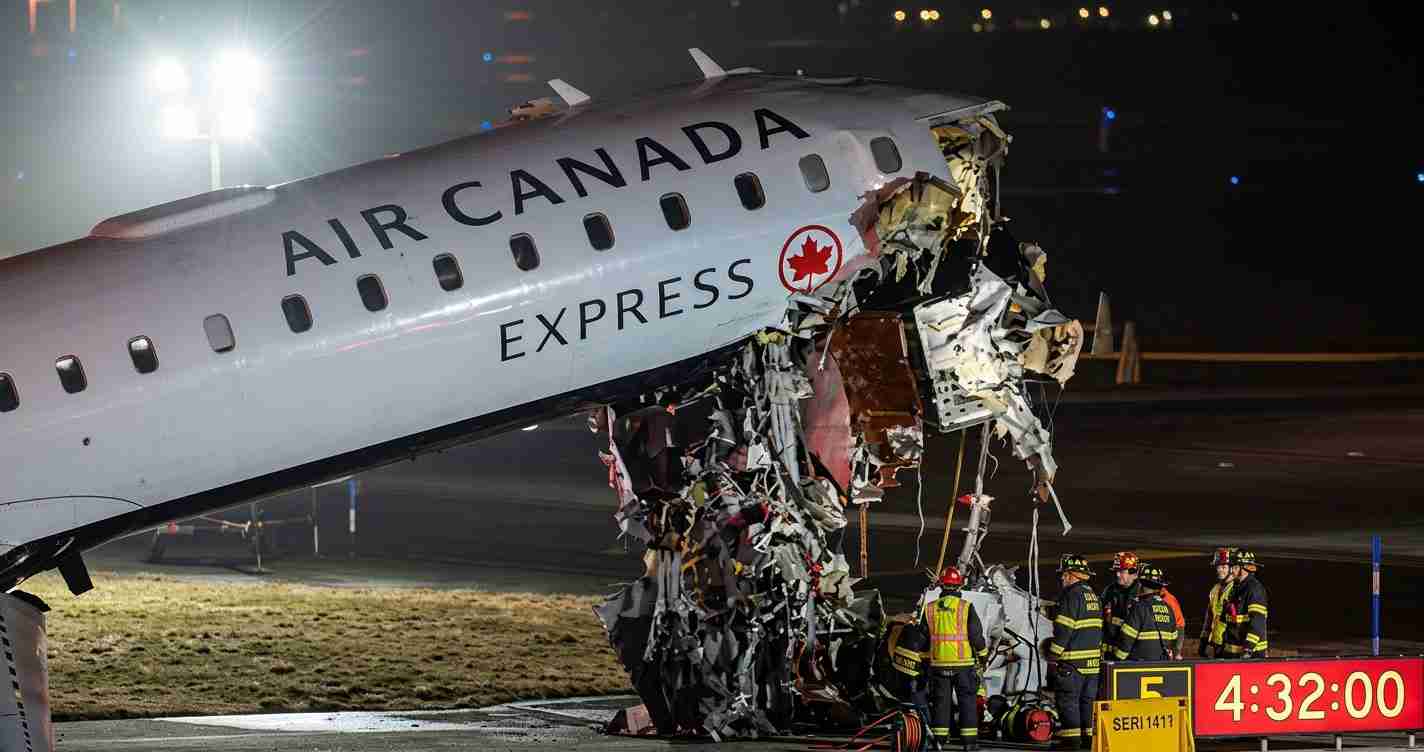
Reports differ on the jet’s ground speed at impact. Flightradar24 data listed a last recorded ground speed of about 24 mph (39 kph) before the signal ended, while other accounts cited higher impact speeds between 93–105 mph. Witnesses and media described severe nose damage and landing‑gear contact with the truck. The jet reportedly skidded roughly 130 meters to taxiway E after the strike, leaving a wide debris field across runway and taxiway areas. Sources: Fox News, ABC News, Airlineratings.
Rescue, recovery and recorders
Emergency response: Crews moved passengers off the aircraft; photos and eyewitness accounts showed people with head wounds and bloodied clothing. Two Port Authority firefighters suffered broken bones and serious but non‑life‑threatening injuries. Air Canada confirmed its care team notified families; pilot identities have not been publicly released. Sources: Fox News, Business Insider, ABC News.
Recorders: The NTSB, working with the FAA and Port Authority, recovered both the cockpit voice recorder (CVR) and flight data recorder (FDR). NTSB Chair Jennifer Homendy said the CVR “was not damaged” and was transported to the NTSB’s laboratory in Washington, D.C., for analysis. Responders cut a hole in the roof to access and remove the units; work on the FDR began the following day with hopes it will show precise positions of the aircraft and the truck prior to impact. Sources: Fox News, The Jerusalem Post.
Investigation scope and process
The NTSB said it will review surveillance footage, air traffic control data and a replay of the airport surface detection equipment used by controllers. Investigators plan to interview the LaGuardia tower controller and Port Authority responders. Chair Homendy described the wreckage field as “pretty expansive”, noting evidence documentation and wreckage removal will take days. Sources: Fox News, The Jerusalem Post.
Context and safety questions
This is the first fatal crash at LaGuardia in roughly three decades and renews attention on runway incursions — unauthorized people, vehicles or aircraft entering a runway. Federal and local agencies will examine clearance procedures, radio monitoring protocols, and whether Port Authority rules and training were followed when emergency vehicles operate on movement areas. Sources: ABC News, Fox News, Airlineratings.
Officials on the scene
Port Authority Executive Director Kathryn Garcia briefed reporters, confirming dozens hospitalized, with some seriously injured; at one briefing she confirmed 32 people had been released and nine remained seriously injured. U.S. Transportation Secretary Sean Duffy’s office confirmed four crew members, including two flight attendants. NTSB Chair Jennifer Homendy is leading the investigative response. Sources: Fox News, Business Insider, The Jerusalem Post.
Implications for Fresno, California
Economic impact: Fresno travelers to or through New York may face delays, cancellations and higher fares as airlines rebook or reroute flights. Fresno Yosemite International Airport (FAT) is not directly affected, but connecting services may be shuffled, creating ripple effects for schedules and ticket prices. Source: Business Insider.
Political consequences: The crash is likely to reignite federal and local debate about runway‑incursion prevention and emergency‑vehicle coordination. Fresno officials and lawmakers may press for funding and clearer national standards. Source context: Fox News, The Jerusalem Post.
Practical advice for Fresno residents: If you have upcoming travel to New York, check with your airline for rebooking and refunds, allow extra time, monitor FAA and airline updates, and review travel insurance terms. Consider alternate routing through other hubs if needed.
Investigative next steps
The NTSB will continue analyzing the FDR and CVR, review tower recordings and surface‑movement replays, document the debris field before wreckage removal, and interview tower and Port Authority personnel to determine how the vehicle entered an active runway while an aircraft was landing. The agency expects days of evidence processing before key findings are released. Sources: Fox News, The Jerusalem Post.
Sources and reporting notes
This article compiles reporting and official statements from the above sources, Port Authority briefings, and NTSB comments. All factual details and URLs from original reporting have been preserved.