
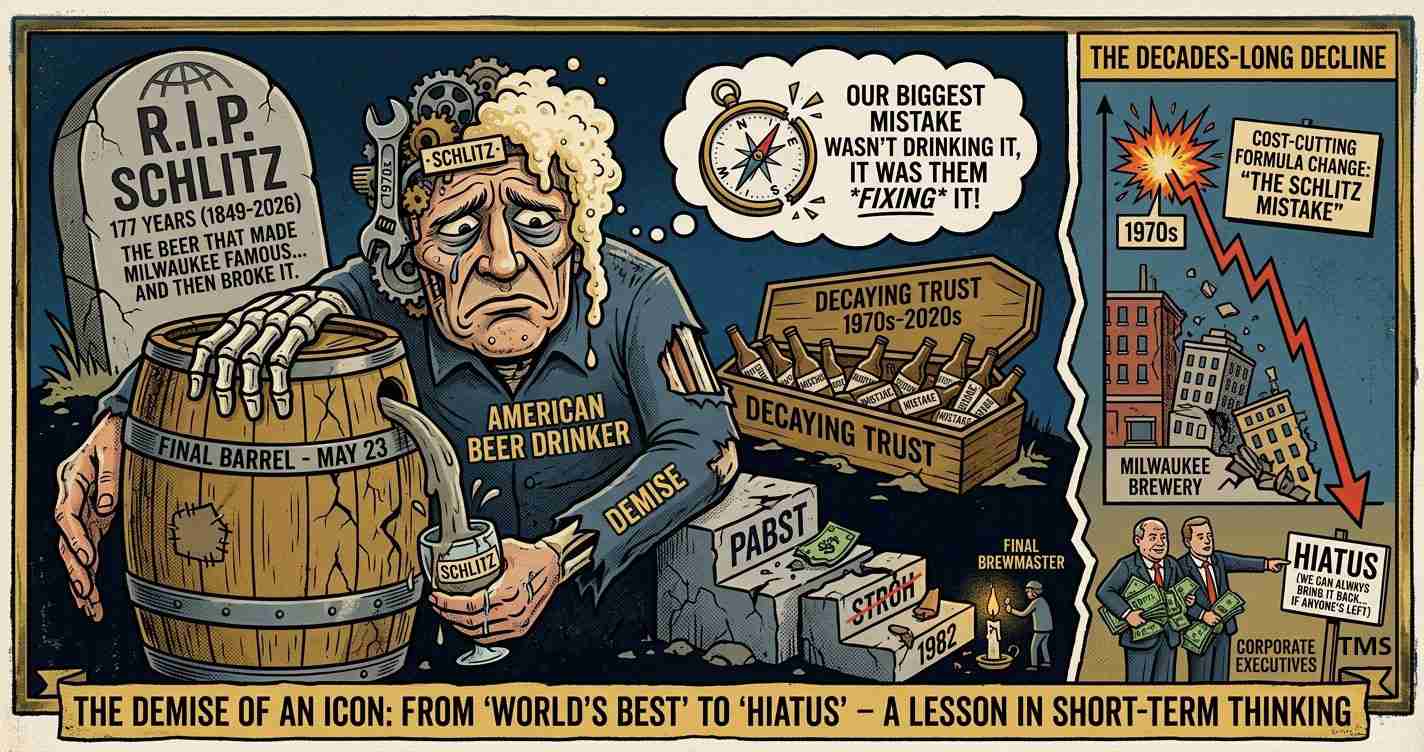
Schlitz, “the beer that made Milwaukee famous,” brews its final batch after 177 years
The historic Schlitz beer brand — once “the beer that made Milwaukee famous” — brewed a final batch May 23 at Wisconsin Brewing Company in Verona; a limited late‑June release will mark the end of Schlitz Premium after 177 years.
Key takeaways
- Final scheduled brew: May 23 at Wisconsin Brewing Company in Verona, Wisconsin.
- Limited release: A late‑June retail release will be the final availability of Schlitz Premium in this run.
- Owner statement: Pabst calls the move an “on hiatus” decision; local outlets and the brewery frame the May brew as the final batch after 177 years.
- Reason given: Pabst cited rising storage and shipping costs as a primary driver of the decision.
The last Schlitz: what’s happening now
Wisconsin Brewing Company — which produced Schlitz under contract in recent years — brewed what local outlets are calling “the last Schlitz” on May 23. The brewery and Milwaukee‑area bars organized farewell events tied to the batch, and the company expects a limited release in late June. While Pabst has used the phrase “on hiatus”, the scheduling and local coverage frame this as the formal end of continuous production of Schlitz Premium after 177 years.
Why it matters: Schlitz’s rise and fall
Founded in 1849, the Joseph Schlitz Brewing Company grew from a regional Milwaukee brewer into one of the nation’s most recognizable brands. Its slogan — “the beer that made Milwaukee famous” — captured Schlitz’s influence on Milwaukee’s identity as a brewing capital. The brand expanded nationally, notably shipping beer after the Great Chicago Fire of 1871, a move cited in historical accounts such as the Encyclopedia of Milwaukee.
By the late 1940s and 1950s Schlitz was among the world’s most popular beers, buoyed by heavy advertising and memorable taglines, including “When you’re out of Schlitz, you’re out of beer.”
The “Schlitz mistake” and the long decline
Histories point to a pivotal misstep in the 1970s — now called the “Schlitz mistake.” Facing cost pressures and stiff competition, Schlitz altered its brewing formula and processes to cut costs and speed production. Industry writers and historians (for example, AmericanCraftBeer.com) say those changes involved cheaper ingredients and process tweaks that affected flavor and clarity, prompting consumer complaints and damaging the brand’s reputation.
Public reaction over subsequent decades has been mixed: some mourn the loss of a family favorite, while others argue the “real” Schlitz ended with the recipe changes decades ago.
Ownership changes, nostalgia and limited revivals
After losing market share, Schlitz passed through multiple owners. Stroh Brewing acquired the company in 1982; Pabst later obtained many former Stroh brands, including Schlitz, in 1999. Under Pabst the label became a nostalgia‑oriented, value brand, occasionally released in variants such as a “Classic” formula meant to evoke pre‑1970s taste.
Pabst’s Zac Nadile told Milwaukee Magazine the decision to retire Schlitz Premium centers on rising storage and shipping costs — framed as a logistical and business choice rather than only a publicity move. While “on hiatus” leaves the door open to future limited revivals, practical and contractual hurdles make long‑term returns harder.
Public reaction: nostalgia, derision and memories
Online responses ranged from affectionate remembrances to derision. Social posts recalled family rituals and college memories, while other commentators noted that the brand’s peak quality preceded the 1970s changes. The stream of tributes often invoked images of cold bottles at backyard cookouts, fraternity stories and regional traditions.
The brand’s physical legacy
The original Schlitz brewery complex in Milwaukee no longer produces beer but survives as Schlitz Park, a redeveloped mixed‑use campus preserving the brewery’s architecture and signage. The site remains a tangible reminder of Schlitz’s role in Milwaukee’s industrial and cultural history.
What happens next for Schlitz and similar legacy beers
After the May 23 brew and the expected late‑June limited release, Schlitz Premium will likely disappear from store shelves for the foreseeable future. Other Schlitz sub‑brands (such as Schlitz Malt Liquor) were not the focus of recent reports; the retirement appears aimed primarily at Schlitz Premium. Pabst’s language leaves theoretical room for future nostalgic releases, but logistical and economic barriers increase over time.
Implications for Fresno, California
Economic impact: Direct retail effects in Fresno will be limited. Schlitz Premium has been a niche, nostalgia item for years, so its disappearance is unlikely to affect broad beer sales or tax receipts. Local wholesalers and retro‑label retailers may see a short spike in demand as collectors seek remaining stock.
Political and regulatory consequences: No immediate political consequences are expected; the decision is a private, logistical business choice. It does highlight broader supply‑chain and distribution cost issues that local economic officials monitor.
Social and cultural effects: Nostalgia may surface at family gatherings, reunions and alumni events. Midwestern transplants in the Central Valley may prompt public conversations about continuity, memory and changing tastes; bars could stage throwback events to tap that sentiment.
Local business opportunities: Fresno retailers and promoters could leverage the moment with themed packages, farewell events, or collaborations with local brewers recreating a “Schlitz‑style” lager. Museums or university programs might host panels on brewing history and industrial heritage.
Sources and further reading
- Wisconsin Brewing Company
- Pabst Brewing Company
- Milwaukee Magazine
- Encyclopedia of Milwaukee (Joseph Schlitz Brewing Company entry)
- AmericanCraftBeer.com
- Schlitz Park
- The Independent
- Fox Business
Reporting by Times Media Service; additional local reporting and archival sources cited above.



