
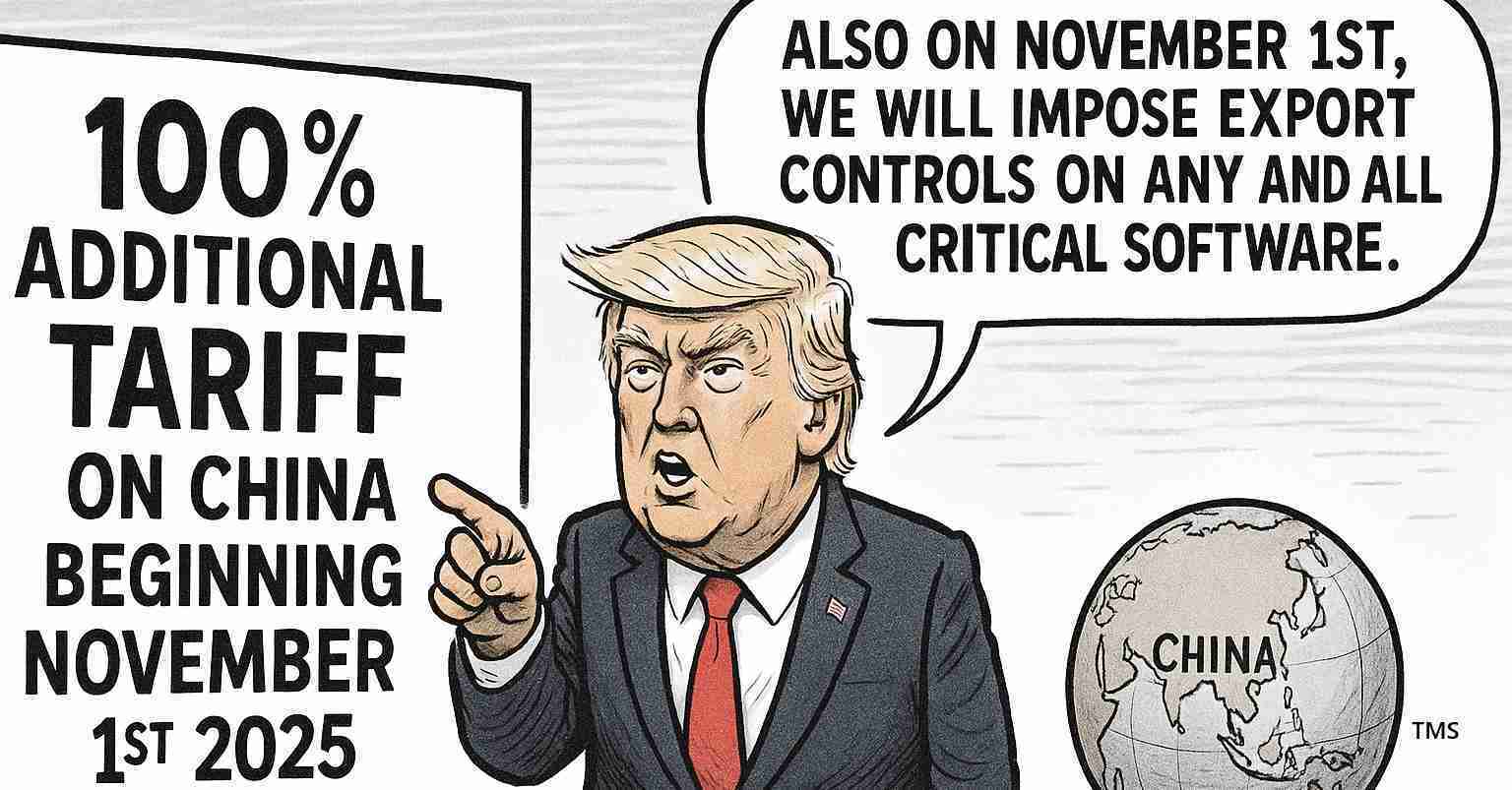
Trump orders 100% additional tariff on China as U.S. retaliates for new rare earth controls
President Trump announced a 100% additional tariff on all Chinese imports, effective November 1, 2025, and matched export controls on critical software — a direct response to China’s expanded rare-earth export restrictions and pressure on global supply chains.
Key takeaways
- 100% additional tariff: An extra 100% tariff on all imports from China will be applied on top of existing U.S. tariffs, scheduled to begin November 1, 2025.
- Export controls on software: The U.S. will impose controls on “any and all critical software” that could affect China’s access to advanced tools, effective the same day or sooner.
- Response to China’s rare-earth measures: The move retaliates against Beijing’s expanded export controls covering five more rare earth elements and production technologies.
- Wider impacts: Large cost increases, supply-chain disruption and geopolitical escalation are likely; local economies such as Fresno could face immediate and longer-term effects.
Key information and sources
The announcement included multiple specific policy steps and was widely reported. Primary media accounts cited include CBS News (tariff announcement), another CBS News (rare-earth coverage) report, coverage by the Economic Times, and context from TheJournal.ie. Video of the announcement is available: Video of Trump’s announcement.
What the White House announced
Framing: The administration described China’s expanded rare-earth export rules as “extraordinarily aggressive” and framed the tariff and controls as necessary to deter further steps that would weaponize supply chains. The president indicated the 100% tariff could be enforced earlier than November 1 if China takes additional measures.
The new U.S. export controls
Scope: Officials said export controls will target “any and all critical software” that can be used in semiconductors, aerospace, and military systems. The aim is to limit China’s ability to turn minerals and advanced software into sensitive military and high-tech applications.
China’s expanded rare earth controls
Beijing expanded export controls to include five additional elements — holmium, erbium, thulium, europium, and ytterbium — bringing restricted rare earths to 12 of 17 types. Controls now cover production technologies and overseas uses and require government approval for items with trace amounts tied to sensitive applications. The Chinese Commerce Ministry said the rules aim to “safeguard national security and interests.” (Economic Times)
Why rare earths matter
Importance: Rare earth minerals are essential to semiconductors, electric-vehicle motors, wind turbines, jet engines, smartphone components, and many defense systems. While not geologically rare, they are difficult to mine and refine, giving controlling countries leverage over global tech and defense supply chains.
Potential business and market impacts
An additional 100% tariff on top of existing duties would sharply raise costs for U.S. importers and companies relying on Chinese parts. Firms may pass costs to consumers, delay investments, or seek alternate suppliers. Industries dependent on rare earths, electronics, EVs and defense components face heightened disruption and price risk. Economists and industry groups warn such escalation can slow growth and raise inflationary pressure. (TheJournal.ie, CBS News)
Diplomacy and next steps
The measures could complicate scheduled trade talks, prompt emergency consultations in capitals, and increase market volatility. No coordinated international response was announced; the U.S. action appears unilateral for now. Observers expect trade and foreign policy officials to reassess negotiations and contingency plans for supply-chain resilience.
Reactions and warnings
Industry and experts: Economists warn of higher prices and slower growth from tariff escalation, while some defense and technology experts back measures to protect sensitive supply chains and reduce dependence on a single source for critical minerals.
Coverage and reporting sources
- CBS News: Trump announces 100% tariff on China
- CBS News: reporting on rare-earth elements
- Economic Times: coverage of tariff announcement and China controls
- TheJournal.ie: coverage and context
- Video of Trump’s announcement
Implications for Fresno, California
Economic impact: Fresno businesses importing Chinese goods or parts may face higher costs. Local retailers, electronics repair shops, and manufacturers could see price increases. Farmers and ag businesses may be affected indirectly through costlier equipment parts, fertilizers, or processing components. Consumer price increases could reduce purchasing power in a region already managing cost-of-living pressures.
Supply chains and manufacturing: Fresno’s ag-tech and small manufacturers rely on sensors and electronics that may contain rare earths. Supplier price increases or halted shipments could cause delays, increased production costs, and project slowdowns.
Jobs and local economy: Short-term disruptions could affect hours and hiring; construction, repair, and small manufacturing employers might delay hiring or reduce investments. Long-term diversification could create opportunities but requires time and capital.
Technology and education: Technical schools and community colleges may see shifts in training demand. Partnerships for workforce development could emerge if businesses invest in domestic supply chains.
Consumer effects: Households could face higher prices for electronics, EVs, and goods containing rare-earth components, with disproportionate burdens on lower-income residents.
Regional policy: Local leaders may press for federal support, incentives for domestic processing capacity, or trade relief for affected sectors.
Practical steps for Fresno businesses and residents
- Review supply chains: Audit sources of parts and materials and identify critical dependencies on Chinese suppliers.
- Seek alternatives: Explore U.S. or allied-country suppliers and redesigns that reduce reliance on restricted materials.
- Plan for price volatility: Budget for higher input costs, consider hedging, and adjust inventory strategies.
- Engage with policymakers: Communicate needs to state and federal representatives for relief, incentives, or support.
- Invest in workforce training: Coordinate with community colleges for advanced-manufacturing and recycling training to build local capacity.
Reporting note
This developing story synthesizes the White House announcement and reporting by CBS News, the Economic Times, TheJournal.ie, and related coverage. Updates will follow as officials implement measures and as business and foreign-government responses develop.



