
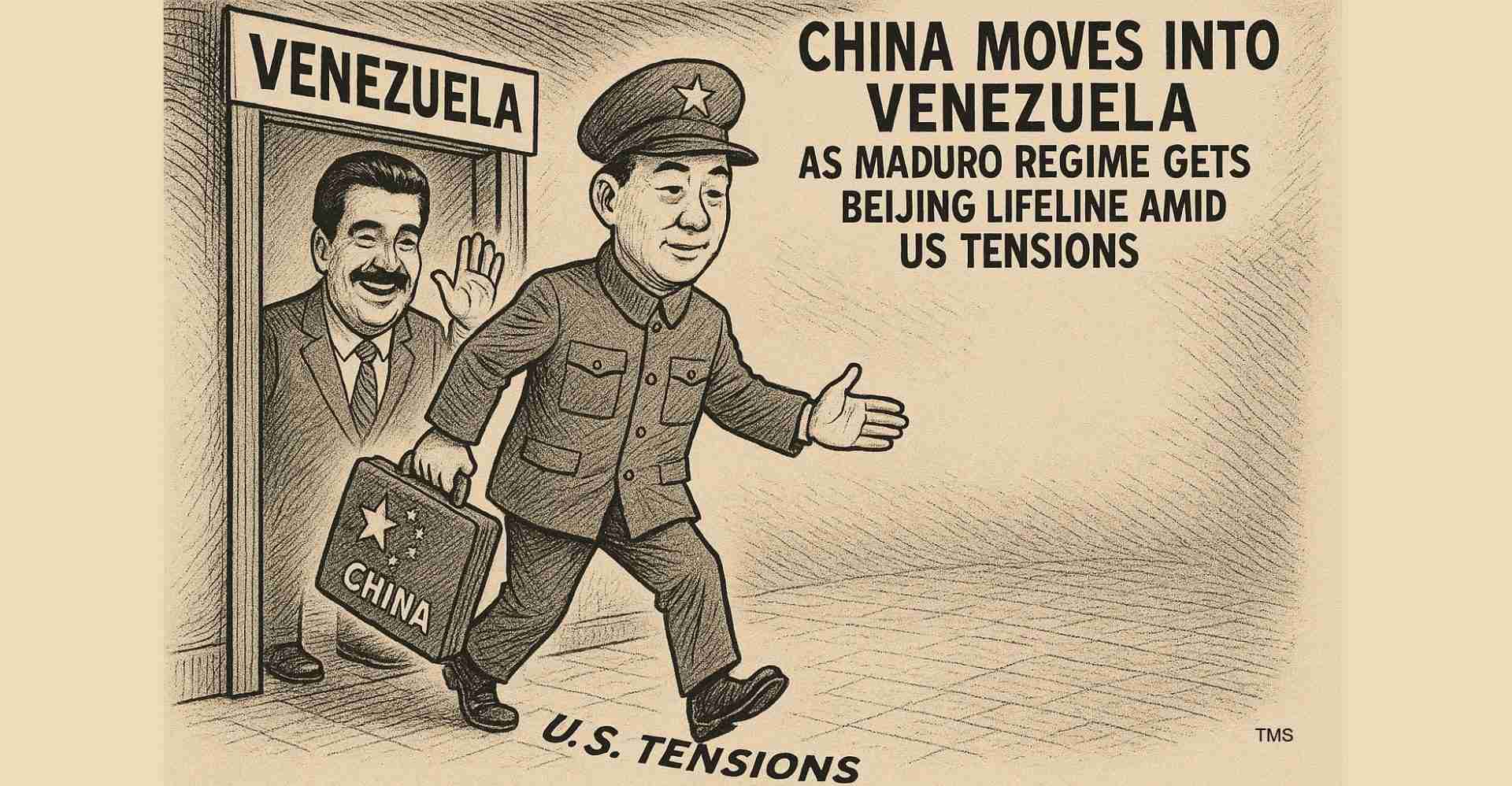
China moves into Venezuela as Maduro regime gets Beijing lifeline; Special Economic Zones and trade deals deepen partnership
China and Venezuela have shifted from loan-heavy ties to a strategic “productive partnership” focused on trade, technology, Special Economic Zones and a Bilateral Investment Treaty, giving Maduro’s government a crucial economic lifeline amid mounting U.S. tensions.
- New model: Caracas and Beijing pivoted from large oil-for-loan deals to a productive partnership emphasizing trade, tech, investment and SEZs — reporting by El País.
- Debt legacy: Venezuela remains China’s largest Latin American debtor — past loans collateralized by oil totalled more than $60 billion (analysis in Global Policy Journal and background by the CFR).
- Legal and trade opening: A zero-tariff deal and a modern Bilateral Investment Treaty lowered barriers and protections for Chinese investment — see Fietta Law and coverage in Fox News.
- Strategic alignment: Beijing and Caracas declare an “all‑weather strategic partnership” with party-to-party ties; official statements from China’s agencies outline the diplomatic deepening (CIDCA, MFA).
Shift from loans to a productive partnership
For two decades China’s relationship with Venezuela was dominated by large credit lines secured by oil shipments. The new phase emphasizes trade, technology transfer, agricultural projects and targeted investment inside Venezuela Special Economic Zones (SEZs), designed for foreign-managed operations and to create on-the-ground production rather than simply extending credit. Reporting and analysis detail this strategic shift (El País).
How the SEZ model works in practice
Under the SEZ framework, Chinese firms receive tax incentives, logistical privileges and regulatory flexibility while employing Venezuelan labor. Observers note this reduces Beijing’s need for upfront financing and lets companies retain operational control, creating de facto industrial footholds backed by treaty protections (El País).
Risk and reward: If SEZs are operated mainly by Chinese firms, local businesses may see limited benefit; proponents counter that SEZs can bring jobs, tech and infrastructure if Venezuelan rules are enforced.
Oil leverage and investment reality
Despite the new deals, the legacy of prior lending endures. Analysts estimate more than $60 billion in past loans collateralized by future oil deliveries — a form of leverage that ties China to Venezuela’s most valuable export (Global Policy Journal; CFR).
At the same time, Chinese state-owned enterprises have been selective with new upstream oil projects due to payment disputes and governance concerns at PDVSA. Some Chinese firms appear involved in alternative trade routes that move Venezuelan oil internationally, illustrating a mix of caution and opportunism (El País).
Trade expansion and legal safeguards
Bilateral trade surged in 2024–2025 following a zero-tariff agreement and other measures. Venezuelan exports to China more than doubled while imports of Chinese-made goods — motorcycles, parts, electronics — rose sharply, deepening Caracas’s dependence on Chinese supply chains (OEC).
A modern Bilateral Investment Treaty (BIT) that entered into force on April 1, 2025 streamlines investor protections and dispute-resolution procedures favored by Chinese businesses, lowering perceived legal risk for new projects (Fietta Law).
Political and strategic alignment
Beijing and Caracas describe their relationship as an “all‑weather strategic partnership”, with growing diplomatic coordination and party-to-party ties between the Chinese Communist Party and Venezuela’s PSUV. Official Chinese releases outline training, ideological cooperation, and reciprocal support on international sovereignty issues (CIDCA; MFA).
Voices in the U.S. warn of potential Chinese dominance: as commentator Gordon Chang put it, “This really looks like China is going to completely take over the Venezuelan economy.” Others argue Beijing is preferring targeted investments and legal tools to expand influence without open-ended financial exposure (Fox News; El País).
Broader international picture
China’s engagement with Venezuela fits a regional strategy that pairs resource access with diplomatic backing for regimes at odds with Washington. Think tanks note Beijing balances economic interests with geopolitical goals to expand influence while minimizing costly exposures (CFR).
Implications for Fresno, California
Why local residents should care: Though the developments are international, they can ripple to Fresno’s economy, politics and community life.
Economic impact
Fresno, in the Central Valley, may feel effects if Chinese-backed SEZ agriculture in Venezuela alters commodity flows or introduces new competition. Local farmers should monitor potential commodity shifts, price changes and opportunities for technology partnerships tied to SEZ-driven projects (El País; OEC).
Political consequences
Local and state officials will watch federal policy responses closely. Deeper China‑Venezuela ties complicate U.S. diplomacy and could shape congressional debates over sanctions, trade enforcement and aid for democracy programs, affecting federal priorities that fund local initiatives (CFR).
Social effects
Fresno’s large Latino community follows Latin American events closely. Renewed China‑Venezuela ties could affect family remittances, asylum flows and local advocacy needs—potentially increasing demand for immigrant services and legal support (El País).
Cultural relevance
Community groups, cultural institutions and media in Fresno may see more requests for reporting, public forums and education on U.S.-China-Latin America dynamics as residents seek to understand how distant policy choices affect local life.
Practical applications for residents
- Farmers & agribusiness: Track commodity trends and explore technology-transfer or joint-project opportunities tied to SEZ agricultural initiatives (El País).
- Small businesses: Those importing consumer goods should watch supply-chain shifts as Chinese products flow through new regional channels (OEC).
- Policymakers & civic groups: Push for transparency and ethical standards in U.S. responses to protect local economic interests while upholding human rights and rule-of-law concerns (CFR).
Sources and further reading
- Fox News: China moves into Venezuela … Maduro regime gets Beijing lifeline amid US tensions
- El País: Venezuela and China showcase partnership through productive deals, not loans
- Global Policy Journal: China, Trump and regime change in Venezuela
- Council on Foreign Relations: China’s influence in Latin America
- Fietta Law: China‑Venezuela BIT enters into force
- CIDCA: Chinese government statement
- MFA: Chinese government statement
- OEC: Venezuela‑China bilateral trade profile



