
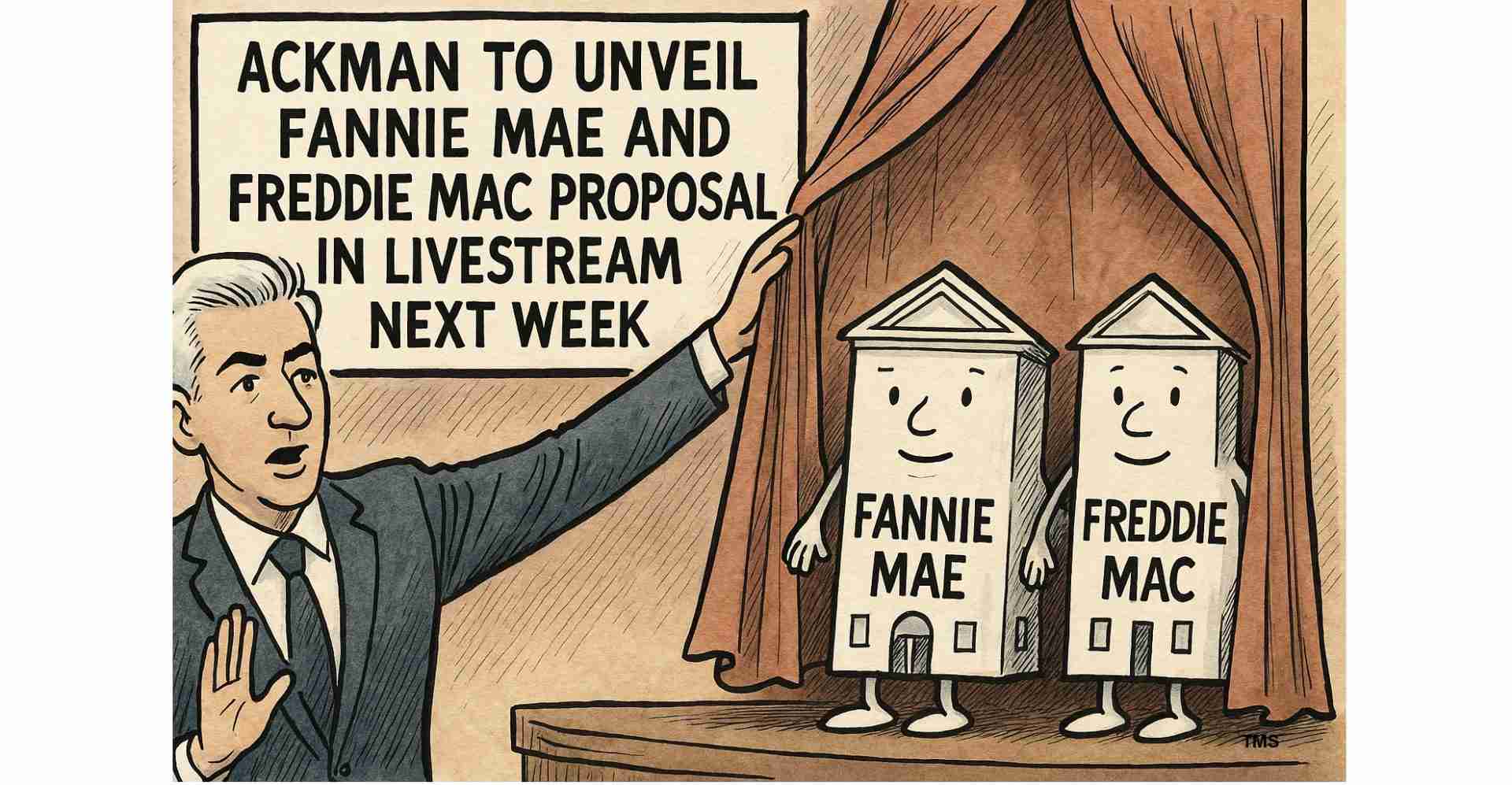
Bill Ackman to unveil Fannie Mae, Freddie Mac merger plan in livestream next week
Billionaire investor Bill Ackman will unveil next week a proposal to merge Fannie Mae and Freddie Mac into a single government‑sponsored enterprise, a plan he says could reshape mortgage finance, oversight and the costs of home loans nationwide.
- Who: Bill Ackman, billionaire hedge fund manager; reporting cited from Fox Business and Benzinga.
- What: A proposal to merge Fannie Mae and Freddie Mac into a single entity as part of a broader rethink of housing finance; reporting and analysis also noted by Friedman Vartolo.
- When: Ackman says he will unveil the plan in a livestream next week; initial announcement coverage by Fox Business.
Key takeaways
- Merging the two GSEs: Ackman proposes combining Fannie Mae and Freddie Mac to reduce duplication and improve operational efficiency.
- Oversight & privatization: The plan emphasizes clearer FHFA oversight and arrives amid debates over privatization and potential IPOs.
- Potential impacts: Supporters cite possible cost savings and simpler regulation; critics warn of higher costs and reduced public protections.
Background: Why Fannie and Freddie matter
Fannie Mae and Freddie Mac are government‑sponsored enterprises (GSEs) that buy mortgages from lenders, package them and sell guarantees to investors, helping lenders replenish funds to make more home loans. Together they back roughly 70% of U.S. mortgages — a point underscored by reporting from Friedman Vartolo. Both were placed in federal conservatorship after the 2008 financial crisis and remain subject to ongoing policy debate (Friedman Vartolo).
What Ackman is proposing, in broad strokes
According to reporting, the central idea is to merge Fannie Mae and Freddie Mac into a single, streamlined organization. Ackman has argued a merger could reduce overlap, lower operating costs and make mortgage delivery more efficient. Supporters say a single GSE could simplify oversight and boost accountability under the Federal Housing Finance Agency (FHFA). Full details are expected in Ackman’s livestream next week (Fox Business; Benzinga; Friedman Vartolo).
Streamlined oversight and privatization talk
Ackman’s outline reportedly includes clearer regulation, with the merged company overseen by the FHFA. Proponents argue that removing duplicated supervision would make accountability more straightforward. The plan appears while Washington and Wall Street continue debating privatization and potential IPOs — some policy concepts have discussed selling minority stakes (reports suggested a potential IPO could offer up to 15% and raise tens of billions) (Friedman Vartolo).
Potential benefits cited by supporters
- Lower costs through efficiency: Combining overlapping functions could reduce administrative expenses (Friedman Vartolo).
- Streamlined regulation: A single regulator-company relationship could simplify policy implementation and oversight.
- Possible downward pressure on rates: Supporters say operational savings might translate into lower mortgage costs for some borrowers.
Concerns and criticisms
Critics warn that merging and privatizing the GSEs could shift risk to private investors and raise borrowing costs for homeowners. Some estimates cited by analysts suggest mortgage costs could rise by $1,800 to $2,800 per year for some borrowers under certain privatization scenarios. There are also concerns that reduced direct government control could weaken protections that previously helped stabilize markets (Friedman Vartolo).
Market and political context
Ackman’s proposal arrives at a sensitive time. Lawmakers, regulators and major financial firms are actively engaged in debates over the GSEs’ future. Investment banks including JPMorgan, Goldman Sachs and Bank of America have been noted in reporting as part of broader conversations among policy makers and bankers. Any structural change could affect bank trading desks, mortgage lenders and investor appetite for mortgage‑backed securities (Friedman Vartolo).
What to expect from the livestream
Ackman plans to present the proposal in a livestream next week, where he is expected to outline governance, capital structure, consumer protections and timelines. Observers will watch regulator, congressional and market reactions to determine whether the proposal can move beyond a public pitch to policy action (Fox Business; Benzinga).
Implications for the US mortgage market
Because Fannie Mae and Freddie Mac back the majority of U.S. mortgages, a merger could alter mortgage costs and loan availability nationwide. If efficiencies lower operating costs, some borrowers might see improved access and marginally lower rates. Conversely, privatization that shifts risk to investors could increase costs and tighten lending standards. The balance between private capital and public oversight will be central to outcomes, and timing — including interest rates and economic growth — will shape real‑world effects (Friedman Vartolo; Benzinga).
Implications for Fresno, California
Economic impact
Mortgage rates matter in Fresno. If the proposal leads to higher mortgage costs, homeownership could become more expensive locally and housing demand may cool. Conversely, cost reductions could improve affordability for some buyers. Changes to loan guarantees would also affect local banks and credit unions that depend on the secondary mortgage market (Friedman Vartolo).
Political consequences
Local leaders and California’s congressional delegation could be drawn into debates over consumer protections and access to credit. Fresno officials may face pressure to respond if proposals threaten higher mortgage costs or reduced access to affordable lending; state and federal policymakers will likely monitor any legislative or regulatory actions (Friedman Vartolo).
Social effects
Fresno’s mix of renters and homeowners faces affordability challenges. Any shift that raises mortgage costs could keep more households renting, affecting household finances and local housing demand. Programs for first‑time and low‑income buyers could be altered depending on the merged entity’s underwriting priorities (Friedman Vartolo).
Cultural relevance
Homeownership supports community stability in Fresno. Changes that make buying harder could affect neighborhood turnover, family wealth-building and long‑term planning. Housing advocates will likely scrutinize proposals for impacts on equity and access.
Practical applications for residents
Borrowers should monitor mortgage rates and lender guidelines closely. If the proposal advances, lenders may alter eligibility rules or product offerings. Homebuyers planning near‑term purchases should consult mortgage professionals and follow developments in the proposed merger for potential effects on loan availability and costs (Friedman Vartolo).
Sources and reporting
This article draws on reporting and analysis from Friedman Vartolo, Fox Business and Benzinga, which detailed Ackman’s announcement and broader debate about Fannie Mae and Freddie Mac privatization and IPO plans.
Note: Readers in Fresno and elsewhere are advised to follow the livestream and monitor reactions from the Federal Housing Finance Agency, members of Congress, and major lenders for the most immediate updates on how the Bill Ackman housing plan could affect the US mortgage market.



