NTSB releases frame-by-frame images showing engine separating in deadly UPS Flight 2976 crash; probe centers on pylon fatigue cracks
The NTSB released sequential surveillance stills and a preliminary report on the fatal UPS Flight 2976 crash in Louisville, showing a left-engine and pylon separation; investigators now focus on metal fatigue cracks in the pylon as a likely factor.
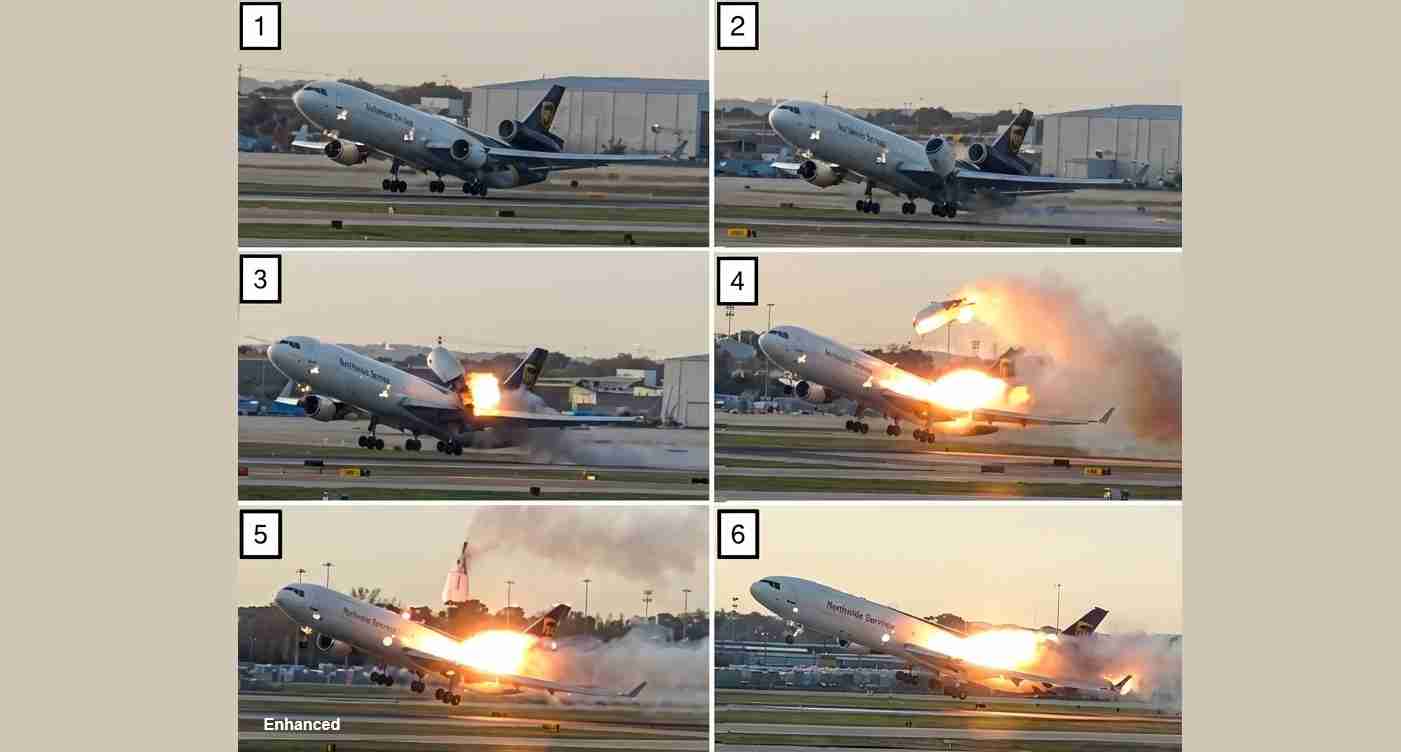
- Engine and pylon separation visible: Sequential airport camera frames show the left engine/pylon detaching immediately after rotation (NTSB investigation page).
- Preliminary evidence of metal fatigue: Inspectors report cracks in the left pylon consistent with fatigue growth; the NTSB is examining maintenance, design and inspection records (Flying Magazine).
- Severe human toll: All three crewmembers died; 11 people on the ground were killed and dozens injured, per the preliminary report (NTSB preliminary report (PDF)).
Surveillance images and what they show
Airport security cameras captured the final seconds of UPS Flight 2976. The sequence of released still frames — included with the agency’s initial materials — depicts a clear progression:
- Attached at start: The left engine and pylon appear fully attached during the takeoff roll and early rotation (video frames).
- Separation at rotation: Immediately after rotation the left engine and pylon separate from the wing, followed by a burst of fire at the wing-pylon junction (ABC News coverage).
- Engine trajectory: The detached engine travels up and over the fuselage, then falls to the ground; the aircraft crashed shortly after and post-impact fires continued until wreckage came to rest (Flying Magazine).
Preliminary findings: focus on the pylon
Early inspection work by the NTSB and technical teams has focused on the left engine pylon — the structural assembly that attaches the engine to the wing. Investigators report evidence consistent with metal fatigue cracks in that structure. The agency emphasizes the investigation is ongoing and the preliminary report does not yet assign a final cause (NTSB preliminary materials).
Key technical points under review:
- Crack origin and growth: Analysts are tracing how cracks formed and propagated in the pylon, and why they were not detected earlier (FreightWaves).
- Aircraft and engine type: The freighter was an MD-11 powered by General Electric CF6 engines, a common configuration in cargo fleets (NTSB).
- Maintenance and design review: Investigators are examining maintenance logs, inspection histories and design/manufacturing records for the pylon and engine mounts (industry reporting).
Timeline and crash sequence
According to the NTSB preliminary report and media coverage, the event unfolded in seconds on Nov. 4:
- MD-11 rotated for takeoff and climbed only about 30 feet before the left engine and pylon separated (NTSB preliminary report (PDF)).
- A burst of fire erupted at the wing-pylon area; the detached engine crossed the top of the fuselage as the crew struggled to maintain control (ABC News).
- The aircraft crashed near the airport and ignited further fires on impact. Emergency responders reached the scene quickly, but all three crewmembers died and 11 people on the ground were killed; dozens were injured (NTSB investigation page).
Why investigators are focused on fatigue
Metal fatigue is a process where repeated cyclic stress causes small cracks to initiate and grow until a component fails suddenly. Investigators are tracing the timeline of crack initiation, growth rate, and inspection history to determine whether existing inspection practices would have detected the damage before failure (technical reporting).
Investigative avenues include:
- Review of maintenance and inspection logs for the aircraft and pylon assemblies (NTSB).
- Examination of design and manufacturing records for the pylon and engine mounts (NTSB).
- Assessment of industry inspection standards for MD-11 pylons and similar structures to determine if early-stage fatigue would be caught by current practices (industry reporting).
Reporting and public evidence
The NTSB has released still frames and videos from airport cameras; media outlets have published those materials with analysis and the agency’s preliminary report. Key sources and publicly posted materials include:
- NTSB investigation page
- NTSB preliminary report (PDF)
- ABC News coverage and images
- Flying Magazine overview
- AVweb report
- FreightWaves summary
- Surveillance video excerpt 1 and Surveillance video excerpt 2
Implications for Fresno, California
Although the crash occurred in Louisville, the NTSB’s findings could have ripple effects in Fresno and the San Joaquin Valley, where air cargo supports agriculture, medical logistics and e-commerce.
Economic impact: Increased inspections or grounding of specific freighter types could slow shipping, raise costs and affect growers and businesses that rely on fast freight.
Political and public-safety consequences: Local leaders may press for stronger federal oversight, updated emergency plans, and funding for airport safety improvements. Community groups may renew calls for buffer zones and clearer public information.
Practical steps for Fresno residents and officials:
- Emergency preparedness: Review response plans and use the NTSB materials as a case study for training first responders and public information officers.
- Business continuity: Freight-dependent companies should assess alternate shipping routes and inventory buffers.
- Public communication: City and county officials can brief neighborhoods near airports on safety measures and contingency planning.
- Workforce readiness: Airport and cargo workers may face new training and inspection requirements as industry practices evolve.
“The NTSB’s ongoing inquiry into the Louisville crash and the role of engine pylon fatigue cracks will likely shape national safety rules and industry practice.”
Sources
Reporting sources: NTSB, ABC News, Flying Magazine, AVweb, FreightWaves; surveillance video releases.