
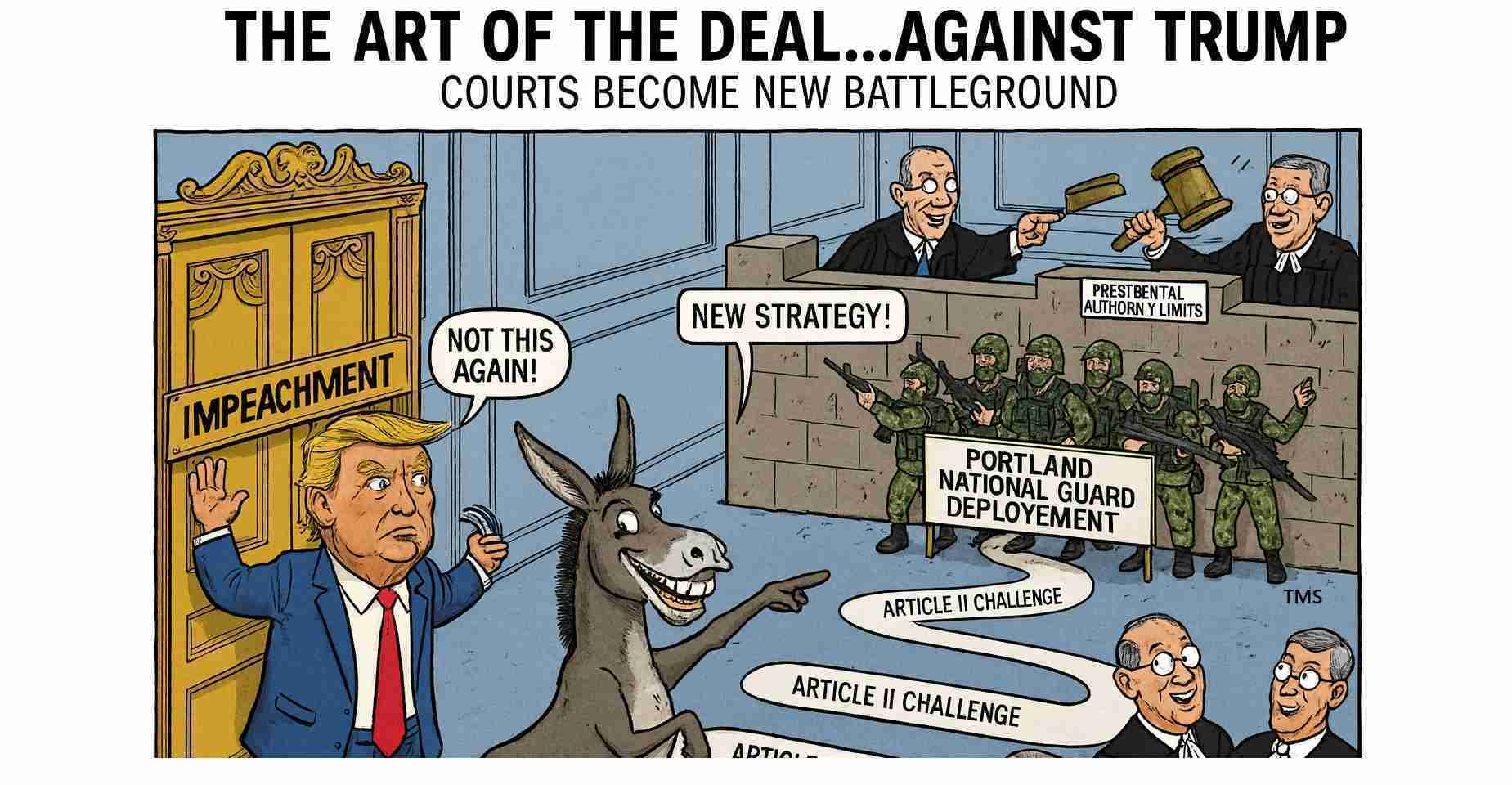
Democrats Shift From Impeachment to Courts, Using Article II Legal Challenges to Check Trump; Portland National Guard Deployment Becomes Latest Battleground
Democrats and activists are increasingly turning to federal courts, using Article II legal challenges to block President Trump’s executive actions — with the Portland National Guard deployment becoming a frontline case over separation-of-powers limits this year.
Key takeaways
- Legal strategy over impeachment: Democrats and advocacy groups are filing lawsuits arguing the President is exceeding Article II authority to stop or delay policies rather than pursuing impeachment.
- Portland as a test case: The Portland National Guard deployment raises questions about statutory limits and coordination with state officials and has become a key battleground.
- Broad litigation wave: More than 100 lawsuits and dozens of restraining orders challenge a range of administration actions, from DEI bans to immigration and agency rules.
- Separation-of-powers stakes: Courts are shaping whether the executive will have broader latitude or remain constrained by statutes and constitutional review.
How Article II legal challenges work
Article II of the U.S. Constitution vests executive power in the President. Lawyers now bring suits claiming the President or federal officials have exceeded that power or ignored laws enacted by Congress. These Article II legal challenges typically seek immediate judicial relief — temporary injunctions or restraining orders — that can halt executive actions while the case proceeds.
This avenue differs from impeachment: impeachment is political and slow, conducted in Congress; court fights are legal, often faster, and force judges to decide whether an action complies with the Constitution and federal statutes. For many Democrats and civil-rights groups, filing in court offers a direct, enforceable way to stop actions they view as unlawful without needing a congressional majority to impeach.
The Portland National Guard case: the latest battleground
A high-profile example is litigation over the Portland National Guard deployment, where plaintiffs argue federal leaders sent forces into the city without satisfying statutory and constitutional requirements. Plaintiffs point to laws that require coordination with state officials and protect local authority, and they argue the deployment expanded federal reach into local law enforcement.
“Courts are now referees in real time, weighing whether federal officials can act inside cities with minimal statutory or constitutional oversight.” — legal observers
Analysis from the Center for American Progress frames the Portland dispute within broader concerns about executive overreach and explains how courts might contain power grabs.
Some judges have issued temporary orders limiting federal actions while cases proceed; others have permitted broader executive steps, creating a patchwork of rulings that often requires higher courts to resolve.
Other legal fights testing Trump executive authority
Beyond Portland, a wave of lawsuits challenges a wide range of administration actions. Notable among them is litigation over an executive order curbing diversity, equity and inclusion (DEI) programs. A federal court temporarily blocked enforcement of a January 2025 order that would have restricted DEI initiatives across federal agencies and some contractors, finding parts of the order vague and potentially suppressive of protected speech and due process concerns (Callabor Law).
Legal trackers show more than 100 lawsuits targeting diverse executive actions — from immigration rules to agency operations — many brought by states, cities, unions and civil-rights organizations. The Just Security litigation tracker maintains a running tally and analysis of these cases.
What courts are saying about separation of powers
At the core of many suits is the separation of powers. Some recent high-court decisions have been interpreted as expanding executive authority by treating officials as close extensions of the President, which can limit Congress’s ability to check the executive and narrow judicial review. Critics warn that such rulings risk weakening checks and balances.
The Regulatory Review provides an in-depth look at how recent rulings have shifted legal doctrine, while scholars at Brookings warn that unchecked growth in executive power poses risks to constitutional democracy.
Judges have not spoken with one voice: some rulings favor plaintiffs and issue injunctions demanding stronger legal justification; others defer to the administration. The result is a legal landscape that will likely be clarified only by higher courts over time.
Why Democrats and activists favor Article II challenges now
There are both practical and political reasons for the shift away from impeachment and toward litigation:
- Speed and enforceability: Courts can act quickly and issue orders that apply across jurisdictions.
- Record-building: Lawsuits bring evidence into the public record and force officials to explain legal bases.
- Durable precedents: Court victories can bind the administration and future presidents, potentially protecting rights and local authority.
- Risk of adverse precedent: If courts expand executive power, lawsuits may fail and strengthen the administration’s legal footing — so plaintiffs often pick clear statutory or constitutional violations to litigate.
Sources and legal analysis
Key legal analysis and trackers cited in this coverage include: The Regulatory Review, the Center for American Progress, Brookings, Callabor Law, and the Just Security litigation tracker.
Implications for Fresno, California
Economic impact: Federal rulings on DEI, contracting rules, or grant conditions could alter who gets federal contracts and how workplaces run diversity programs, affecting Fresno universities, hospitals and businesses.
Political consequences: Successful lawsuits could empower state and local resistance to federal directives; rulings expanding presidential authority could limit tools available to Fresno officials in upcoming campaigns.
Social effects: Fresno’s diverse and immigrant communities may see changes in policing, immigration enforcement and civil-rights protections if federal deployments or expanded federal policing powers are authorized.
Cultural relevance: Local institutions — farms, schools, non-profits — that engage with federal civil-rights, labor and education programs may have to adjust hiring practices and outreach depending on litigation outcomes.
Practical advice: Residents should watch court rulings closely: an injunction could preserve local DEI programs, while rulings for the administration could change grant rules and workplace policies. Consult local officials for guidance as cases progress.



