
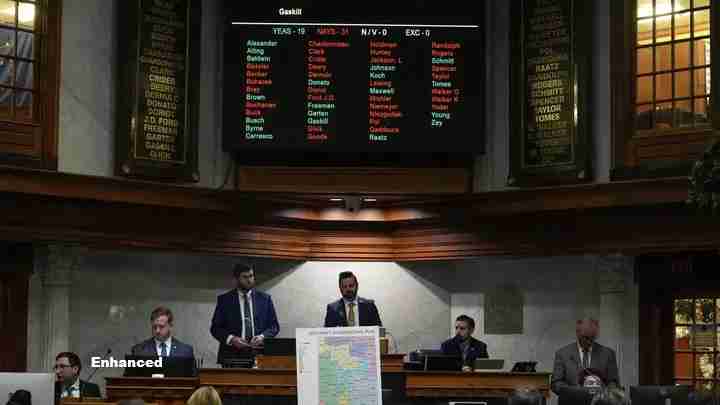
Indiana Senate Rejects Trump-Backed Map, Blocking Plan to Add Two GOP House Seats
Indiana’s Republican-dominated State Senate rejected a congressional redistricting map on December 11, 2025, voting 31–19 to defeat a Trump-backed plan designed to add two GOP House seats, with 21 Republicans joining all 10 Democrats against it.
- Vote result: The map was defeated 31–19 after 21 Republicans joined 10 Democrats in opposition; reporting by Indianapolis Star.
- Stakes: The proposal, publicly backed by former President Donald Trump, sought to create two additional safe Republican U.S. House seats (ABC News).
- Outcome: The Senate defeat effectively kills the measure for this session because it lacked the supermajority needed to advance (Indianapolis Star).
What happened in the Senate
State senators held a high-stakes vote on a proposed congressional map that proponents said would shift the balance of Indiana’s U.S. House delegation by creating two additional safe Republican seats. The chamber’s final tally was 31 against to 19 in favor, a result made notable because Republicans hold a strong majority in the Indiana Senate. In a dramatic turn, 21 Republican senators voted with every Democrat present to reject the plan (Indianapolis Star).
Supporters had framed the map as a tool to protect incumbents and expand GOP representation; they argued the redistricting would translate to two more Republican seats in Congress, a meaningful gain ahead of upcoming election cycles (ABC News).
Trump’s role and the political pressure
The redistricting effort carried the open backing of former President Donald Trump, who publicly urged lawmakers to pass the map and framed it as part of a broader effort to secure Republican power at the federal level. Media coverage characterized the vote as a test of Trump-backed redistricting influence on state-level GOP officials (Indianapolis Star; ABC News).
Observers noted the public push intensified attention and pressure on legislators; nonetheless, the sizable GOP defections suggested many state Republicans were unwilling to align with the package as presented or were influenced by local considerations that outweighed national endorsements.
Why the map failed: internal party divisions
The vote underscored significant Indiana GOP dissent. With 21 Republicans joining the opposition, the defeat signaled fractures within the party over redistricting strategy and priorities. Coverage framed the measure as more than a map: it became a marker of how much sway national figures hold over state legislators and how state-level concerns can run counter to national party objectives (Indianapolis Star).
Some legislators raised procedural or representational concerns, suggesting the map might create political liabilities or fail to reflect local interests. Others were wary of the optics of appearing to rubber-stamp a map widely perceived as drawn for partisan advantage.
Immediate aftermath and next steps
Because the plan failed to clear the Senate, it cannot advance during this legislative session without an alternative path. The bill lacked the supermajority or procedural backing necessary to resurrect it immediately, leaving Indiana’s current congressional map in place for the near term (Indianapolis Star).
Political operatives and party leaders must decide whether to rework the proposal to address defectors’ concerns, pursue behind-the-scenes negotiations, or explore litigation or new legislation in the next session. National actors who invested political capital will weigh how to respond after a public rebuke in a GOP-controlled chamber (ABC News).
Media coverage and public attention
Local outlets provided live coverage and analysis as events unfolded. Indianapolis Star reporters tracked the vote and documented the bipartisan alignment against the measure, noting the unusual scale of Republican opposition in a deeply GOP chamber (Indianapolis Star). ABC News placed the vote in the national context of Trump’s continuing influence and its limits at the state level.
The broader story ties into national debates about partisan gerrymandering and the role of state legislatures in shaping federal elections; the Indiana episode may be studied as an example of how local considerations, institutional rules, and individual legislators’ calculations can override high-profile endorsements.
Implications for Fresno, California
Although the map affects Indiana directly, there are indirect consequences for communities like Fresno:
- Economic impact: Changes to congressional composition can shift federal priorities — including funding formulas, agricultural policy, and disaster relief — that matter to Fresno’s large farming sector and infrastructure projects.
- Political consequences: The vote illustrates how intra-party dynamics can reshape national strategy; California leaders may note that state lawmakers sometimes resist national party pressure.
- Social and cultural effects: The episode highlights the importance of state politics in national outcomes and may resonate with Fresno’s preference for pragmatic, community-focused governance.
- Practical applications: Local advocacy groups and officials can use the episode to argue for stronger transparency and public participation in redistricting.
Ongoing developments to watch
Watch for whether Indiana lawmakers revisit redistricting options in future sessions, revise proposals to address GOP defections, or pursue legal or procedural avenues. National operatives will decide how aggressively to press state allies after this setback. Observers should monitor any renewed efforts, legal challenges, or procedural changes that could affect when and how congressional maps are redrawn (Indianapolis Star; ABC News).
Sources
- Indianapolis Star — coverage and vote tally.
- ABC News — context on national political pressure and stakes.


