
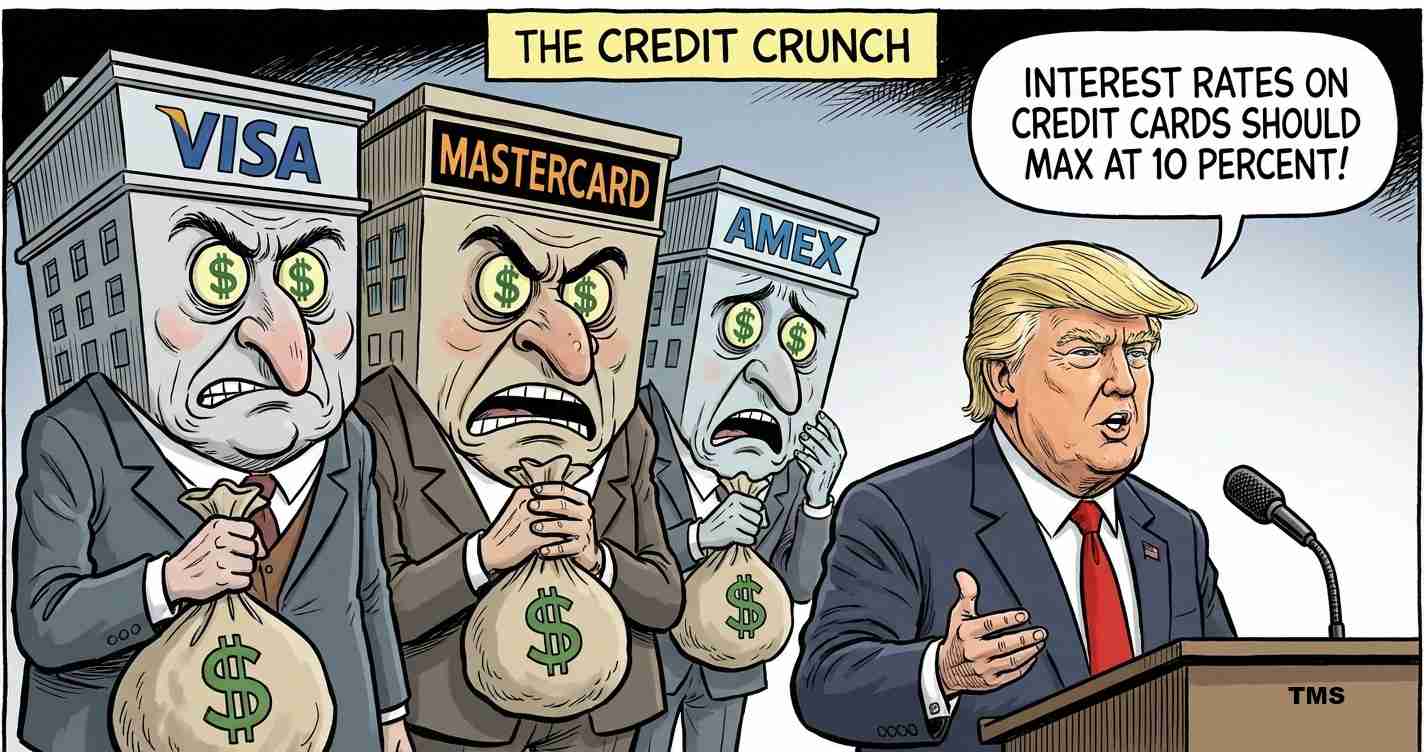
Trump calls for one-year, 10% credit card interest cap as he blames Biden for high rates
Donald Trump proposed a one-year, 10% cap on credit card interest rates beginning January 20, 2026, framing it as an “affordability” initiative to lower average APRs he says are ripping off Americans, a move raising legal and economic questions.
- Proposal: Trump announced a one-year, 10% cap on credit card interest rates to take effect Jan. 20, 2026, described as part of an “AFFORDABILITY” push (Fox Business, Business Insider, CBS News).
- Impact: The cap would sharply cut rates from current averages above 20% and some subprime rates near or above 30%.
- Feasibility: Legal and practical hurdles mean a president could not unilaterally impose a nationwide cap without Congressional action or contested regulatory moves.
What Trump announced and why it matters
What he said: In a Truth Social post, Trump charged Americans were being “ripped off” by card companies charging “20 to 30%, and even more,” and stated: “Effective January 20, 2026, I, as President of the United States, am calling for a one year cap on Credit Card Interest Rates of 10%.” The date aligns with the one-year mark following a potential second inauguration and serves as a symbolic return to the White House. Reporting cited his post and reactions from other politicians (Fox Business, Business Insider).
Context: credit card rates in 2026
Credit card APRs have increased as overall borrowing costs rose. Federal Reserve–based reporting shows average APRs above 20%, with penalty and subprime rates reaching or exceeding 30% for riskier borrowers. A flat 10% cap would represent a dramatic reduction for many accounts and force major shifts in lenders’ risk models (CBS News, Fox Business).
Legal and practical feasibility
Legal experts note a president cannot simply enact a nationwide interest-rate cap without Congressional legislation or a clearly defined regulatory strategy. Alternatives—such as emergency regulatory actions or executive pressure on issuers—would likely face swift court challenges and political opposition. Similar 10% cap bills have been introduced in Congress in the past but did not become law; details remain unclear on whether this announcement signals a legislative push, reliance on regulators, or public-pressure tactics (Business Insider, CBS News).
Who supports the idea
Some lawmakers and consumer advocates back a 10% cap. Past bill sponsors have included unusual bipartisan pairings—Sen. Josh Hawley (R‑Mo.) and Sen. Bernie Sanders (I‑Vt.)—and House supporters have ranged from Rep. Alexandria Ocasio‑Cortez (D‑N.Y.) to Rep. Anna Paulina Luna (R‑Fla.). Supporters argue the cap would reduce interest burdens for households carrying revolving balances and point to bank profits and executive pay as evidence issuers could absorb lower rates (CBS News).
Industry opposition and warnings
Banks and card-issuer trade groups warn that a uniform 10% cap could shrink credit access. The American Bankers Association and the Bank Policy Institute say issuers might respond by pulling credit lines or denying new cards to higher‑risk borrowers, potentially cutting off credit for millions who rarely pay in full. Trade groups caution reduced access could push some consumers toward higher‑cost, less‑regulated alternatives like payday loans; credit unions likewise warn many cards for subprime borrowers would not be profitable at a 10% rate (CBS News).
Political framing and recent debate
Trump framed the cap as part of an affordability campaign and a rebuke to big banks. Opponents recall prior deregulatory moves by his administration—such as reduced funding for the Consumer Financial Protection Bureau—that critics say contributed to rising APRs. The announcement has become another flashpoint between populist messaging against Wall Street and industry warnings about market disruption (Business Insider).
Trump’s broader financial moves
This credit card cap is one element in a broader set of proposals: urging the Treasury to buy mortgage-backed securities to lower mortgage costs, restricting some institutional investors from buying single-family homes, and publicly pressing the Federal Reserve to cut benchmark rates. Trump has also said he would nominate a Fed chair sympathetic to lower rates—suggesting a broader strategy to attack big business and promote affordability ahead of the 2026 policy calendar (Business Insider).
Open questions reporters are asking
- Mechanism: Will the White House pursue legislation, regulatory authority, or voluntary issuer cuts? (Business Insider).
- Scope: Would the cap cover consumer cards, small-business cards, store cards, and variable-rate accounts? (CBS News).
- Risk-based pricing: How would lenders serve subprime borrowers under a flat 10% cap? (Fox Business).
- Duration and exit strategy: What happens after one year—would rates rebound or would extensions be sought? (Business Insider).
Reporting and responses so far
Journalists contacted the White House and major card issuers for specifics. As of initial reports, outlets had not received a concrete implementation plan or definitive industry acceptance of voluntary cuts. Coverage emphasizes that the announcement currently functions as a political and policy signal rather than a binding rule (Fox Business, Business Insider, CBS News).
Implications for Fresno, California
Economic impact
Many Fresno families carry credit card debt. If a true 10% cap were enacted and applied, affected Fresno households could see interest payments fall, freeing funds for bills, groceries, or savings. Yet local banks and credit unions warn a hard cap might tighten lending—reducing limits or denying cards for those with imperfect credit histories and limiting emergency spending or small-business cash flow (CBS News).
Political consequences
The proposal could appeal to moderate Fresno voters worried about household costs and may be cast as bipartisan consumer protection. Local leaders will be pressured to take positions: officials tied to business interests may highlight credit-availability risks, while consumer advocates will press for borrower protections.
Social effects and cultural relevance
Lower interest costs could reduce financial stress for some households, lowering overdue bills and deepening savings. Community financial counselors might see increased demand for refinancing or dispute assistance if rates fall. Conversely, if access tightens, low- and moderate-income residents could face harder choices between expensive alternatives and cutting essentials. In Fresno—where homeownership and small-business credit matter—debate over access and bank profits is likely to resonate.
Practical applications for residents
- Watch for changes in card offers, limits, and fees if the proposal advances.
- Consumers who carry balances should review statements, evaluate fixed-rate products or balance-transfer options, and consult credit unions or community lenders.
- Local nonprofit financial counselors can be key sources of guidance; monitor updates from federal regulators and trusted local institutions.
Sources and reporting
This article draws on reporting from Fox Business, Business Insider and CBS News, which compiled the announcement and broader debate over a 10% interest-rate limit. All original facts, information, and URLs are preserved above.
Quote: “Effective January 20, 2026, I, as President of the United States, am calling for a one year cap on Credit Card Interest Rates of 10%.” — Donald Trump, Truth Social post (reported by news outlets)



