
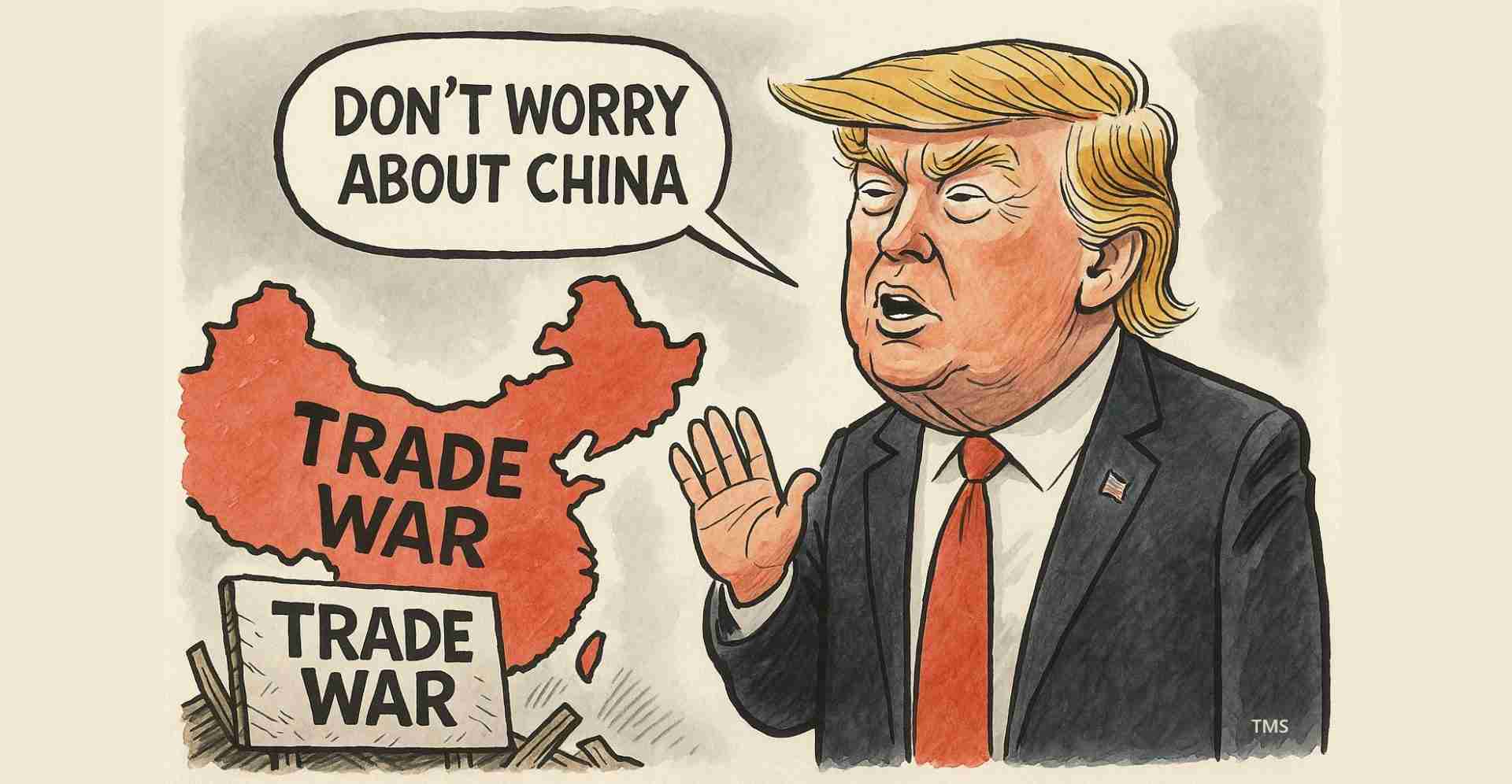
Trump Tells Americans “Don’t Worry About China” After Beijing’s Defiant Reaction to 100% Tariff Threat
WASHINGTON (Times Media Service) — President Trump urged Americans “don’t worry about China” after Beijing announced new controls on rare earth exports and he threatened 100% tariffs — a move that has spooked markets and raised questions about supply chains and policy escalation.
- Rare earths are pivotal: China’s export controls amplified leverage over high-tech and defense supply chains.
- Tariff threat escalates risk: Trump’s 100% tariff warning and possible software limits rattled markets and prompted Beijing’s warning.
- U.S. officials signal broader tools: Voices like Vice President J.D. Vance framed the issue as a national emergency and hinted at export controls and other measures.
- Local impact possible: Fresno-area agriculture and manufacturers could face higher costs; long-term investment in domestic processing is a potential upside.
Trigger: China’s new export controls
Beijing announced rules restricting exports of foreign-made products that contain Chinese-processed rare earths, citing national security and industrial priorities. The move came just as Washington signaled possible tougher trade measures — an overlap that heightened bilateral tensions. For reporting on the policy and market reaction, see Le Monde.
Why rare earth minerals matter
Rare earths — a group of 17 elements — are essential for magnets, batteries, sensors and many defense and high-tech products. China controls roughly 70% of mining and nearly 90% of processing, giving Beijing significant influence over global supply chains and manufacturing costs.
What Beijing announced
Official Chinese guidance restricts exports of foreign-made goods that incorporate Chinese-processed rare earths. Beijing described the steps as routine export controls to protect key industries, but the timing — amid rising U.S. tariff rhetoric — made the measure politically sensitive.
Trump’s response and tone
President Trump threatened to raise tariffs on many Chinese goods to 100% and floated limits on China’s use of certain advanced U.S. software tools, which could affect semiconductor design and other high-tech sectors. On social media he sought to reassure the public, writing that the U.S. “wants to help China, not hurt it,” and calling Chinese President Xi Jinping as having “had a bad moment.” For Fox Business coverage, see Fox Business.
China’s reply
China said it “does not want a tariff war” but is “not afraid of one,” warning it would take corresponding measures if the U.S. moved forward.
The Commerce Ministry emphasized dialogue while criticizing repeated tariff threats as a poor basis for managing bilateral relations. Beijing’s public stance combined warning language with an opening for talks.
Market impact and investor fears
Markets reacted negatively: tech stocks fell hardest amid worries about disrupted supply chains and higher component costs. Analysts compared the episode to earlier trade disputes that raised manufacturing costs and squeezed corporate profits. Investors fear a 100% tariff would push consumer prices higher and accelerate companies’ search for alternative suppliers.
U.S. political response and tools beyond tariffs
U.S. officials — including Vice President J.D. Vance — framed China’s market position as a “national emergency”. That language signals willingness to use a broader toolkit: export controls, software restrictions, investment screening and other non-tariff measures alongside tariffs. See Fox Business for reporting on the administration’s comments.
Diplomatic fallout and the APEC summit
These developments cast doubt over a planned Trump–Xi meeting at the upcoming APEC summit. Both sides publicly left room for dialogue but also prepared for retaliatory steps, increasing diplomatic uncertainty and investor anxiety. High-level talks often help defuse tensions; ambiguity raises the stakes.
What this means for supply chains and U.S. industry
If tariffs rise sharply and Chinese controls tighten, U.S. firms may accelerate redesigns, seek alternative suppliers, or invest in domestic processing. That transition will be costly and slow: short-term impacts include higher costs and production delays for electronics, EVs and defense contractors, while long-term outcomes could include increased domestic investment and reshored capabilities.
Implications for Fresno, California
Economic impact
Agriculture and food processing: Fresno farms rely on equipment with motors, sensors and electronics. Higher part prices and longer lead times could push up operating costs and, eventually, food prices.
Manufacturing and contractors: Local manufacturers tied to tech or clean-energy supply chains may face higher input costs; a 100% tariff on Chinese goods could raise prices for machines and tools.
Jobs and investment: Short-term hiring may slow if companies delay projects; conversely, federal efforts to boost domestic rare earth mining and processing could bring long-term jobs to California and the West.
Political consequences
Fresno-area leaders may pressure federal officials for relief or support. Local politics could see debates over trade policy impacts, with messaging that emphasizes supply-chain resilience likely to resonate with pragmatic voters.
Social and cultural effects
Rising consumer prices could strain household budgets in a region already facing affordability challenges. Community colleges and workforce programs may see increased demand for retraining if domestic processing and advanced manufacturing expand. Local environmental and water concerns will shape responses to any proposed mining or processing projects.
Practical applications for residents
- For farmers and small businesses: Start inventory reviews, identify critical parts, and explore alternative suppliers or cooperative purchasing to limit price shocks.
- For workers: Watch for training programs in manufacturing, processing and clean-energy technologies as potential pathways to new jobs.
- For local officials: Coordinate with state and federal representatives to seek guidance, relief options and investment that could mitigate short-term impacts and capture long-term opportunities.
Sources and further reading
- Fox Business — reporting on Trump’s comments and Beijing’s response
- Le Monde — overview of rare earth tensions and market reactions
This article preserves original facts and source URLs cited in reporting from Fox Business and Le Monde.



