
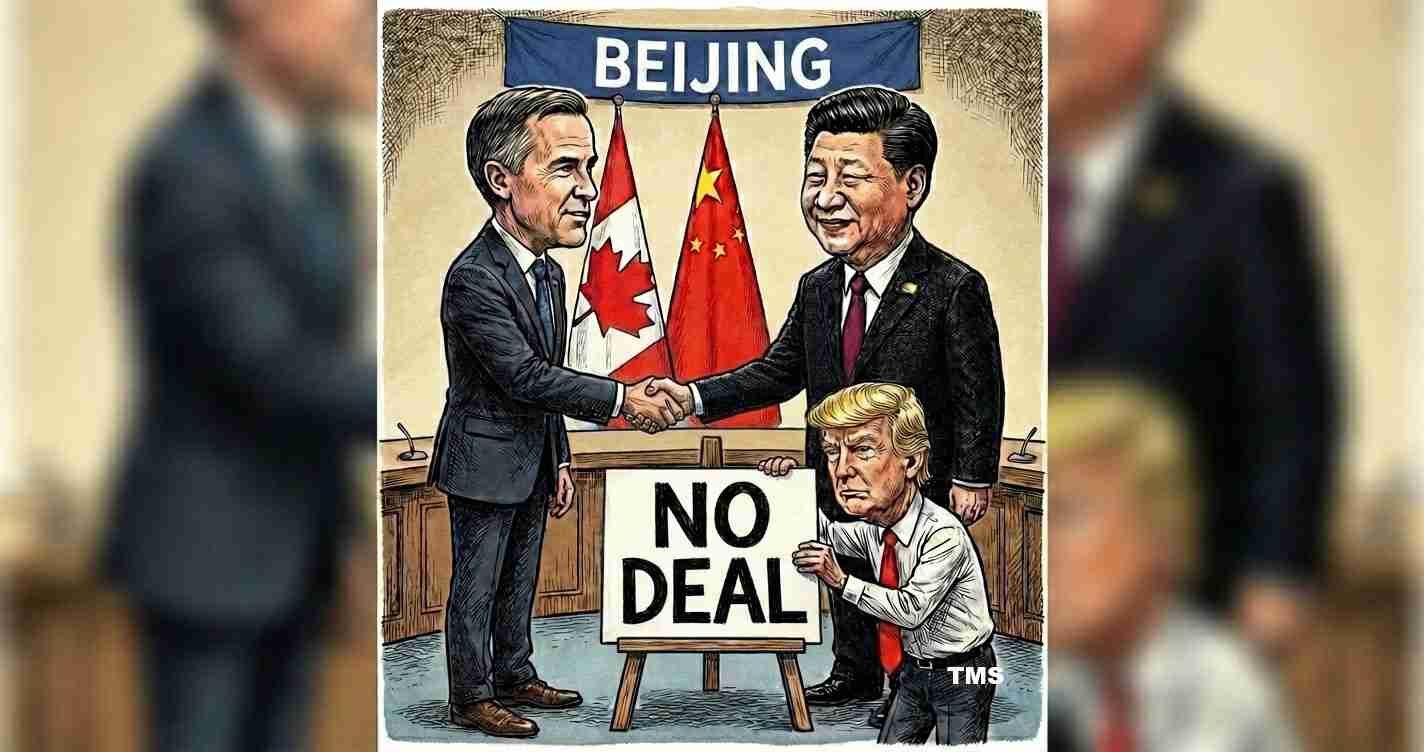
Trump Threatens 100% Tariffs on Canada if Ottawa Seals Deal With China, Calling PM “Governor” Carney
President Donald Trump threatened a 100% tariff on all Canadian goods if Canada completes a deal with China, calling Prime Minister Mark Carney “Governor Carney” and warning the pact would turn Canada into a conduit for Chinese imports.
- 100% tariff threat: Trump said he would impose sweeping tariffs if Canada allows Chinese goods access to U.S. markets via Canadian ports.
- Canada denies a free trade deal: Ottawa says it is not pursuing a broad free trade agreement with China and pushed back on the warning.
- Economic risks: Experts warn such tariffs would disrupt integrated U.S.-Canada supply chains and raise prices for U.S. consumers and producers.
- Local impact: Fresno-area agriculture and supply chains could face higher input costs and logistics disruptions if tariffs are enacted.
Key developments
- President Trump posted on Truth Social that he would impose a 100% tariff on all Canadian goods if Canada strikes a deal with China permitting Chinese products access to U.S. markets via Canadian ports. (ABC News)
- Trump referred to Prime Minister Mark Carney as “Governor Carney,” echoing prior remarks about Canada’s U.S. relationship. (NBC Montana)
- Ottawa says it is not pursuing a free trade agreement with China and publicly pushed back on the tariff threat. (ABC News)
- The warnings follow a narrow pact easing 100% Canadian tariffs on some Chinese electric vehicles in exchange for lower Chinese tariffs on select Canadian agricultural products. (ABC News)
- Video and audio of the exchanges were posted online — see the YouTube clip and a second YouTube clip.
What Trump said and where he posted it
In a Truth Social post shared Saturday, Trump wrote that if “Governor Carney thinks he is going to make Canada a ‘Drop Off Port’ for China to send goods and products into the United States, he is sorely mistaken.” He added that “China will eat Canada alive, completely devour it, including the destruction of their businesses, social fabric, and general way of life,” and warned: “If Canada makes a deal with China, it will immediately be hit with a 100% Tariff against all Canadian goods and products coming into the U.S.A.” (ABC News; video post, video post).
Administration specifics: The White House provided no legal steps or timeline for implementing such sweeping tariffs, framing the warning as protection for U.S. manufacturing and national security from perceived unfair Chinese practices. (NBC Montana)
Context: the Canada-China trade move at issue
The president’s threat centers on an agreement announced last Friday under which Canada agreed to sharply reduce its 100% tariffs on some Chinese electric vehicles (EVs) in return for China lowering tariffs on certain Canadian agricultural exports. The deal was described as narrow and sector-specific — focused on EVs and farm goods, not a broad free trade agreement. (ABC News; video).
Ottawa’s rationale: Canadian officials say the deal aims to diversify export markets and expand opportunities for farmers and manufacturers while maintaining a strong partnership with the United States. Dominic LeBlanc, Canada’s minister for Canada-U.S. trade, told reporters there is “no pursuit of a free trade agreement with China” and emphasized Canada’s “remarkable partnership” with the U.S. (ABC News).
Canadian response and diplomatic friction
Canadian officials responded quickly and firmly to the tariff threat. LeBlanc and other ministers stressed Ottawa is not negotiating a broader agreement that would hand China unfettered access to U.S. markets via Canada, and they reaffirmed close bilateral ties. (ABC News)
The dispute revives long-standing tensions over trade balance, supply chains and sovereignty. Canada is the United States’ second-largest trading partner, and roughly 75% of Canadian exports go to the U.S., a fact Ottawa cites when underscoring the bilateral relationship’s importance. (video reporting).
Legal and economic questions about a 100% tariff
Feasibility and consequences: Imposing a blanket 100% tariff on all Canadian goods would be extreme and disruptive. Such a move would require legal and administrative actions and could face challenges at the World Trade Organization and in U.S. courts. Experts note tariffs of this magnitude would sharply raise prices for U.S. consumers and businesses that rely on Canadian inputs. The administration did not outline a legal plan or timeline. (ABC News)
Trump’s pattern of rhetoric toward Canada
The tariff threat continues a string of barbed remarks and policy actions aimed at Canada. Trump has repeatedly used the incorrect title “Governor” for Canada’s prime minister — a practice applied both to Mark Carney and former PM Justin Trudeau. He has also previously suggested Canada could be part of the U.S., posting an altered map showing Canada attached to the United States. (ABC News; NBC Montana).
At the World Economic Forum in Davos, Trump said “Canada lives because of the United States,” while Carney warned that global trade tensions risk a “rupture” in world order. Carney received a standing ovation at Davos. (video source).
Potential fallout for U.S.-Canada trade and global markets
A U.S. move to impose sweeping tariffs on Canadian goods would likely cause major disruption. Canada is deeply integrated into U.S. supply chains across automotive, agriculture, energy and manufacturing. Tariffs that raise costs for Canadian inputs could drive up costs for U.S. producers and consumers and invite retaliatory measures from Ottawa, further straining global markets already navigating post-pandemic shifts and geopolitical tensions. (ABC News).
Implications for Fresno, California
Economic impact
Fresno and the San Joaquin Valley rely heavily on agricultural exports and supply chains that include inputs from Canada. A sudden 100% tariff on Canadian goods could raise prices for farm equipment parts, fertilizers and other inputs, increasing production costs for local farmers and food processors. Logistics disruptions could slow shipments and raise freight costs, affecting perishables shipped nationally and internationally. (Trade context; reporting: ABC News).
Political consequences
Fresno is politically mixed and pragmatic; voters and leaders typically favor policies protecting jobs and keeping prices stable. A high-tariff policy may be viewed skeptically if it harms regional agriculture or raises consumer prices. Local officials may face pressure to seek federal relief or carve-outs if tariffs affect the region’s economy.
Social and business effects
Increased costs for farm inputs and consumer goods would be felt across Fresno County. Small businesses reliant on cross-border logistics could see tighter margins. Labor markets tied to processing, packing and distribution may experience stress if trade flows slow or costs rise. Retaliatory Canadian measures targeting U.S. agricultural goods could directly hit Fresno producers.
Cultural relevance and practical applications
Fresno’s agricultural identity means trade policy affects daily life — from fertilizer and fuel prices to the cost of fruits and vegetables at local markets. Local chambers of commerce, the county agriculture commissioner and farm bureaus will likely monitor developments closely and push for federal guidance if tariffs are imposed. Businesses should review contingency plans and consider supplier diversification where feasible.
Sources and reporting notes
This article draws on reporting and direct posts from multiple outlets and platforms, including ABC News, NBC Montana, and posted videos and clips (see YouTube clip and YouTube clip).
Reporting on the Canada-China tariff adjustments around electric vehicles and agricultural tariffs was included in coverage by ABC News. Officials quoted include President Trump’s Truth Social post and statements from Canada’s Dominic LeBlanc and Prime Minister Mark Carney as reported by the above outlets.
Investigative questions to watch
- Will the U.S. administration move from rhetoric to formal tariff actions, and if so, what legal mechanism will it use?
- How will Canada respond beyond public statements — through the World Trade Organization, reciprocal tariffs, or negotiations?
- What contingency plans are being developed by U.S. industries and local governments, including Fresno-area agricultural and logistics firms, to limit disruption?
The situation is evolving. Journalists and local officials in Fresno should monitor official Federal Register notices, statements from the U.S. Trade Representative, and follow-up posts from the White House and Canadian ministries for any concrete regulatory moves or trade measures. Primary reporting sources include ABC News, NBC Montana, and video archives (YouTube clip, YouTube clip).



