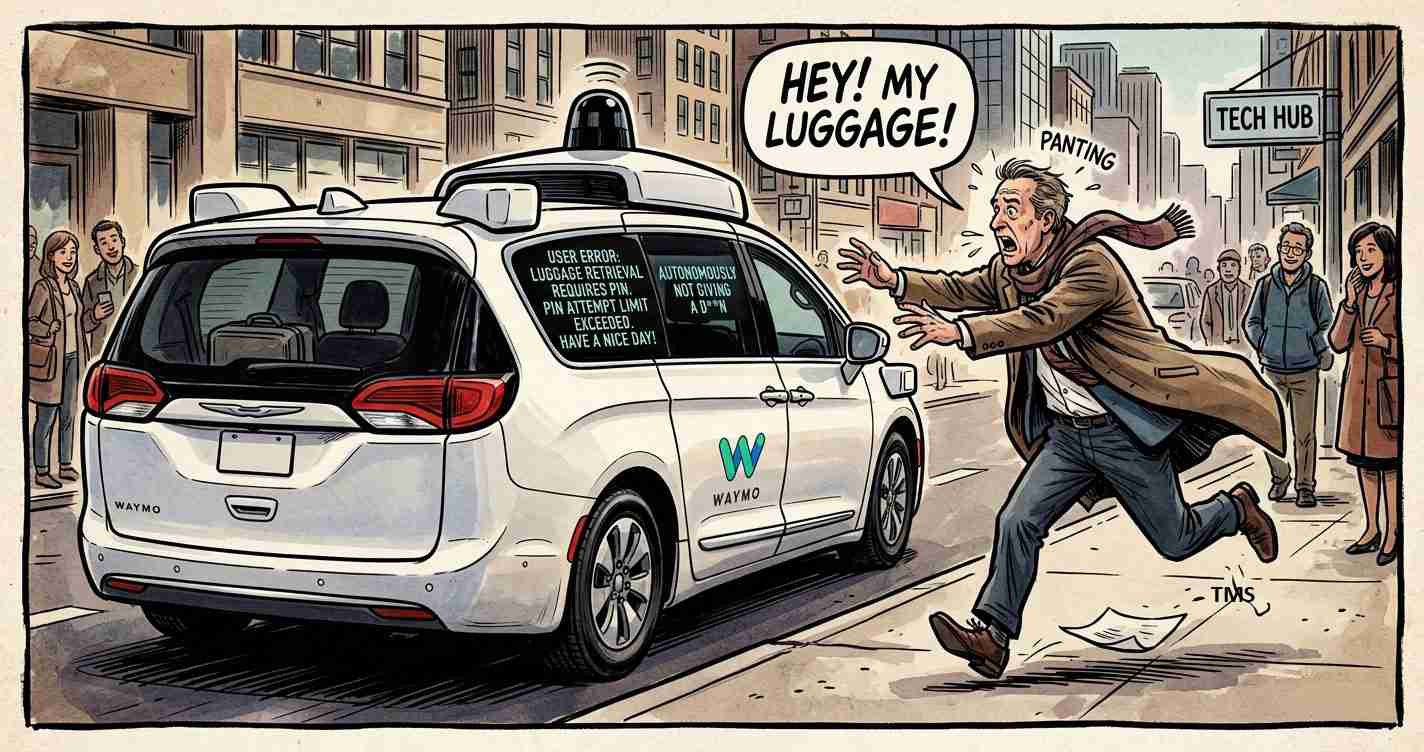
Waymo robotaxi drives off from SJC with passenger’s suitcase, raising questions about trunk access and company policies
A passenger’s first Waymo robotaxi ride to San José Mineta Airport ended with his suitcase inside after the trunk failed to open, leaving him stranded and spotlighting gaps in Waymo’s trunk access and lost-item policies.
- Trunk failure: Rider Di Jin reported the trunk would not open and the vehicle departed with his luggage (Source: Fox News).
- Company response: Waymo said the luggage was secured at a depot and initially asked the rider to cover shipping before agreeing to pay after pushback (reported by CyberGuy).
- Policy limits: Waymo’s support pages explain trunk-opening methods and warn it cannot guarantee recovery, delivery time, condition, or reimbursement (Waymo support).
- Broader concern: The incident highlights accountability and operational gaps when driverless vehicles serve busy, time-sensitive hubs like airports.
What happened at SJC
According to published accounts, Di Jin — on his first Waymo trip from Sunnyvale to San José Mineta International Airport — exited the vehicle and was unable to open the trunk. He pressed the trunk release, attempted the app controls, but the cargo area remained closed. With no human driver to stop or recall the vehicle, Jin watched the Waymo depart and immediately contacted customer support. Support told him the vehicle was already en route to a depot and could not be redirected. Waymo later confirmed the suitcase was located and stored at a company depot; the company initially asked Jin to cover shipping before agreeing to pay after he pushed back (Source: Fox News; CyberGuy reporting).
Waymo trunk access and lost-item policy
Waymo’s public support pages list three ways riders can open the trunk:
- Press a trunk release button located above the license plate.
- Tap “Open trunk” in the app.
- Rely on the trunk to open automatically when the trip officially ends and the vehicle stops at the destination.
Waymo also warns that the trunk may not open if a rider exits before the trip is officially complete. Its lost-and-found guidance states support will try to reunite riders with items but does not guarantee recovery, delivery timing, condition, or reimbursement for item value. Those explicit limits frame the public scrutiny in Jin’s case (Waymo support).
Why this matters: humanless interactions at airports
Airports are high-traffic, time-sensitive spaces where travelers juggle luggage and schedules. In traditional rides with a human driver, passengers can flag down the car or ask the driver to stop. With robotaxis, there is no on-scene human fallback — riders rely on an app and remote support. If a vehicle departs, there is often no immediate way to intercept it.
“Seeing a vehicle drive off with your belongings and having no driver to call back feels unnerving to many travelers.”
Other reports show airports can be complicated for autonomous systems: a separate Phoenix incident involved a Waymo looping in a parking lot before reaching the terminal, illustrating routing challenges in complex airport lots (Related coverage).
Public reaction and regulatory questions
Stories like Jin’s attract attention because they mix inconvenience with vulnerability. Media accounts focus on the human experience: missed meetings, lost work materials, and the unsettling feeling of no human driver to address problems immediately. Regulators and the public may press for:
- Mechanical redundancies or mandatory on-site staff at busy hubs.
- Clearer passenger recourse and faster depot-recall requirements for airport deployments.
- Transparent compensation policies when technical failures cause loss or delay of personal property.
Sources and what is not yet verified
The detailed account of Jin’s experience is primarily drawn from reporting in Fox News and coverage cited by technology outlets; CyberGuy reported on Waymo’s responses and noted Waymo declined comment on the specific case. Waymo’s support pages describe trunk access and lost-item procedures (Waymo support). Major national outlets had not published follow-ups on this specific incident as of reporting.
Implications for Fresno, California
Economic impact
Business travelers from Fresno who use Fresno Yosemite International Airport (FAT) or connect through SJC may be hesitant to trust robotaxis for tight schedules or trips carrying presentation materials. Slower consumer adoption could affect local taxi, rideshare and shuttle markets if public wariness persists.
Political consequences
Local officials could call for stricter rules on autonomous operations at airports serving Fresno residents — including fail-safes, depot contact protocols, or mandatory human support at busy hubs — balancing innovation with consumer protections.
Social effects
Public trust may erode if widely shared incidents show perceived unreliability in critical moments. Equity concerns arise if expansion slows and lower-income riders lose access to new mobility options.
Cultural relevance
In Fresno, where practicality and reliability are highly valued, a service seen as unreliable at key moments (like just before a flight) may face stronger resistance. Local leaders and media may emphasize tangible impacts — missed meetings, added hassle — when covering such incidents.
Practical applications for Fresno travelers
- Verify trunk procedures: Double-check trunk controls in the app and wait for trip-end confirmation before exiting.
- Keep essentials with you: Place passport, laptop, chargers and change of clothes in carry-on or on your person.
- Document incidents: Take photos (vehicle, license plate area), timestamped app screenshots, and insist on written confirmation from customer support about recovery steps and timelines.
What officials and companies could do
- Airport-company coordination: Establish clear pick-up/drop-off rules and depot contact protocols so vehicles that leave with luggage can be intercepted faster.
- Regulatory requirements: Require faster depot recall options at major hubs and clearer passenger compensation rules for lost or delayed items.
- Product improvements: Add in-app trunk checks, visual indicators showing trunk locked/unlocked status, and real-time live-video support during airport drop-offs.
Reporting notes and sources
This account draws on reporting from Fox News and technology coverage that referenced Waymo’s policies and the passenger’s account. Waymo’s public support pages describe trunk access and lost-item procedures (Waymo support). Additional related coverage includes reporting of other airport incidents (Related coverage).
Sources: Fox News, Waymo support pages, and related technology reporting (CyberGuy). Waymo declined to comment on the specific incident when contacted by a tech reporter.