SAN BERNARDINO, Calif., June 24 (Inland Empire News Online) — A University of Hawaiʻi at Mānoa-led study published in a peer-reviewed journal says tectonic stress along the San Andreas and San Jacinto fault systems in Southern California has reached, and in some places exceeded, the highest levels seen in the past 1,000 years.
The research, published in Journal of Geophysical Research: Solid Earth, was led by Earth scientists at the University of Hawaiʻi at Mānoa and identifies what the authors describe as a critically loaded fault system in one of the state’s most densely populated regions.
Lead author Liliane Burkhard, identified by the university as a research affiliate in the Hawaiʻi Institute of Geophysics and Planetology at the UH Mānoa School of Ocean and Earth Science and Technology and a scientist at the University of Bern in Switzerland, said the findings show stress levels on multiple fault segments are now at or above the highest values seen in the past millennium.
“Right now, with stress at historically high levels across the region and more than 160 years elapsed since the last major rupture, the system is in a critically loaded state,” Burkhard said in the university release.
The study’s findings have direct relevance for seismic hazard assessments in Southern California, including the Inland Empire corridor, where the San Andreas and San Jacinto fault systems run near major population centers and critical infrastructure.
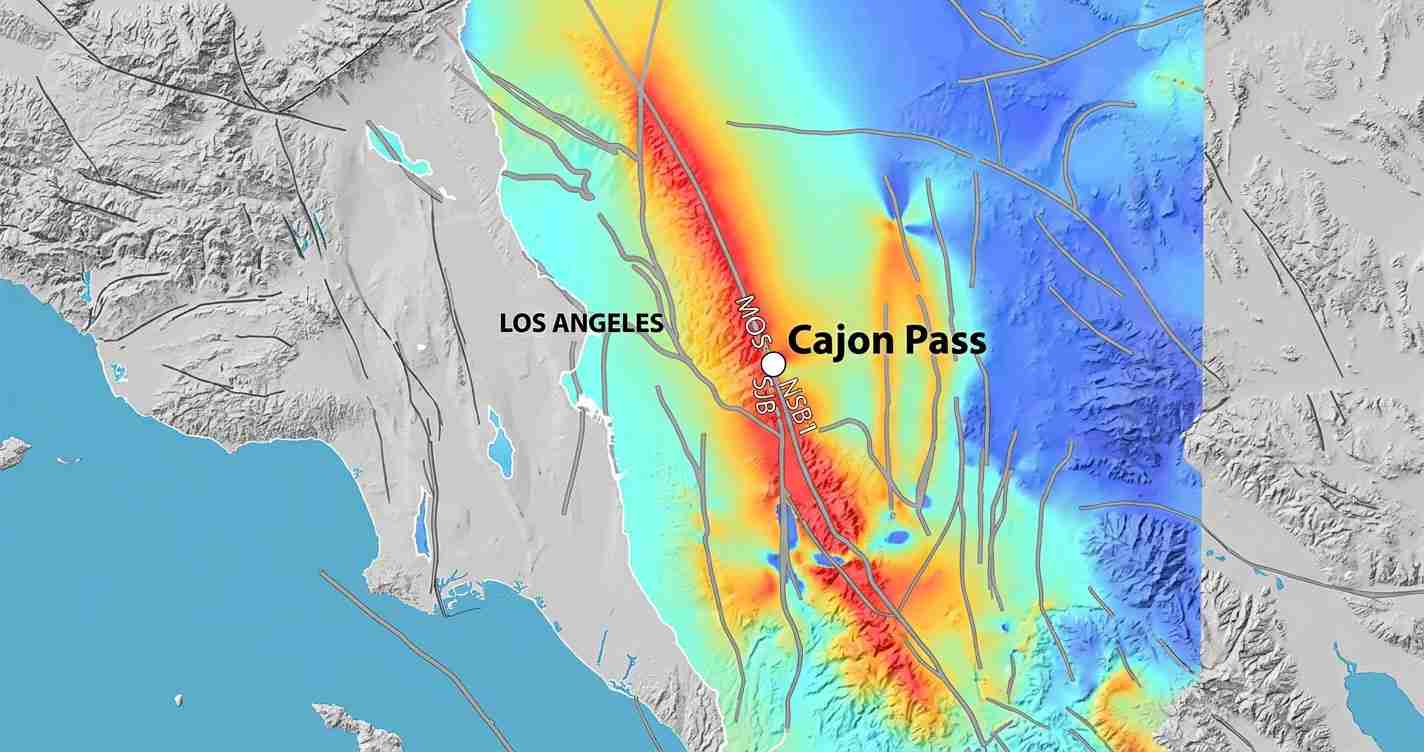
According to the study, modeled stress reached 3.6 MPa on the San Jacinto-Bernardino section, exceeding the highest value seen anywhere in the 1,000-year simulation, and 2.8 MPa on the neighboring Mojave South section of the San Andreas Fault.
The researchers said the San Jacinto-Bernardino section and the Mojave South section appear to be part of a broader system in which stress has been building over time rather than easing.
The university release said the work suggests Cajon Pass could help trigger a joint rupture of both the San Andreas and San Jacinto faults at the same time. The authors said such a rupture could be significantly more damaging than a single-fault event.
A simultaneous rupture could affect densely populated areas including Los Angeles, San Bernardino, Riverside and the Coachella Valley, according to the university’s summary of the study.
The release did not say the study predicts when a major quake might happen. Instead, it presents a reconstruction of stress conditions over roughly the past 1,000 years and compares those results with the current state of the fault system.
The researchers said the findings matter because the fault system sits in a region where millions of people live and where roads, utilities and other infrastructure cross or sit close to active fault traces.
The university release said the study’s message is that the region is now in a state that warrants close attention from seismic hazard planners and scientists monitoring California earthquake risk.
Burkhard and her co-authors said the work adds to evidence that the San Andreas and San Jacinto systems may not behave as isolated structures in Southern California, but instead can interact in ways that influence the size and shape of future earthquakes.
The study was published in Journal of Geophysical Research: Solid Earth, indicating the findings have passed peer review.
The university release and the study summary did not provide a timetable for the next major earthquake, confidence intervals for the stress reconstruction or the full set of modeling assumptions used in the analysis.