
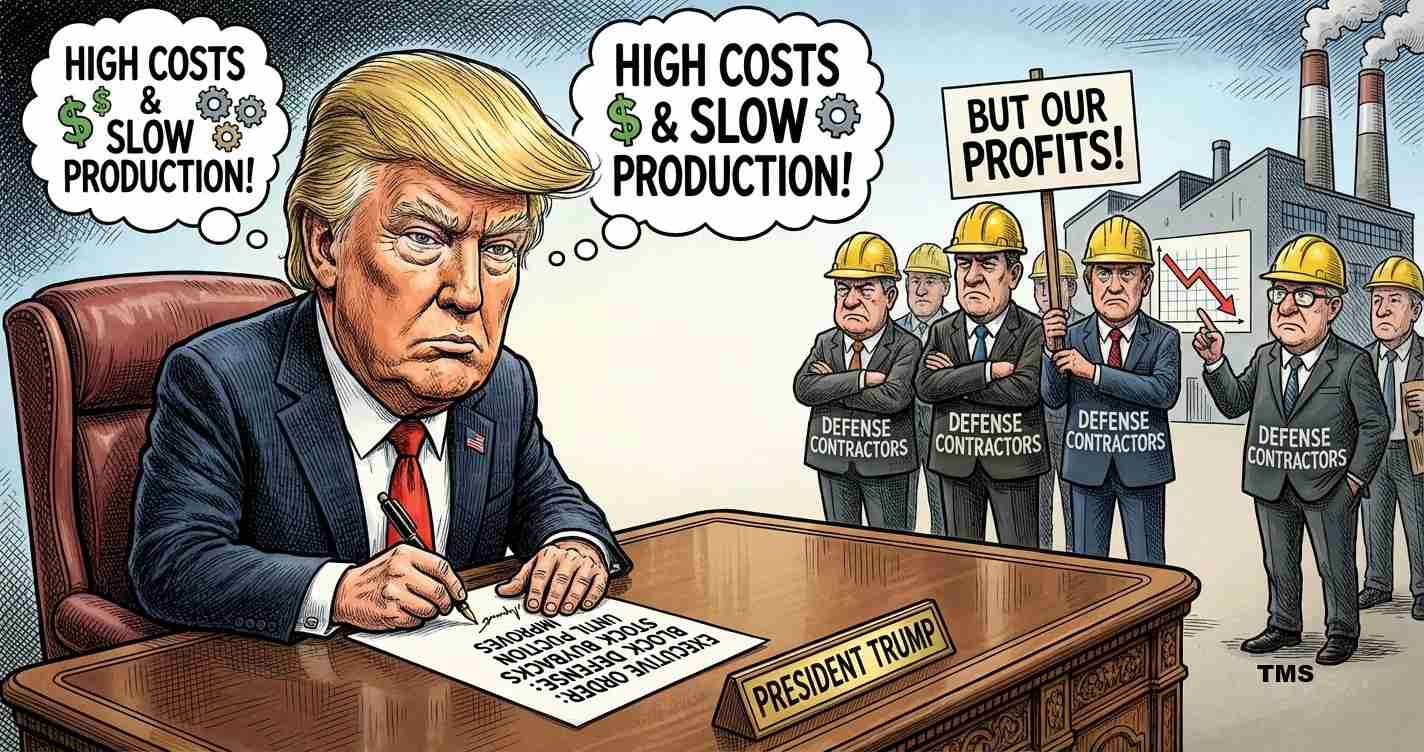
Trump signs order blocking buybacks and dividends at underperforming defense contractors to force faster production
President Donald Trump issued an executive order blocking dividends and stock buybacks at underperforming U.S. defense contractors, redirecting funds to weapons production and tying future contracts and executive pay to performance metrics affecting firms like Lockheed Martin and Raytheon.
Key takeaways
- The order bars dividends and buybacks at defense contractors deemed “underperforming” until production and delivery improve—per the White House fact sheet.
- Timelines are strict: the Defense Department must ID underperformers within 30 days and add contract clauses within 60 days that can block payouts during underperformance (Breaking Defense; Fox Business).
- Executive pay will be tied to production metrics—incentives must reward timeliness, capacity expansion and delivery rather than short-term stock gains (Defense One).
Main story
What the executive order does
The executive order uses federal contracting power rather than securities law to press defense firms to prioritize production. It targets companies that do business with the U.S. government and labels them “underperforming” if they fail to invest in capacity, prioritize U.S. contracts, or meet delivery schedules. Under the order, the Department of War (Defense) must identify such firms within 30 days; those companies then have 15 days to submit remediation plans. Within 60 days the Secretary must ensure future contracts include clauses that bar dividends and buybacks while a company is underperforming (White House fact sheet; Breaking Defense; Fox Business).
The order also empowers the government to cease advocacy for underperforming companies in foreign military sales, a move that could affect export business for large primes. The White House framed the measure as prioritizing “the warfighter over Wall Street.” (White House fact sheet).
Why the White House says it’s needed
The administration argues defense firms have prioritized shareholder returns—dividends and buybacks—over expanding production capacity. Officials cited “high costs and slow production,” saying buybacks and large dividends undermined investment in factories and tooling. The order follows repeated public rebukes from the president aimed at defense executives and specific firms he has publicly singled out for poor responsiveness to Pentagon needs (Politico; Defense One).
Legal and practical mechanism
Legally, the order leverages procurement: the government can condition access to contracts on capital-allocation and compensation rules. While the federal government can add contract terms and withhold procurement support, experts warn that directly dictating corporate board decisions on dividends and buybacks is limited and could prompt legal challenges. Many implementation details are left to the Defense Department and the Secretary of War, whose guidance will determine how strictly “underperformance” is defined and enforced (Politico; Breaking Defense).
Analysts note: the measure could be tested in court or face executive-legislative pushback if companies argue the government overstepped in policing corporate payouts.
Relationship to the buybacks and CEO pay debate
This order enters a long-running debate about stock buybacks, dividends and executive compensation. Reporting shows major defense firms paid roughly $89 billion in buybacks and dividends from 2021–2024, a figure the administration cites to argue cash was diverted from capacity expansion. The EO also mandates that incentive pay for covered contractors reward on-time delivery and increased production rather than short-term stock performance (Politico; Defense One).
Industry and analyst reaction
Reactions were mixed. Some defense companies declined to comment. Analysts cautioned that firms may not invest in new plants without long-term contract guarantees, arguing predictable demand and multi-year procurement deals often spur investment more effectively than temporary payout restrictions. The White House says it will pair the policy with higher defense spending to boost production capacity (Breaking Defense; Defense One).
Market reaction
Stocks for major defense contractors fell after the announcement, reflecting investor concern about restrictions on capital returns and potential limits on export advocacy. Reported intraday moves included Lockheed Martin −4.8%, Northrop Grumman −5.5% and General Dynamics −3.6% in New York trading; coverage shows broader sector declines in low- to mid-single-digit percentages (Politico).
Implications for Fresno, California
Economic impact: Central California hosts parts suppliers and smaller defense contractors tied to the national supply chain. If primes reallocate funds into factories and parts, Fresno-area suppliers could win new contracts; conversely, legal pushback or slowed procurement could delay orders (Politico; Breaking Defense).
Jobs and workforce: Successful plant investments could increase hiring in manufacturing, welding, machining and testing. Local workforce programs and community colleges may need to scale training to capture opportunities; litigation or procurement delays could push hiring later (Defense One).
Local contractors and small businesses: Fresno firms supplying components, IT, or logistics could benefit if primes commit to sustained domestic orders, though short-term fixes would limit gains (White House fact sheet).
Political consequences: Local officials and members of Congress who back defense jobs may press the Department of Defense for clarity on enforcement; Fresno representatives will likely weigh production goals against business community concerns if contracts are delayed or challenged (Politico).
Daily life: Residents could see ripple effects through hiring, supplier contracts and workforce training. Airport and freight hubs that move defense parts might experience volume changes if primes shift sourcing or add domestic plants. Short-term effects may be limited; long-term outcomes depend on pairing the order with stable, long-term contracts and clear implementation rules (Breaking Defense).
Sources and further reading
- White House fact sheet: President Donald J. Trump prioritizes the warfighter in defense contracting
- Politico: Trump orders defense companies to stop stock buybacks, dividends
- Breaking Defense: Trump warns defense CEOs about buybacks, salary limits
- Fox Business: Trump signs order to block defense companies from buying back stock until arms production improves
- Defense One: Trump lambastes defense CEOs over pay, stock buybacks



