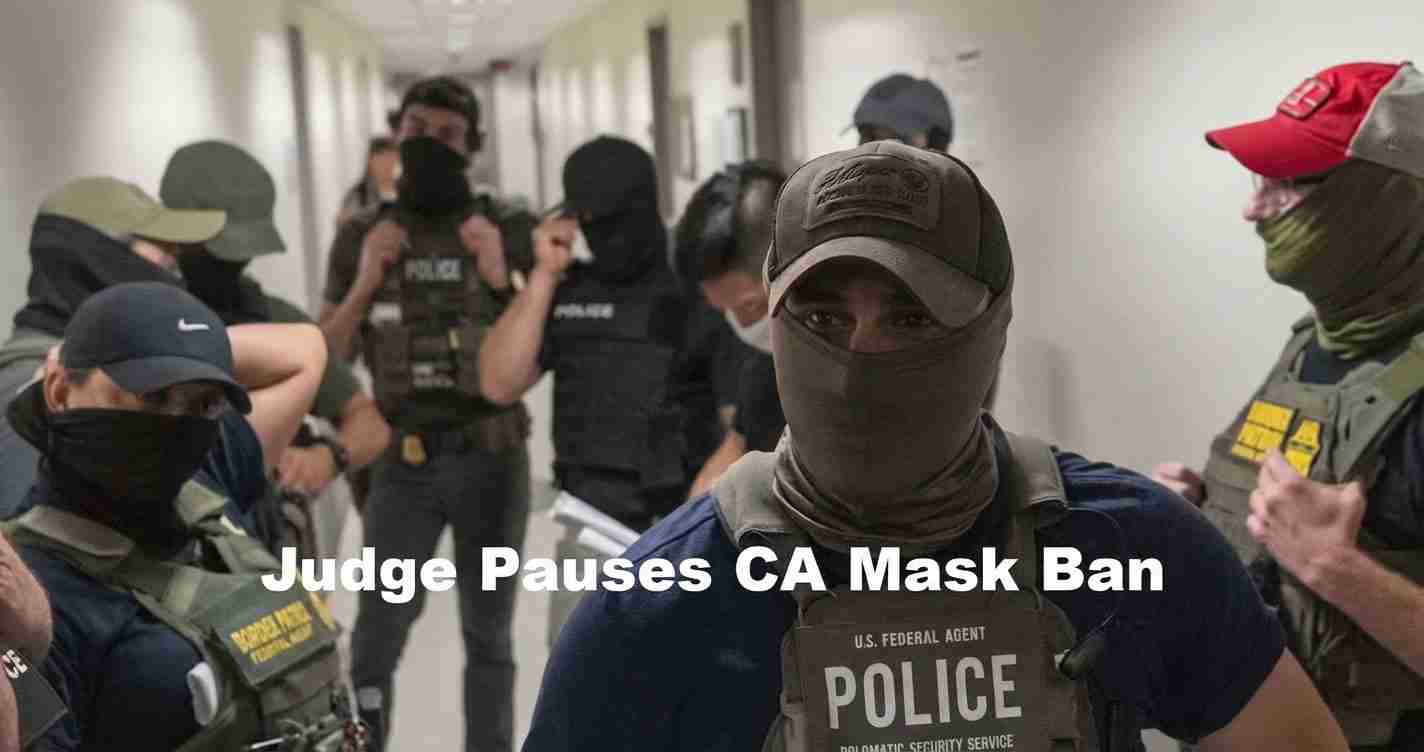
Federal judge blocks California from enforcing mask ban on ICE, saying state law unlawfully singles out masked federal officers
A federal judge in Los Angeles issued a preliminary injunction blocking California’s No Secret Police Act from being enforced against masked federal officers, ruling the statute unlawfully discriminates by exempting state officers and violates the U.S. Constitution’s Supremacy Clause.
Key takeaways
- Preliminary injunction issued: U.S. District Judge Christina A. Snyder stopped California from enforcing the mask ban against federal officers, including ICE agents.
- Supremacy Clause basis: Snyder found the law discriminates by applying differently to state and federal officers, creating an unlawful interference with federal duties.
- Limited scope: The order pauses enforcement only of the masked-officer portion of the No Secret Police Act; a separate No Vigilante Act was not enjoined.
- Immediate reactions: Public figures such as Florida Attorney General Pamela Bondi praised the ruling as protective of federal agents and safety.
Main content
Background: what the No Secret Police Act would have done
California lawmakers passed a measure intended to limit the use of masks by officers during immigration enforcement and certain law-enforcement actions. Supporters said the law aimed to increase transparency and accountability when officers act in public; the statute would have banned masked officers from carrying out specified enforcement actions and allowed penalties for violations.
State leaders framed the measure as a response to concerns about officers hiding their identities during some operations. Critics at the federal level argued the law would interfere with federal agents performing duties and could endanger them by forcing identity disclosure in dangerous situations.
Judge Snyder’s ruling: why she blocked enforcement
In her order, U.S. District Judge Christina A. Snyder centered on the Supremacy Clause — the constitutional principle that federal law and duties take precedence when state rules conflict. Snyder concluded the No Secret Police Act penalized federal officers while exempting many state officers, creating unequal treatment that unlawfully singled out federal officials and risked obstructing federal programs and duties.
Snyder noted that the legal problem was not whether federal officers may perform their functions without masks, but that the statute’s unequal application discriminated against the federal government. For that reason, she granted a preliminary injunction blocking the state from applying the mask ban against federal officers.
Sources reporting on Snyder’s order include Courthouse News and the Daily Journal.
What the injunction does — and does not — do
The preliminary injunction is a temporary court order that halts enforcement of the masked-officer portion of the No Secret Police Act while the court resolves the full case. It does not permanently invalidate the law.
The judge declined a broader request to enjoin a separate state measure sometimes called the No Vigilante Act, so only the mask-related restriction is paused for now. Because the full court opinion was not published in the available reports, additional details — such as the injunction’s duration or fuller reasoning — may appear later in court filings.
Reporting on the injunction’s main holding can be found at Courthouse News and the Daily Journal.
Federal preemption and the Supremacy Clause explained
The Supremacy Clause declares federal law the “supreme Law of the Land.” In practice, states cannot enact rules that interfere with federal duties or that make it harder for federal officers to carry out their work. Courts often enjoin state laws that conflict with federal authority or that treat federal officers differently from state officers in a way that impedes federal functions.
In Snyder’s view, California’s law created a unique burden on federal agents by exempting state officers from the mask restriction while penalizing federal officers — an impermissible state intrusion on federal functions.
Reactions and political context
The ruling drew immediate reaction. Florida Attorney General Pamela Bondi praised the decision on social media, saying it protects federal agents and avoids additional safety risks. The reaction was reported by Courthouse News.
“The injunction protects federal agents from being unfairly targeted and prevents additional safety risks,” public statements said, according to reporting.
California officials have argued the law sought to protect civil rights and public safety by increasing transparency when officers act in public. Available coverage, however, centers on the judge’s legal finding under the Supremacy Clause; full comments from California state leaders or the state attorney general’s office were not included in the reports reviewed.
Legal next steps
The preliminary injunction is likely to prompt additional filings. California may defend the law and argue it should be applied equally, or it could amend the statute to remove unequal treatment. The federal government can seek expedited relief or ask the court to make the injunction permanent after full briefing and hearings.
If the dispute continues, appeals to higher courts are probable. The preliminary ruling does not end the litigation; appellate review may be sought to determine whether the state law conflicts with federal duties and whether the injunction should remain long-term.
Implications for Fresno, California
Economic and law enforcement impact:
- Federal agents in Fresno — including local U.S. Immigration and Customs Enforcement personnel — can continue using masks during operations for health, safety, or tactical reasons while the injunction is in place.
- Local law enforcement agencies are reminded of legal boundaries between state rules and federal functions; if California amends the law to apply equally, local departments may need policy adjustments.
Political consequences:
- The injunction may influence local debate in Fresno on public safety and immigration; some will see it as a legal check on state lawmaking, while supporters of the No Secret Police Act may push for statutory revisions.
- Local officials and candidates may cite the ruling in campaigns or statements to advocate for state-level changes or to defend local law-enforcement practices.
Social and community effects:
- Immigrant communities in Fresno will observe federal officers’ practices in coming months; opinions vary between support for state measures limiting aggressive tactics and concerns about officer safety.
- Community groups and legal aid organizations may use the ruling to press for clearer rules, more transparency, or uniformly applied state legislation.
Practical daily impacts: Residents should expect no immediate change to federal operations in Fresno while the injunction stands; any future shift depends on state revisions or further court rulings. Local agencies may update internal guidance to reflect the injunction and prepare for potential changes.
Sources and reporting notes
This article draws on reporting from Courthouse News and the Daily Journal, which covered the preliminary injunction and Judge Christina A. Snyder’s findings.
Available reports emphasize the injunction’s primary holding under the Supremacy Clause. Court docket entries, the full opinion text and any immediate appeals were not available in the sources reviewed for this story.