Big Bear eaglets named Sandy and Luna as Jackie and Shadow’s 2026 chicks take center stage
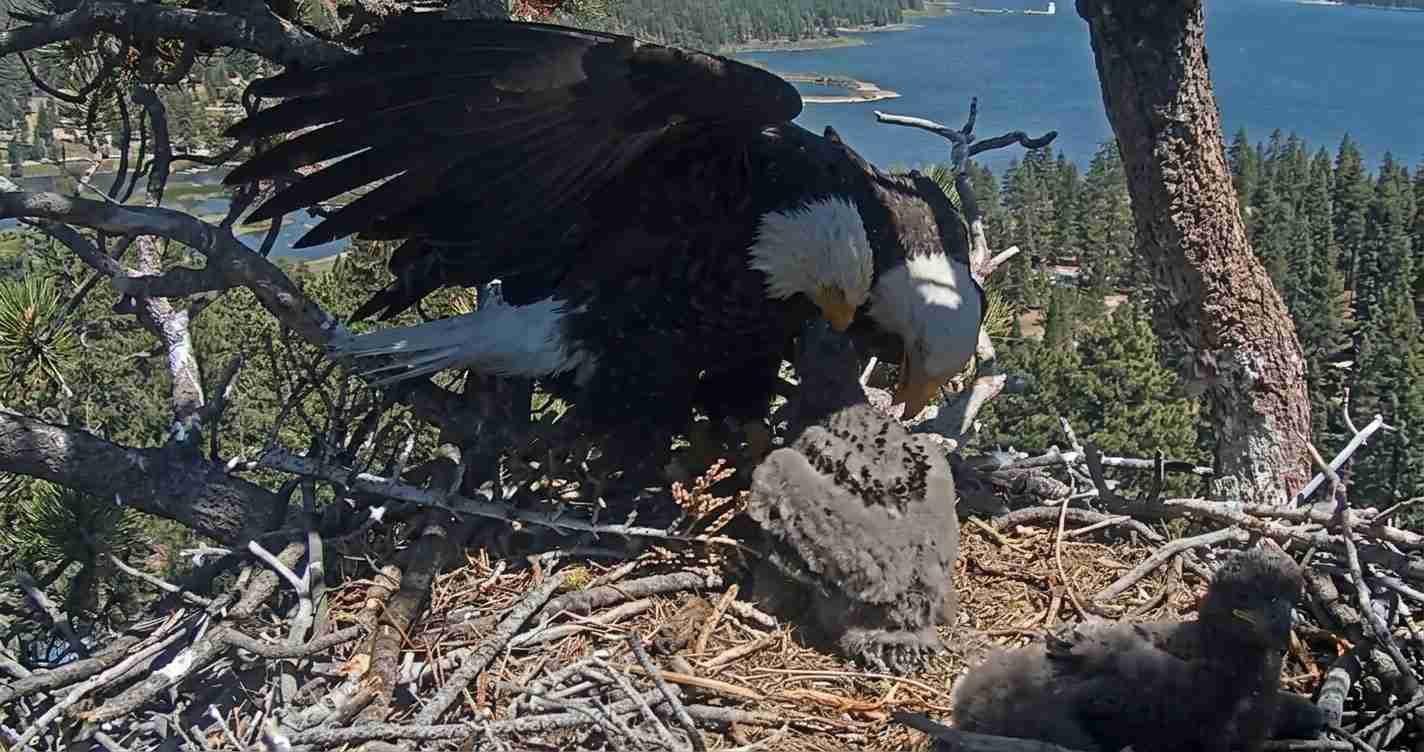
Big Bear Lake’s famed bald eagles Jackie and Shadow welcomed two eaglets in April 2026 this spring, officially named Sandy and Luna after a community fundraiser and third-grade vote honoring late FOBBV leader Sandy Steers.
Key takeaways
- Sandy (hatched April 4) and Luna (hatched April 5) were named by Big Bear Valley third graders from a 30-name ballot.
- FOBBV collected 63,915 public name submissions; 3,706 entries were “Sandy.”
- Vote totals: Sandy — 30 votes; Luna — 25 votes; runners-up included Star, Chip and Phoenix.
- The naming was part of a fundraiser and classroom lesson tied to the 24-hour live nest cam on YouTube.
Main report
Key information
- Parents: Jackie and Shadow, the Big Bear Lake bald eagles.
- Hatch dates: Chick 1 hatched April 4, 2026 (now Sandy); Chick 2 hatched April 5, 2026 (now Luna) — video record available on FOBBV’s YouTube feed.
- Names selected by: Big Bear Valley third-grade students from a 30-name ballot drawn from public submissions.
- Public submissions: Nearly 64,000 gender-neutral name entries collected via a FOBBV fundraiser (63,915 names total).
- Vote totals: Sandy — 30 votes; Luna — 25 votes. Runners-up: Star, Chip and Phoenix.
- Significance: Sandy was the most popular public submission with 3,706 entries.
- Live cam: 24-hour Big Bear Bald Eagle Nest Cam on YouTube at youtube.com/@FOBBVCAM (Cam 1: youtu.be/B4-L2nfGcuE).
How the names were chosen
Friends of Big Bear Valley (FOBBV), which runs the live nest cam, led a two-step community naming process combining fundraising and classroom education. The group solicited gender-neutral name suggestions from the public and collected 63,915 entries overall. Staff then randomly selected 30 names from that pool to create a ballot for local third-grade classrooms.
Students studying bald eagle biology and conservation cast the deciding votes; the ballots produced final counts with Sandy at 30 votes and Luna at 25. The process was framed as an educational tie-in to teach civics and science while ensuring community participation (ABC7).
A tribute to Sandy Steers
The name Sandy holds special meaning: FOBBV’s long-time executive director, Sandy Steers, founded the Big Bear Bald Eagle Cam in 2015 and led the nonprofit until her death in February 2026 following a battle with cancer. The name was the single most popular public submission — 3,706 entries — and was chosen by students and the community as a tribute (ABC7).
FOBBV said Steers would have been honored by the community participation and the decision to remember her through the naming process, while emphasizing the program’s role as a community institution connecting local wildlife to viewers worldwide.
Telling Sandy and Luna apart
As the chicks near one month old, observers note subtle differences: Sandy (April 4 hatchling) appears slightly larger with a bigger head and neck and a subtle curve to its gape and has sometimes been more submissive. Luna (April 5 hatchling) is smaller and showed more aggressive behavior early on; the common “bonking” — pecking and jostling among eaglets — has been easing as they bond. FOBBV cautioned these traits are subtle and may change as the birds grow (LAist).
Growth and biology
The eaglets have shown typical rapid growth: each weighed roughly 2 ounces at hatching and by late April were nearly 3 pounds apiece — illustrating the species’ dramatic early weight gain. Visual sexing remains unreliable at this stage; biologists typically wait until about 9–10 weeks for more reliable sex determination (LAist).
This nest is FOBBV’s second clutch of 2026: eggs were laid Feb. 24 and Feb. 27 and hatched over Easter weekend. Continuous video monitoring provides a full developmental record from egg to fledging and creates a long-term dataset useful for education and research (FOBBV livestream).
Transparency and community science
FOBBV’s two-step model — public submissions to fundraise followed by randomized ballots distributed to third-grade classrooms — was designed to be inclusive and educational. The organization published vote totals and submission counts to maintain transparency, and multiple media outlets reported the numbers behind the fundraiser and vote (ABC7, Popular Science).
Wildlife advocates sometimes warn that naming wild animals can shape public expectations about intervention. FOBBV stresses the eagle cam is strictly observational and that staff and volunteers follow wildlife regulations and best practices; the livestream is an educational, nonintrusive window into mountain wildlife (LAist).
Watch the nest live
Follow Jackie, Shadow, Sandy and Luna via the Big Bear Bald Eagle Live Nest Cam on YouTube: channel youtube.com/@FOBBVCAM and the primary camera feed youtu.be/B4-L2nfGcuE. The continuous feed is a global resource for eagle watchers, educators and researchers tracking the pair across more than a decade (LAist).
Sources
- ABC7 reporting on the naming and FOBBV statements
- VVNG coverage of the community vote
- LAist summary of Sandy and Luna and the nest cam
- Popular Science vote totals and analysis
- FOBBV YouTube livestream and clip and Cam 1 feed
Implications for Fresno, California
Economic: Big Bear Lake lies roughly two hours from Fresno, and continued interest in the nest cam can boost regional tourism — rentals, restaurants and guides — as viewers plan mountain trips around spring and summer wildlife viewing.
Political: High-profile conservation stories like Jackie and Shadow bolster arguments for funding habitat protection, trail maintenance and forest health, providing local officials with narrative support for grants and partnerships relevant across the region.
Social and educational: The student-driven naming project offers a model for Fresno classrooms combining fundraising, public engagement, and hands-on science-civics lessons. Birding clubs, educators and outdoor businesses can use the cam for virtual lessons, watch parties and coordinated field trips.
Cultural and practical: The tribute to Sandy Steers reinforces values of stewardship and volunteerism across the Central Valley. For local residents, the livestream is a low-cost educational tool for families, scouts and community groups and can help connect valley audiences to watershed and wildlife protection messages.
Final note
The naming of Sandy and Luna links a global livestream to a local classroom project and a community tribute, creating ongoing opportunities for education, engagement and conservation as the chicks grow.