World’s Oldest McDonald’s Quarter Pounder Turns 30 — Australia Intact Burger Stuns Friends, Sparks Questions About Burger Preservation Secrets
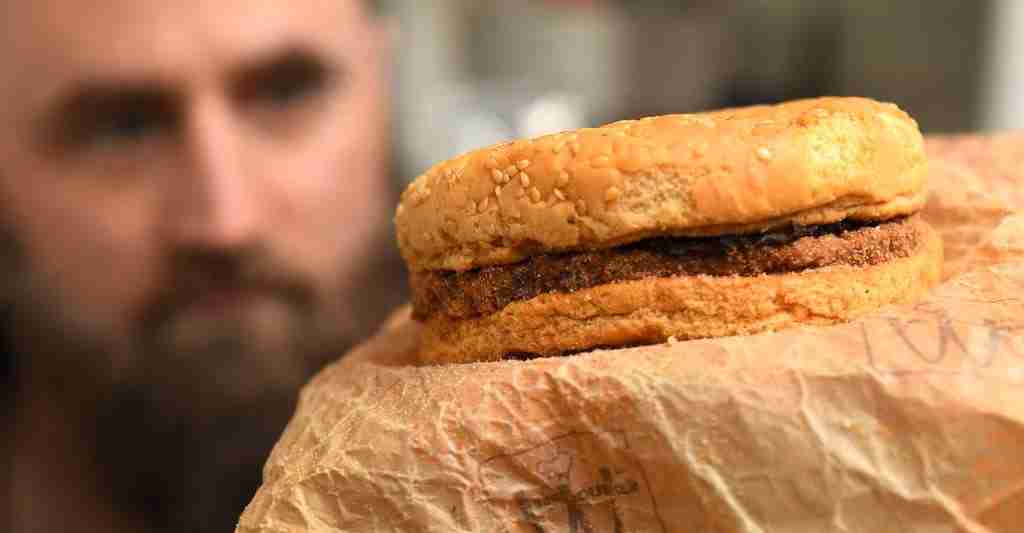
An Australian McDonald’s Quarter Pounder purchased in November 1995 has turned 30 years old, remaining eerily intact and mold-free. Friends Eduards Nits and Casey Dean kept it dry over decades—experts say environment, not preservatives, explains preservation.
Key takeaways
- Thirty-year artifact: A McDonald’s Quarter Pounder bought in November 1995 — nicknamed the Senior Burger — is being kept as a memento by friends.
- Condition: The sandwich has shrunk, no longer looks like a fresh burger and remains free of visible mold or strong odor (WEAR‑TV).
- Expert explanation: Food professionals attribute preservation to dry, cool storage rather than secret preservatives (BigCheese1079).
- Verification limits: Owners cannot file a Guinness claim because they lack the original receipt (BigCheese1079).
Main story
How the burger was kept and how it looks now
The item: The Quarter Pounder was bought in November 1995 and earned the nickname the Senior Burger. Friends Eduards Nits and Casey Dean originally kept the sandwich as a teenage joke and later as a long-term memento (BigCheese1079).
According to reports, the burger was stored in its original wax paper wrapper and moved over the years from cupboards to garbage bags to garden sheds; it was never refrigerated or frozen (WEAR‑TV, 13WHAM).
Present condition: Today the sandwich has shrunk in size and “does not look like a fresh burger.” Nits said,
“It’s no longer food. It just looks like artwork.”
The owners treat it as a prized possession; Nits’ sister has even travelled with the burger overseas and the pair have created social profiles for the artifact (BigCheese1079).
Why the burger hasn’t visibly spoiled: what experts say
The surprising fact: After 30 years the Quarter Pounder shows no visible mold and gives off no strong odor. That has provoked internet debate about whether fast food contains special preservatives that prevent rot.
Expert view: Chef and former McDonald’s chef Mike Haracz told reporters the preservation likely stems from dry, cool conditions rather than secret preservatives. Mold and bacterial growth need moisture and warmth; kept dry and sealed, microbes cannot easily grow. Haracz and food scientists note that home-cooked burgers kept similarly dry could also avoid visible mold (BigCheese1079, WEAR‑TV).
Investigative questions and limits to verification
The owners describe the item as the “Oldest McDonald’s Quarter Pounder”, but they lack the original purchase receipt and so cannot register an official Guinness World Record (BigCheese1079).
Testing gap: No independent scientific testing or lab results have been publicly released to show the burger’s chemical composition after 30 years. That absence leaves room for questions about exactly what changed inside the sandwich (WEAR‑TV, Fox Noticias).
Cultural reaction and why the story spread
The story taps a long-standing internet lore that fast-food burgers do not rot. Social sharing, humor, mild horror and the owners’ posts helped the story gain traction. Reporters emphasize the human angle: the burger is a shared memory — a time capsule of youth and friendship — that evolved from a prank into an odd artifact (BigCheese1079).
What this says about food, preservatives and common myths
Science over sensation: Food scientists and chefs quoted in coverage caution that the lack of visible rot is best explained by environment — low moisture and cool conditions — rather than unique preservatives. Preservatives exist in many processed foods, but they do not explain a decades‑old item kept in a dry shed. Microbial growth requires moisture; absent that, decomposition can slow dramatically (BigCheese1079, WEAR‑TV).
Record attempts and public displays
The owners have promoted the sandwich online and discussed displaying it in a museum or exhibit, but without the receipt they cannot claim an official Guinness designation. Media outlets describe it as a candidate for “Oldest McDonald’s Quarter Pounder” and a piece of pop culture oddity (BigCheese1079, Grabien).
Implications for Fresno, California
Economic and cultural interest
This quirky story could inspire local museums, university talks, or pop culture exhibits in Fresno. A temporary display or lecture series on food myths and preservation might attract families and students and modestly boost museum visits.
Public health and food safety messaging
Health officials can use the case to remind residents that a decades-old item that looks intact is not safe to eat. The story is a teachable moment to explain refrigeration, handling and that visible condition is not the only sign of safety.
Education and school programs
Schools and community centers could use the Quarter Pounder story for classroom demonstrations on microbial growth and the role of moisture in spoilage — safe, simple experiments can teach scientific method and food hygiene.
Tourism and pop culture events
Fresno fairs and festivals could include light features on “food myths” or “burger preservation secrets” to engage families and tie into broader messaging about food safety and science.
Local businesses and branding
Local restaurants might highlight transparency about ingredients and handling while educating customers about freshness and safety — turning curiosity into reassurance about proper food practices.
Political and governance angle
For a moderate audience, the story prompts non‑polarizing discussion about labeling, consumer education, and public health outreach; city and county health departments could publish guides or social posts on safe storage and refrigeration.
Practical daily impact
The practical takeaway: the burger is a cultural curiosity, not a preservation technique. Do not imitate the storage method; refrigeration and proper packaging remain the safest ways to avoid foodborne illness.
Reporting note and sources
This article draws on reporting from Times Media Service partners and outlets that covered the item, including WEAR‑TV, 13WHAM, BigCheese1079, Fox Noticias and Grabien. Links below lead to the original reports and related coverage.