
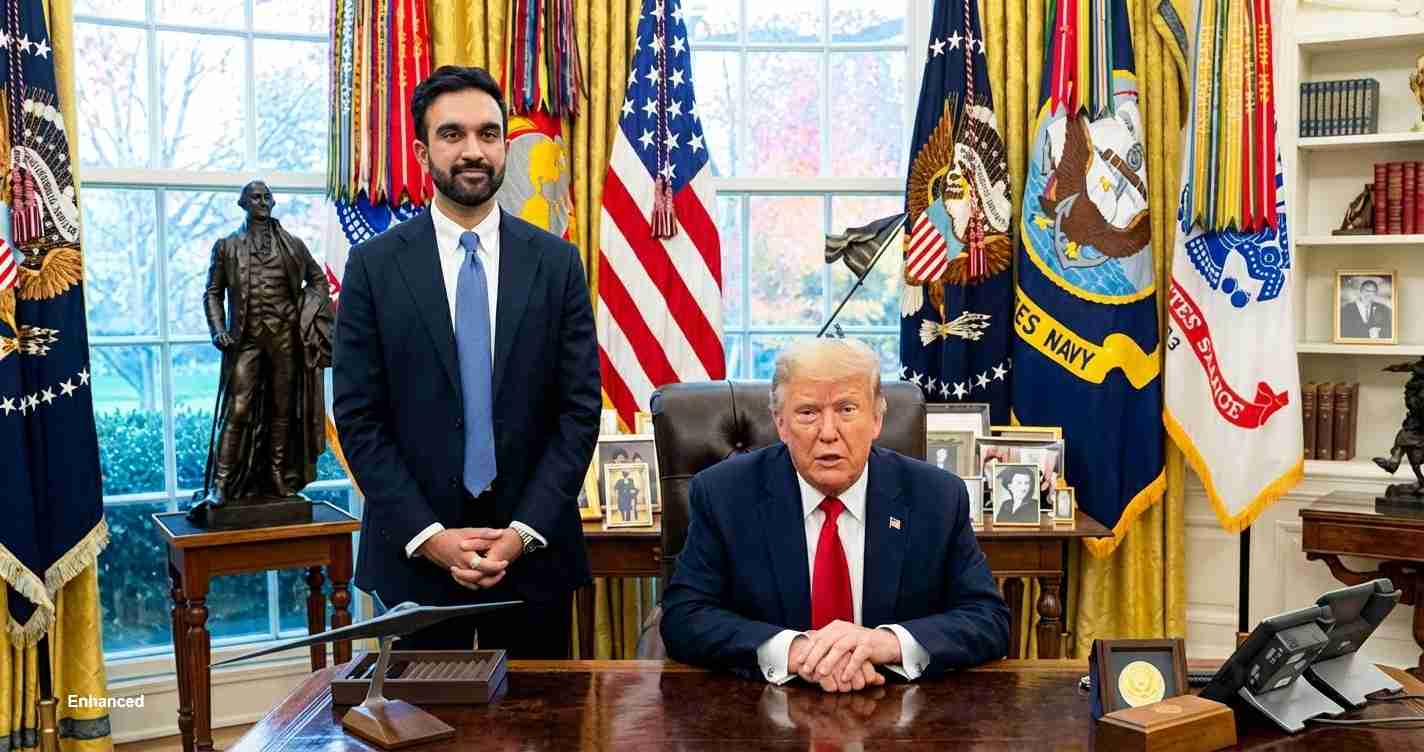
Trump, Mamdani Find Common Ground on Housing and Costs in Oval Office Meeting
President Trump and New York City Mayor-elect Zohran Mamdani met in the Oval Office and, despite prior insults, struck an unexpectedly cordial tone while emphasizing shared priorities: lowering rent, building more housing, and cutting energy costs for New Yorkers.
Key takeaways
- Unusually cordial meeting: After months of public jabs, both leaders prioritized policy over personal attacks; reporters described a measured exchange and mutual focus on results (video; video).
- Shared local priorities: Agreement on building more housing, lowering rent and easing energy bills — including concerns tied to Con Edison — despite differing philosophies on implementation (video).
- Pragmatic caveat: Mamdani pledged to back any agenda that helps New Yorkers and to oppose measures he deems harmful, signaling transactional, issue-based cooperation (reported by the Hindustan Times).
- Implications beyond NYC: The meeting reframes partisan messaging and could inspire federal-local collaborations that other cities, including Fresno, may adapt.
Meeting details and tone
The Oval Office session followed months of sharp back-and-forth between the two men. Yet reporters in the room described a measured exchange that focused on policy over personal attacks. Trump praised Mamdani’s willingness to discuss shared goals and said he wanted to help New York “be great,” while Mamdani emphasized practical results for city residents (video).
White House communications framed the meeting with political context. Press Secretary Karoline Leavitt referenced Mamdani’s socialist label and suggested it reflects trends in the Democratic Party, a comment that underscores how the interaction may be used by both sides in national messaging (Hindustan Times).
Areas of agreement: housing, rent and energy costs
Both leaders articulated overlapping goals on three main fronts. Their alignment focused on pragmatic steps to ease immediate pressures on New Yorkers rather than detailed policy frameworks.
Building more housing
They agreed more units are needed to ease market pressure and increase supply. The proposal was framed as a practical step to address the affordability squeeze, while zoning, permitting and funding mechanisms remain open for negotiation (video).
Lowering NYC rent
Both leaders discussed ways to reduce rent and make housing more affordable for working families. They framed the problem as urgent and bipartisan. Differences persist on regulatory approaches and tenant protections, but both signaled a willingness to explore solutions (video; video).
New York energy costs
The conversation included concern about high utility bills, with specific mention of Con Edison. Both sides signaled interest in solutions that could provide immediate relief to households and potential regulatory or funding responses to lower energy costs (video).
Where disagreement remains
Observers emphasized that agreement on broad goals did not erase deeper policy divides. The two leaders differ on the role of government, regulation, and funding for housing programs. Mamdani’s progressive stances on tenants’ rights and public investment contrast with Trump’s market-driven, private-sector emphasis.
“I will work with [Trump] on any agenda that benefits New Yorkers. If an agenda hurts New Yorkers, I will be the first to say so,” — Zohran Mamdani (reported by the Hindustan Times).
Mamdani’s public caveat makes clear the relationship is likely to be transactional and issue-based rather than a broad political embrace. Policing and public safety were discussed in principle, but specifics were deferred to later negotiations (video).
Political symbolism and broader implications
Although meetings between presidents and incoming city mayors are customary, this encounter drew extra attention because of the personal attacks that preceded it. The cordial tone complicates narratives that seek to paint Mamdani as outside the mainstream, since the president himself acknowledged common goals (video).
For Republicans, the meeting could blunt attacks tying Mamdani’s policies to the national Democratic platform. For Democrats and progressives, Mamdani’s willingness to sit down with Trump may be seen as pragmatic or problematic. Either way, discussion shifted from rhetoric to concrete policy proposals on housing, rent relief and energy prices (Hindustan Times).
What to watch next
- Concrete proposals to increase housing supply and how zoning/permitting/funding will be addressed.
- Potential federal–state–city cooperation on housing financing and pilot programs aimed at rent relief.
- Steps to lower energy bills and any regulatory or rate relief measures affecting utilities like Con Edison.
- How political messaging evolves as both leaders respond to critics and constituents.
Source notes
This report draws on statements and footage from the Oval Office meeting and public remarks by both leaders (video; video) and reporting from the Hindustan Times. For direct footage and remarks see Oval Office video (1) and Oval Office video (2).
Implications for Fresno, California
While the meeting centers on New York City, Fresno residents can draw practical lessons. Major U.S. cities face similar housing shortages and cost pressures; federal or private initiatives that emerge from NYC-focused efforts may become replicable models for Fresno.
Economic impact
If federal or private initiatives grow housing supply, lower rent, or cut energy costs, Fresno could benefit from shared funding streams, best-practice planning, or pilot programs adaptable to California cities. Measures aimed at lowering energy costs in New York could inform regulatory or rate-relief strategies for PG&E customers in the Central Valley.
Political consequences
Local leaders in Fresno may press Washington for flexible funding tied to workforce housing and energy relief. The Oval Office meeting demonstrates cross-partisan deals on local issues are possible, which may enable bipartisan coalitions focused on affordability and job retention.
Social effects
Lower rents and cheaper energy would ease pressure on Fresno families stretched by housing and utility bills. If national policies increase housing supply or provide subsidies, Fresno could see reduced displacement risk and more stable neighborhoods. Community organizations should monitor federal moves to ensure local needs are included.
Cultural relevance
Fresno values pragmatic governance and practical solutions. The Trump–Mamdani meeting underscores a politics-to-policy approach that resonates where voters prioritize cost-of-living issues over ideology. Local officials can frame zoning reform, incentives for affordable units, or energy-efficiency upgrades as practical measures that match Fresno’s realities.
Practical applications for residents
- Housing planners and city officials should review federal grant opportunities or pilot programs emerging from New York initiatives to adapt locally.
- Local energy policymakers can monitor regulatory tweaks aimed at lowering utility bills for lessons applicable to PG&E or municipal programs.
- Community groups and neighborhood associations can prepare outreach and education campaigns for potential rent-relief or housing-supply programs.
Reporting from Washington shows an unexpected alignment between President Trump and Mayor-elect Zohran Mamdani on core, day-to-day concerns for residents. For Fresno, the meeting is a reminder that pragmatic, bipartisan local solutions remain possible and worth tracking.
Sources: Oval Office remarks and video coverage — Oval Office video (1) ; Oval Office video (2). Reporting on the meeting and Mamdani’s comments — Hindustan Times.



