
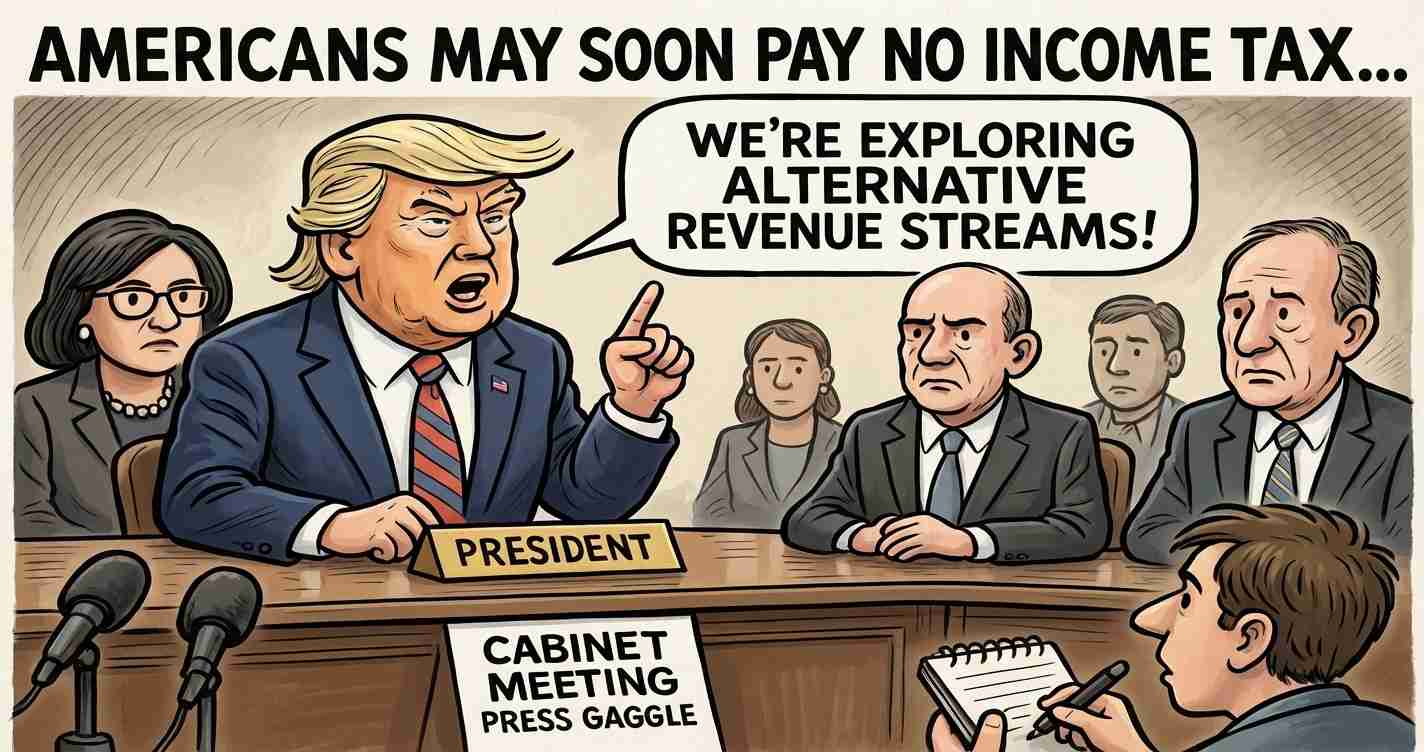
Trump says Americans may soon pay no income tax as White House eyes tariff-driven revenue
President Donald Trump said tariff collections could grow so large that federal income taxes might be unnecessary within a few years, proposing tariffs as a complete revenue replacement and expanding earlier ideas to eliminate income tax entirely.
- Tariffs as revenue: The president said at a Cabinet meeting that rising tariff collections could make income tax obsolete; see details from the Cabinet meeting on Dec. 2, 2025.
- Policy explored: The White House is exploring a plan that would use tariff revenue to replace most or all federal income tax receipts.
- Scale of change: Federal income taxes currently make up roughly 54% of total federal revenue, so repeal would be the largest overhaul in more than a century.
Trump’s claim and timeline
At a Cabinet meeting on Dec. 2, 2025, Mr. Trump said tariff collections were already “so great… so enormous” that income taxes might become unnecessary in the next two, three, four years. The administration has said it could instead lower rates rather than abolish the tax entirely — a range of options the president presented as part of a broader vision for shifting revenue away from direct taxation of Americans. Read the Fox Business report.
Origins and prior proposals
Earlier in 2025 Mr. Trump proposed eliminating income tax for those earning under $150,000 and suggested tariffs could backfill the lost revenue. He later widened that idea to consider removing federal income taxes for all Americans. The administration has even suggested that heavy tariff collections could allow the government to issue refunds and cut federal debt — claims it framed as taking revenue from foreign producers rather than American workers. Source: Fox Business and CPAPracticeAdvisor.
Tariff revenue replacement: what the White House says
The administration is framing tariff increases as a path to tax relief. Treasury Secretary Scott Bessent has been more cautious publicly, suggesting tariff revenue could fund specific tax cuts rather than guarantee full elimination of the income tax. Officials have floated targeted exemptions — for example, exempting tips, Social Security benefits and overtime pay — and restoring some interest deductions tied to American-made cars.
“We’re going to be giving back refunds out of the tariffs because we’re taking in literally trillions of dollars,” the administration has said, arguing tariffs tax foreign producers rather than U.S. workers.
How big a change would this be?
Abolishing federal income tax would be historic. Federal income taxes account for about 54% of federal receipts and fund major programs like Medicare and Social Security. Analysts caution that tariffs are volatile and could not reliably match income-tax revenue without very high rates or major trade shifts. Economists warn of higher consumer prices, retaliatory tariffs and shifting burdens that could widen inequality.
Similar proposals in Congress
The idea echoes other overhaul proposals. One example is the FairTax Act of 2025 (H.R. 25), which would repeal the income tax and replace it with a federal sales tax administered largely by states and would abolish the IRS. While not identical to the tariff-only approach, it shows similar thinking has appeared in Congress.
Broader tax policy the administration is pursuing
The tariff plan is one element of a wider push: the administration seeks to make permanent key provisions of the 2017 Tax Cuts and Jobs Act that otherwise expire at the end of 2025. That includes the seven individual tax rates in place for 2025 (10%, 12%, 22%, 24%, 32%, 35% and 37%). Other priorities: making the Section 199A deduction for pass-through businesses permanent and creating targeted exemptions such as tax-free tips, overtime pay and Social Security benefits.
Political and legislative hurdles
Turning this idea into law would be difficult. Abolishing the income tax requires broad congressional support, complex votes in both chambers, and explicit rules on how tariffs would be set, collected and distributed. The White House faces a narrow House majority and an uncertain Senate. Fox Business notes procedural and political limits that could block sweeping change.
Economists also warn that relying on tariffs to replace more than half of federal revenue would require very high rates and could strain trade relationships — with potential consequences for prices, exports and inequality. Analysts raise these concerns.
Implementation and unanswered questions
The White House did not immediately respond with detailed plans on how tariffs would be set or how replacement revenue would be guaranteed year to year. Key questions remain:
- Which imports would face higher tariffs?
- Would tariffs be temporary or permanent?
- How would changes affect programs funded by income tax — and federal grants to states?
- What mechanisms would ensure steady revenue despite trade volatility?
Implications for Fresno, California
Local economies could feel mixed effects. Fresno relies on agriculture, manufacturing and trade-linked services; that reliance shapes how tariffs would ripple through the region.
Economic impact: Higher tariffs could raise costs for businesses that use foreign-made equipment or parts. Farmers who depend on global supply chains for inputs or who export produce could face higher prices for supplies and possible retaliation from trading partners — squeezing profit margins and increasing processing costs.
Household budgets: If federal income taxes were cut or eliminated, many Fresno residents could see lower withholding. But tariff-funded tax cuts could raise prices on imported goods, hitting low- and middle-income households hardest and potentially offsetting take-home pay gains.
Employers and jobs: Service workers who rely on tips could benefit if tips and overtime are exempted from income tax. Yet changes in consumer demand, employer costs and trade could affect hiring in agriculture, food processing and retail. Some small businesses may benefit if pass-through deductions are made permanent — critics say larger gains may flow to wealthier owners. Analysis at BrightTax.
Public services: Many federal programs that support Fresno — Medicaid, Social Security and disaster aid — depend on federal receipts. A shift to tariff-based funding could alter funding stability and distribution for California, creating uncertainty for local governments and service providers. Source.
Political consequences: Fresno voters prioritize jobs, prices and services; a tariff-based overhaul could become a central local campaign issue if residents see price spikes or disruptions in trade-dependent sectors. Local leaders will likely press for clear explanations of any plan’s regional impacts. More.
Practical steps for residents
Fresno households and businesses should:
- Watch for official guidance from the Treasury and IRS and attend local briefings.
- Review budgets for potential price increases on goods and inputs.
- Follow updates on which goods would face higher tariffs — and monitor Congressional proposals like H.R. 25 that propose alternative overhauls.
What’s next
Key takeaway: The administration is exploring a bold plan that would replace income tax revenue with tariffs, but major policy, economic and political hurdles remain. Any move to abolish the income tax would require detailed legislative design and extensive scrutiny of its effects on households, businesses and federal programs.



