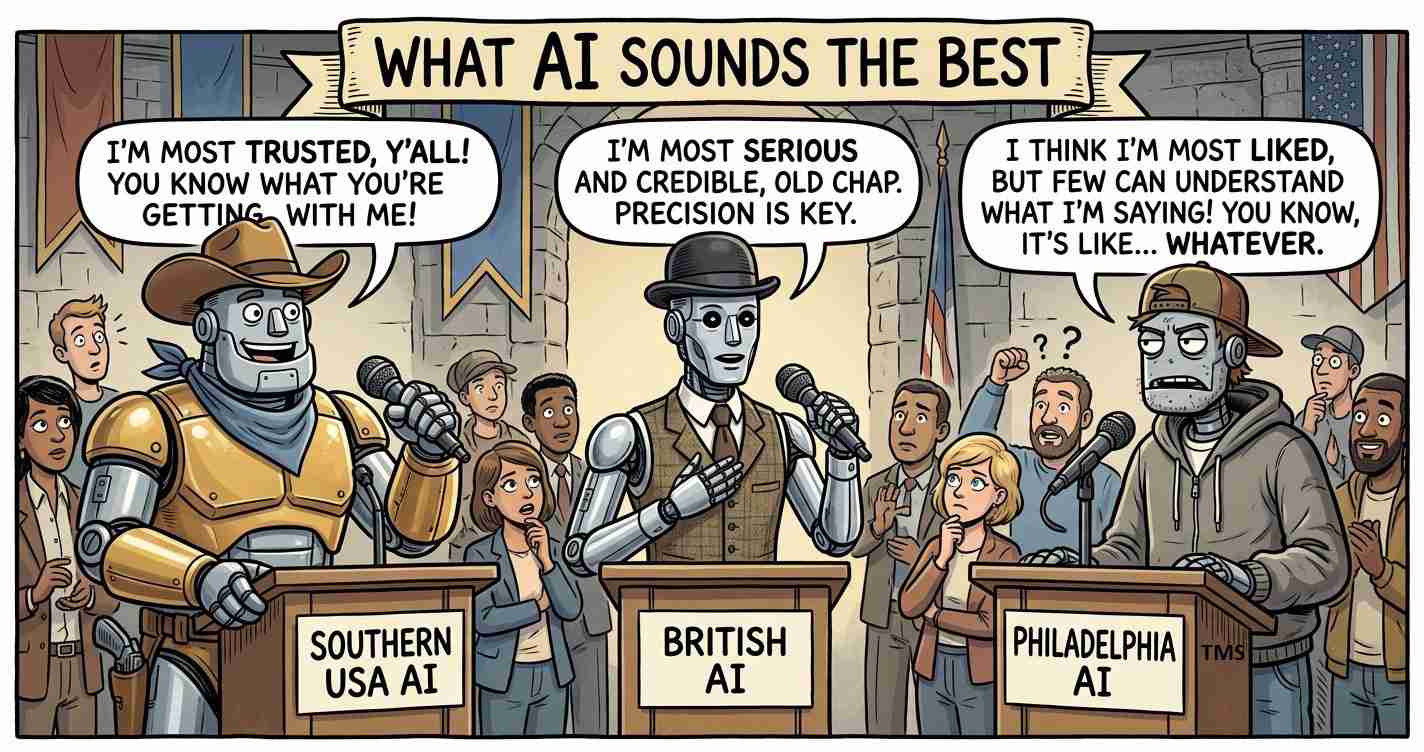
Americans Prefer AI That Sounds Like People — Southern Drawl Tops List as “Calm Authority”
A survey of 3,023 people by The Word Finder finds Americans prefer AI voices that sound human and regionally distinct, with the Southern accent topping the list as a “calm authority,” favoring warmth, clarity and consistent tones for devices.
- Majority preference: 75% prefer human-sounding voices; 73% want one consistent accent for devices.
- Top accent: Southern accent ranked No. 1 overall — described as gentle, reassuring and conveying “calm authority.”
- Context matters: Midwestern/neutral American accents score highest for trust on serious topics like finance.
- Low appetite for cloning: Only 2% want their own voice cloned for AI use.
Key information
The Word Finder surveyed 3,023 participants and found a clear public preference for AI voices that carry human character and regional warmth rather than robotic neutrality. The Southern accent ranked No. 1 overall and was repeatedly described by respondents as gentle, reassuring and resonant with “calm authority.”
“How a voice sounds shapes whether someone feels safe, understood or even amused by a device,” said Praveen Latchamsetty, founder of The Word Finder.
How the survey summed up “human” sound
Respondents said they do not want digital assistants to sound like disembodied machines. Instead, they prefer voices that include:
- Regional markers and slight theatricality
- Approachable tone paired with clarity
- A single, consistent accent across interactions (73% of respondents)
Some answers invoked pop-culture shorthand — a few compared their ideal voice to Matthew McConaughey’s laid-back drawl or to the image of a helpful Alabama librarian, signaling warm storytelling rather than clinical realism.
What the other accents conveyed
Respondents attached specific traits to several accents:
- New York City: brisk, efficient, confident
- BBC English: associated with trust and intelligence
- New England: realism and blunt charm
- SoCal/Valley: relaxed friendliness
- Texas drawl: storytelling confidence
The survey also listed a longer tail of regional flavors — New Jersey, Philadelphia, Chicago and Louisiana — each bringing distinct humanizing texture to AI voices.
Follow-up findings: trust, smarts and topic fit
In deeper probing, Southern accents ranked highest for trust overall and were nearly tied with British (BBC) accents for sounding the smartest. For serious topics such as finance or legal advice, respondents favored Midwestern or neutral American accents, suggesting users match accent to context.
Numbers people care about
- 73% want a single consistent accent from their device.
- 75% prefer human-sounding speech over robotic voices.
- 2% want their own voice cloned for AI use.
These figures point toward demand for consistent, humanlike, regionally adapted AI voices rather than fully personalized voice clones.
Expert take
Praveen Latchamsetty, founder of The Word Finder, told Times Media Service: “How a voice sounds shapes whether someone feels safe, understood or even amused by a device. As AI gets smarter, its voice becomes part of the message — not just a delivery mechanism.”
Implications for Fresno, California
Local stakeholders in Fresno can tailor voice-driven services to match community expectations for warmth and clarity. Below are possible impacts and practical uses.
Economic impact
Banks, customer-service centers and tourism lines that adopt voice-driven services may increase engagement by choosing voices that reflect Fresno-area preferences. A friendly, slightly regional voice could boost calls-to-action and conversion for local commerce.
Political consequences
Public agencies using voice technology for alerts or outreach should match tone to purpose: neutral Midwestern cadence for urgent or technical alerts, and warmer regional tones for community outreach to encourage participation.
Social effects
Fresno’s diverse population may respond differently across communities. Regional voice options that emphasize warmth and clear pacing can lower barriers for older residents and those preferring conversational delivery over rapid speech.
Cultural relevance
Fresno’s Central Valley identity values straightforwardness and neighborly warmth. Voices conveying calm authority — like the Southern accent rated highest overall — or SoCal’s relaxed friendliness may resonate without seeming out of place.
Practical applications
Schools, libraries and local media can pilot voice profiles for literacy programs, non-emergency 911 lines and public-service announcements. Given public preferences for consistency and humanlike speech, a single well-chosen voice for public services may improve clarity and trust.
Notes on source material and search limitations
This report is based on survey data provided to Times Media Service by The Word Finder. Attempts to run a broader content analysis were limited by irrelevant search results. Examples of unrelated research reviewed include the PMC article, the FAU catalog entry, and the CJCSM manual. Additional public sources or a direct link to The Word Finder’s full survey findings would allow richer SEO work and verification.
Bottom line: As AI voices spread into phones, cars and homes, people clearly favor regionally flavored, consistent and emotionally engaging voices — and how a machine sounds may soon shape trust as much as the content it delivers.