
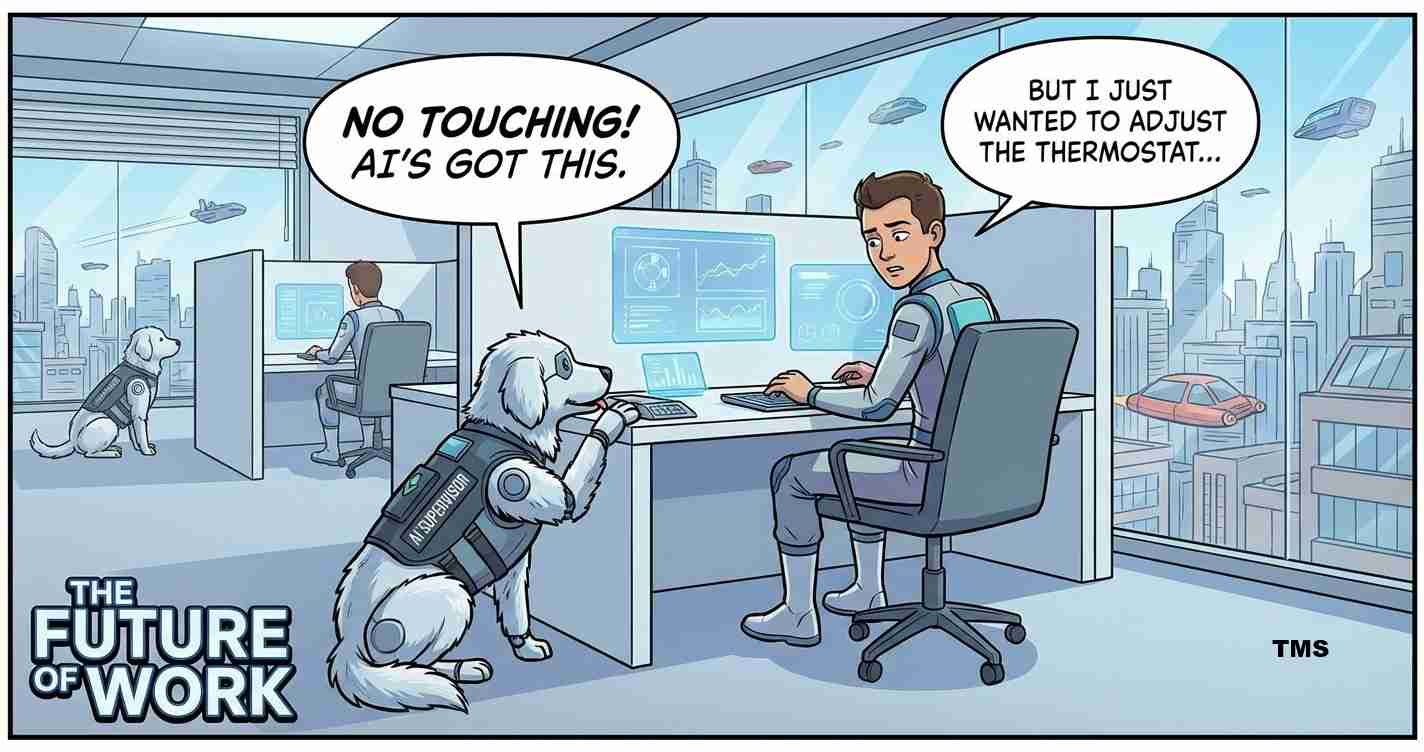
No, AI won’t ruin your life — it could shrink the workweek. But the shift will be messy, warns Andrew Yang
Andrew Yang warned that AI could displace 30 to 40 million U.S. jobs within a decade and urged a $1,000-per-month Universal Basic Income funded by taxes on AI and tech companies, a proposal reported by Business Insider.
Key takeaways
- Large displacement risk: Yang says AI could eliminate 30–40 million U.S. jobs over the next decade and urges a $1,000-per-month UBI funded by taxing AI and tech companies (Business Insider).
- Research snapshot: Reporting cites studies showing current AI can perform skills covering about 11.7% of U.S. labor-market tasks and other analyses that many jobs will be affected.
- Alternative futures: Automation could be reorganized to shorten workweeks and boost productivity rather than simply eliminate jobs.
- Policy debate: Proposals range from UBI funded by tech taxes to retraining, tax credits and portable benefits.
The warning — what Andrew Yang says and why it matters
Former presidential candidate Andrew Yang has been a consistent voice on the risks of rapid automation. He estimates that if half of the roughly 44% of U.S. jobs his team views as vulnerable are “churned through,” then 30–40 million jobs could disappear within a decade. He frames this as an economic, political and social risk that could destabilize communities and raise unrest. (Business Insider).
Yang’s remedy: the return of his campaign-era proposal — a Universal Basic Income or “Freedom Dividend” — giving every American adult $1,000 per month. He proposes funding it in part by taxing profits and activity of AI and tech firms, on the argument that companies that replace human labor should help support displaced workers. (Business Insider).
The data and studies behind the debate
Journalists point to several studies showing that a significant share of work is technically automatable. Reporting synthesizes findings such as MIT’s Iceberg Index, which estimates current AI systems can perform skills representing about 11.7% of the U.S. labor market. Other analyses from groups including McKinsey and assessments cited by the IMF reach varying but sizeable estimates of tasks or hours that could be affected by automation. (Business Insider).
Important caveat: “Automatable” ≠ “will be automated overnight.” Jobs are collections of tasks; adoption depends on cost, regulation, customer acceptance and labor markets. Still, technology is moving from experiments to everyday tools, increasing the likelihood that firms replace repetitive tasks and restructure roles.
The upside — shorter workweeks and higher productivity
Not all scenarios are bleak. Some economists and business leaders argue automation can raise productivity and free people to work fewer hours or focus on higher-value work. A plausible alternative is a shorter workweek: if machines take over routine tasks, governments and companies might redistribute paid work so people work fewer hours while maintaining incomes.
“If scaled, shorter workweeks could reshape daily life — more family time, lower commuting costs, and stronger local spending on leisure and services.”
Pilot programs in some countries and companies have shortened weeks or reallocated hours while maintaining pay to boost morale and output. Scaling that outcome requires active policy, union engagement and employer willingness to redesign pay and scheduling rather than letting gains concentrate in corporate profits.
Policy responses under discussion — UBI and taxing AI
Universal Basic Income: Yang’s UBI proposal would provide a baseline monthly income to adults while society adapts. He suggests funding it by taxing AI and tech firms that benefit from automation. Advocates argue UBI stabilizes incomes and gives people time to retrain; critics raise concerns about cost, incentives and political feasibility.
Other options: expanded earned-income tax credits, targeted job-training, portable benefits for gig workers, and incentives for companies that retain or retrain staff. Most experts say a mix of policies — not a single fix — will likely be necessary to manage the transition.
What businesses are doing — adapting jobs, training and tool adoption
Companies are already shifting how they combine AI tools and human labor. In sectors from customer service to insurance and accounting, AI handles repetitive tasks like data entry, basic claims processing and first-response customer interactions, pushing humans toward oversight, complex problem-solving and relationship work.
Two common responses:
- Retrain and redeploy: Some firms invest in reskilling employees for higher-value roles.
- Cost cutting: Other firms reduce payroll or automate to lower expenses, with sector- and region-dependent impacts.
Industries such as retail, fast food, call centers and back-office functions are especially exposed because they contain many repeatable tasks; those industries also employ large local workforces and are politically visible when disruption occurs.
Reporting limits and sources
Public reporting draws on a patchwork of studies and expert views. The specific estimates cited here — including Yang’s 30–40 million figure and the 11.7% task estimate tied to MIT’s Iceberg Index — come from Business Insider‘s synthesis of academic and industry research. Those reports reference broader work by McKinsey, the IMF and academic institutions; they differ on timing and scale but agree AI will accelerate change in many fields.
Implications for Fresno, California
Economic impact
Fresno’s economy mixes agriculture, food processing, retail, health care and public services. Many local jobs involve repetitive tasks — packing, seasonal farm work, entry-level retail, call centers and administrative roles — leaving parts of Fresno more exposed to automation than tech hubs.
If AI adoption accelerates, Fresno could see two offsetting trends: automation that reduces some low-skill positions, and productivity gains that lower costs and create demand for services, logistics, equipment maintenance and supervisory roles.
Political consequences
Fresno is politically diverse with a sizable working-class population. Large layoffs or slow job creation could become central campaign issues, shaping voter attitudes toward tech regulation, labor protections and safety nets like UBI or expanded benefits. Politicians who address retraining and transitions proactively may gain support.
Social effects
Households reliant on hourly wages may face short-term hardship, driving demand for social services. Schools, community colleges and workforce programs could see increased enrollment as workers seek retraining. Mental-health and community-support organizations should prepare for heightened strain during disruptive periods.
Cultural relevance
Fresno values work, family and community ties. A shift to shorter workweeks or more flexible schedules could be welcomed if pay is maintained and time is returned to families, farms or side businesses. Sudden unemployment without clear pathways to new roles would be harder to accept.
Practical applications for residents
- Workers: Upskill in areas complementary to AI — supervision, maintenance, software oversight, customer relations and niche trades.
- Employers: Audit automatable tasks and plan phased adoption that pairs technology with retraining.
- Local government and colleges: Invest in targeted retraining, apprenticeships and employer partnerships.
- Policy makers: Explore safety nets — from expanded tax credits to UBI pilots — tailored to Fresno’s cost of living and labor market.
Sources and further reading
Business Insider reporting on Andrew Yang and job displacement: Business Insider reporting on Andrew Yang and job displacement



