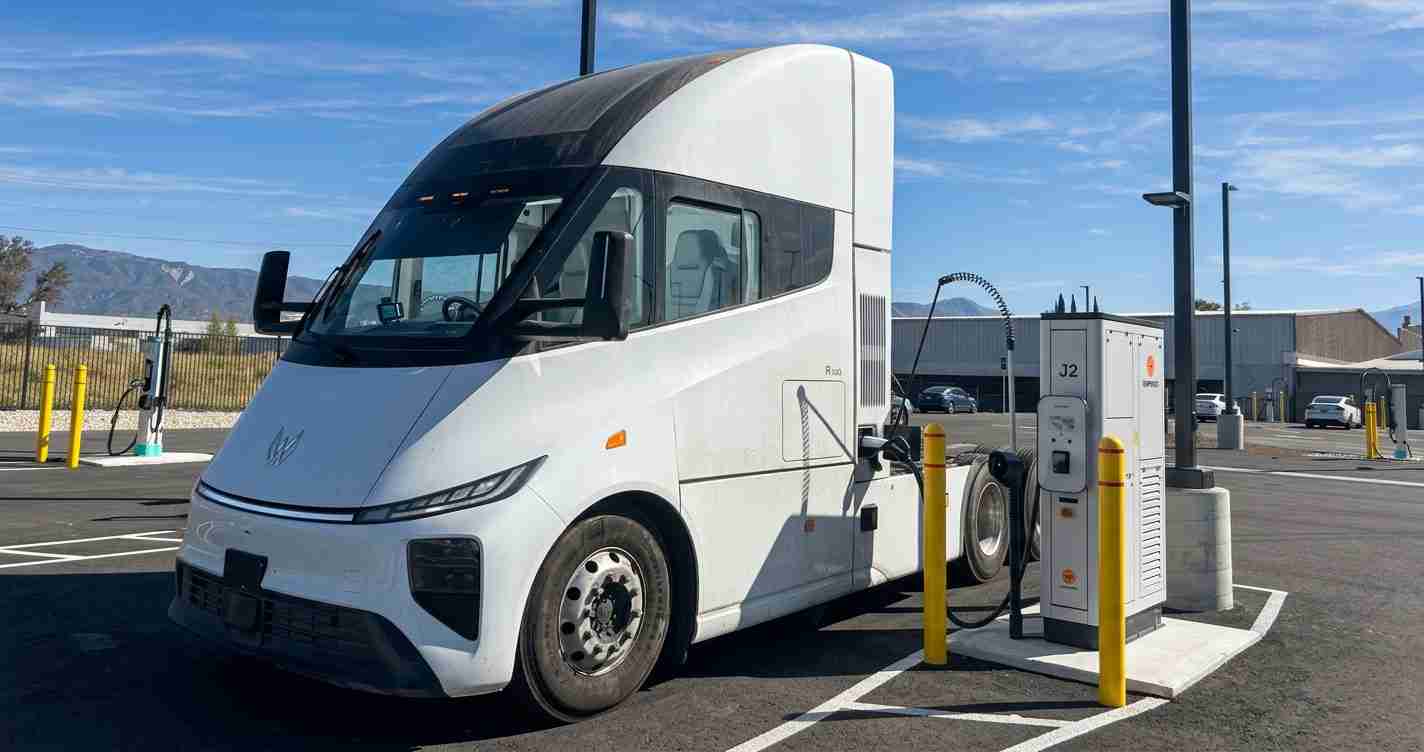
First megawatt truck charging in North America tested at San Bernardino EV charging hub, clearing a hurdle for heavy-duty electric trucks
Kempower and EV Realty completed North America’s first megawatt truck charging session at EV Realty’s San Bernardino hub using a Kempower Mega Satellite MCS, demonstrating real-world interoperability and accelerating heavy-duty fleet electrification nationwide deployment prospects for trucks and fleets.
Key takeaways
- Milestone test: Kempower, Windrose and EV Realty completed the first North American Megawatt Charging System (MCS) truck charge at EV Realty’s San Bernardino hub (Electrek; Charged EVs).
- Power and speed: The site pairs a 1,200 kW Kempower Power Unit with two Mega Satellite dispensers to deliver up to 1.2 MW and 1,500 amps using liquid-cooled cables.
- Operational impact: MCS can shrink charge times, reduce fleet downtime and enable high charger turnover, supporting more trucks per day and lower operating costs (CALSTART).
- Scalable hubs: EV Realty’s larger site concept could serve up to 200 trucks per day and scale to multi-megawatt capacity to meet fleet needs (Automotive World).
Main story
Inside the San Bernardino site
What was tested: The session used a Kempower Mega Satellite MCS connected to a 1,200 kW Kempower Power Unit and two dispensers, delivering up to 1.2 MW and 1,500 amps of continuous power. To manage thermal loads and keep charging stable at these extreme levels, the site relies on liquid-cooled cables, a critical component for reliable megawatt charging (Electrek; Charged EVs).
“We are building sites that can serve any heavy‑duty truck, including those utilizing MCS. This test confirms that we will be ready for real‑world MCS charging when the trucks hit the road later this year,” — Suncheth Bhat, EV Realty chief commercial officer.
Why MCS matters for fleets
The Megawatt Charging System (MCS) is a purpose-built standard for large, heavy vehicles that can deliver more than 1 MW of power — far beyond passenger fast chargers. That power level can dramatically reduce charging time for long‑haul trucks, cut vehicle downtime, and help fleets maintain tight schedules. CALSTART notes MCS can improve route completion and reduce fleet downtime, enabling more freight movement per vehicle.
Operationally, faster charging means trucks can top up during loading or driver swaps, avoiding long idle periods and allowing a single hub to serve more trucks each day — translating to lower operating costs per mile and higher asset utilization.
A step toward deployment, not just a demo
Industry participants emphasized this was a real-world commercial test rather than a lab demo. The session demonstrates that MCS hardware can be installed and operated in working hubs and can interoperate with heavy trucks from different manufacturers. Kempower has already been scaling MCS deployments in Europe; this marks the first time a Kempower Mega Satellite MCS charged a truck in North America (Electrek; Charged EVs).
Windrose, a Chinese truck OEM, participated in the test — reflecting global truck makers’ movement toward long-range MCS‑compatible rigs. The San Bernardino work answers a key industry question about where new electric rigs will charge once they roll out later in 2026.
Broader industry context
MCS supports future scaling up to 3.75 MW (3,750 kW) in later builds, creating a pathway for even faster charging if grid capacity and connector technology advance. The standard has demonstrated momentum globally with prior real‑world sessions in Europe, and Kempower’s recent deployments indicate a shift from pilots to commercial rollouts (Charged EVs; Electrek).
For fleets and charging operators, the move from demonstrations to hubs like San Bernardino is essential: trucks and chargers must arrive together to make electrification practical at scale.
Implications for Fresno, California
Economic impact
Fresno sits on a major freight corridor and in the heart of California’s agricultural supply chain. A working MCS network could make long-range electric trucks practical for regional fleets, reducing diesel fuel costs and generating demand for local charging sites, construction jobs, and electrical upgrades. EV Realty’s hub model — large sites serving hundreds of trucks per day — could attract investment and new employment in charging infrastructure (Electrek; Automotive World).
Political consequences
Local and state leaders aiming for emissions reductions may cite the San Bernardino test as evidence heavy‑duty electrification is feasible at scale, strengthening support for grants, siting approvals and grid upgrades in the Central Valley. At the same time, officials will need to balance permitting speed with neighborhood concerns around truck traffic and grid impacts.
Social effects
Cleaner trucks promise better air quality for Fresno communities long exposed to diesel pollution. Faster charging and shorter turnaround times may reduce truck idling, noise and congestion near freight terminals. Training opportunities in high‑voltage maintenance could expand local job prospects, provided outreach ensures benefits reach impacted neighborhoods (CALSTART).
Cultural relevance
Fresno’s role as an agricultural and logistics hub makes uptime and predictability vital. MCS technology aligns with those priorities by keeping trucks moving on harvest and delivery schedules — an outcome farmers, distributors and small carriers will closely monitor as megawatt charging scales.
Practical applications for daily life
For local drivers and businesses, the shift to electric trucks could mean fewer diesel vehicles and better air quality. For carriers, regional megawatt-capable hubs could cut fueling time and operating costs. However, utilities and municipalities must plan for high-capacity electrical service and potential short‑term construction disruptions as sites are built (Automotive World; CALSTART).
Sources and further reading
- Electrek: Kempower’s first North American megawatt charge at San Bernardino (March 26, 2026).
- Charged EVs: Kempower and Windrose demonstrate MCS at California charging hub.
- CALSTART: Energiize project and MCS benefits for fleets in California.
- Automotive World: Wattev expands California e-truck charging site and capacity.
- Video on MCS specification and power levels
Reporting by Times Media Service.