Palantir CTO says AI is creating a blue-collar productivity boom, pushing back on Sanders’ warning of mass job losses
Palantir CTO Shyam Sankar pushed back on Sen. Bernie Sanders’ warnings, saying AI is driving a blue-collar productivity boom — speeding training, smoothing production and making it profitable for U.S. firms to add shifts and hire workers.
Key takeaways
- AI can expand frontline jobs: Sankar says AI is helping U.S. manufacturers add shifts and hire more workers.
- Training acceleration: AI-driven tools reportedly cut up to years of apprenticeship to months in some cases.
- Policy divide: Sen. Bernie Sanders warns of mass displacement and proposed a data-center moratorium; Sankar emphasizes demand-side applications that create jobs.
- Limits matter: Sankar cautions that organizational software complexity and workplace systems must be fixed for AI to deliver long-term gains.
What Shyam Sankar told investors and reporters
“The real story of AI is not mass unemployment but better use of human labor,” Sankar said to business media and investor audiences.
He described specific manufacturing examples where AI smoothed production plans and made it profitable to add shifts — including an unnamed client that added a third shift after optimization.
Sankar highlighted a concrete case at Panasonic Energy’s Reno battery plant, where he said AI-driven training and clearer workflows helped retrain former casino workers for technician roles in as little as three months instead of years.
He argued that frontline roles — from ICU nurses to factory technicians — can benefit from tools that speed recruitment and day-to-day productivity, and that Palantir focuses on applying AI to real operational weaknesses to build economic strength. (See short clip: short-form clips.)
Senator Sanders’ concerns and the moratorium proposal
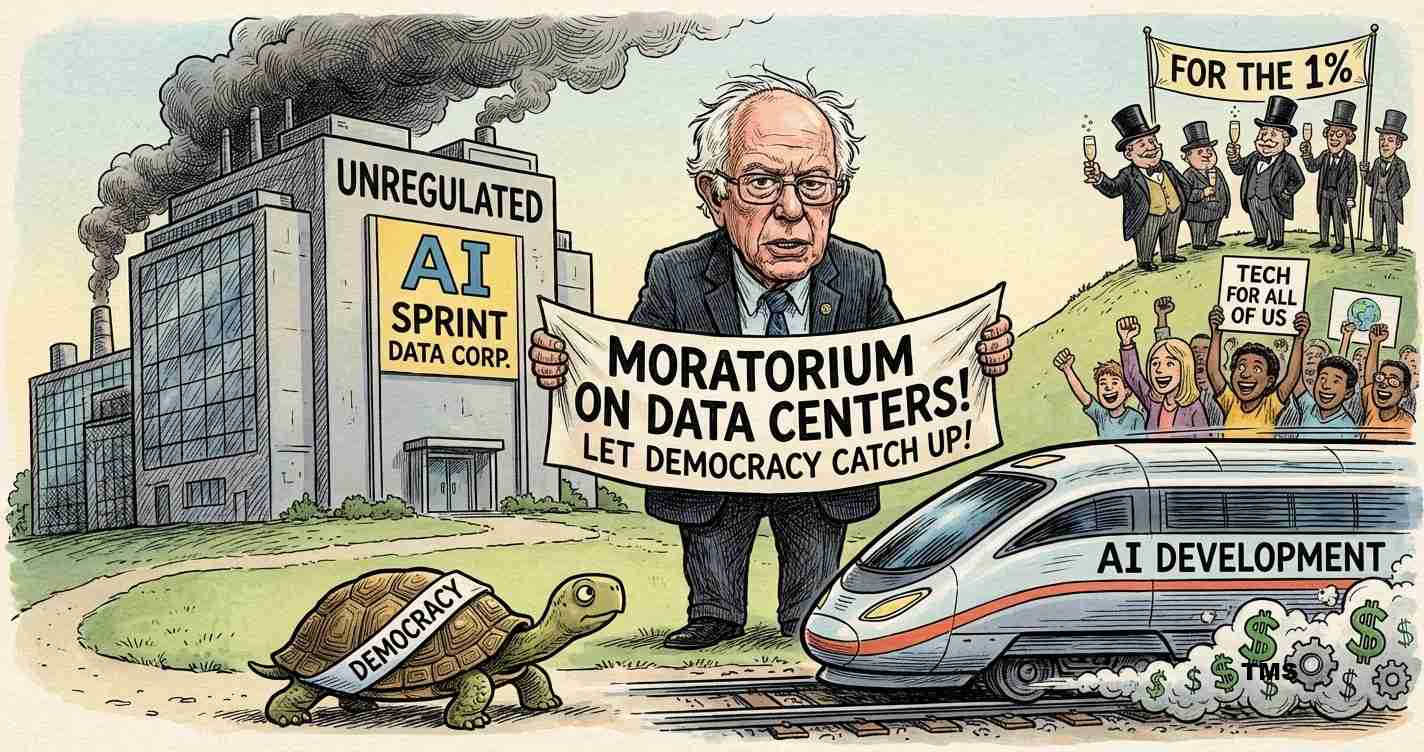
Sen. Bernie Sanders has warned that AI and robotics could eliminate millions of jobs and leave many people without income. In recent public remarks he proposed a temporary moratorium on new data-center construction tied to AI development to allow “democracy a chance to catch up.”
Sanders framed the moratorium as a pause to debate safeguards and to ensure AI benefits are widely shared rather than concentrated among the top 1 percent. Reporting to date summarizes his public video remarks; there is no independent confirmation of enacted legislation or formal progress on the moratorium beyond those statements. (Reporting summary: aggregated reporting.)
Where the data and real-world examples point
Public accounts of AI’s effects on employment remain mixed and often anecdotal. Sankar’s examples — a manufacturer adding a shift and the Panasonic retraining case — suggest AI can reduce training time and lower costs of expanding production, which may translate into new or different jobs.
Independent, nationwide data tying job creation directly to AI adoption are still emerging. Economists caution automation can displace roles even as it creates others; outcomes depend on technology type, local labor markets, industry demand, retraining programs and public policy. Sankar contrasts “demand-side” applications that support work with heavy investment on the supply side like data centers and large models.
Limits of AI and organizational challenges
Sankar’s warning: AI is not a magic bullet; technology can amplify problems if organizations don’t fix hidden software complexity and broken processes first.
Drawing on nearly two decades of experience, Sankar argues companies must address internal issues — fragmented software systems, unclear roles, weak hiring and oversight — before expecting sustained productivity gains from AI. Without those fixes, faster training could raise output without producing broad, stable job gains.
Implications for Fresno, California
Economic impact
Fresno’s economy — manufacturing, food processing, logistics and growing tech services — could benefit if Sankar’s examples scale. Faster retraining and more profitable shifts may make it easier for local firms to expand without importing skilled labor, potentially creating entry-level and technician roles. But payoffs depend on firms’ ability to adopt and maintain tools and on available training pathways.
Political consequences
Moderate Fresno voters may split: Sankar’s private-sector, demand-side framing versus Sanders’ moratorium and environmental concerns about data centers (water, energy) could shape local debates. City leaders will weigh job promises against regulation and community-impact demands.
Social effects
If AI reduces training time, workers from agriculture or hospitality might transition to higher-paying manufacturing or tech-support roles, diversifying incomes. But without accessible retraining at community colleges and workforce centers, accelerated training risks leaving vulnerable workers behind.
Cultural relevance
Fresno communities value stable, long-term employment and strong employer-worker ties. AI-driven hiring and faster onboarding could align with those values if paired with clear pay scales and worker protections; absent those, local concerns about distant corporate gains may intensify.
Practical applications for residents
- Local employers: Evaluate AI scheduling, maintenance forecasting and training tools to see if they make adding shifts viable.
- Workers and trainers: Community colleges and workforce programs should build short, targeted retraining modules aligned to employer needs.
- Policymakers: Require data-center or AI investments to include local-hiring commitments and environmental safeguards when projects are proposed nearby.
- Community groups: Negotiate clear pathways from short training to stable careers with employers adopting AI.
Reporting and source notes
This article draws on Sankar’s public remarks, investor and media interviews, and Sankar’s own essay. Key source links: