
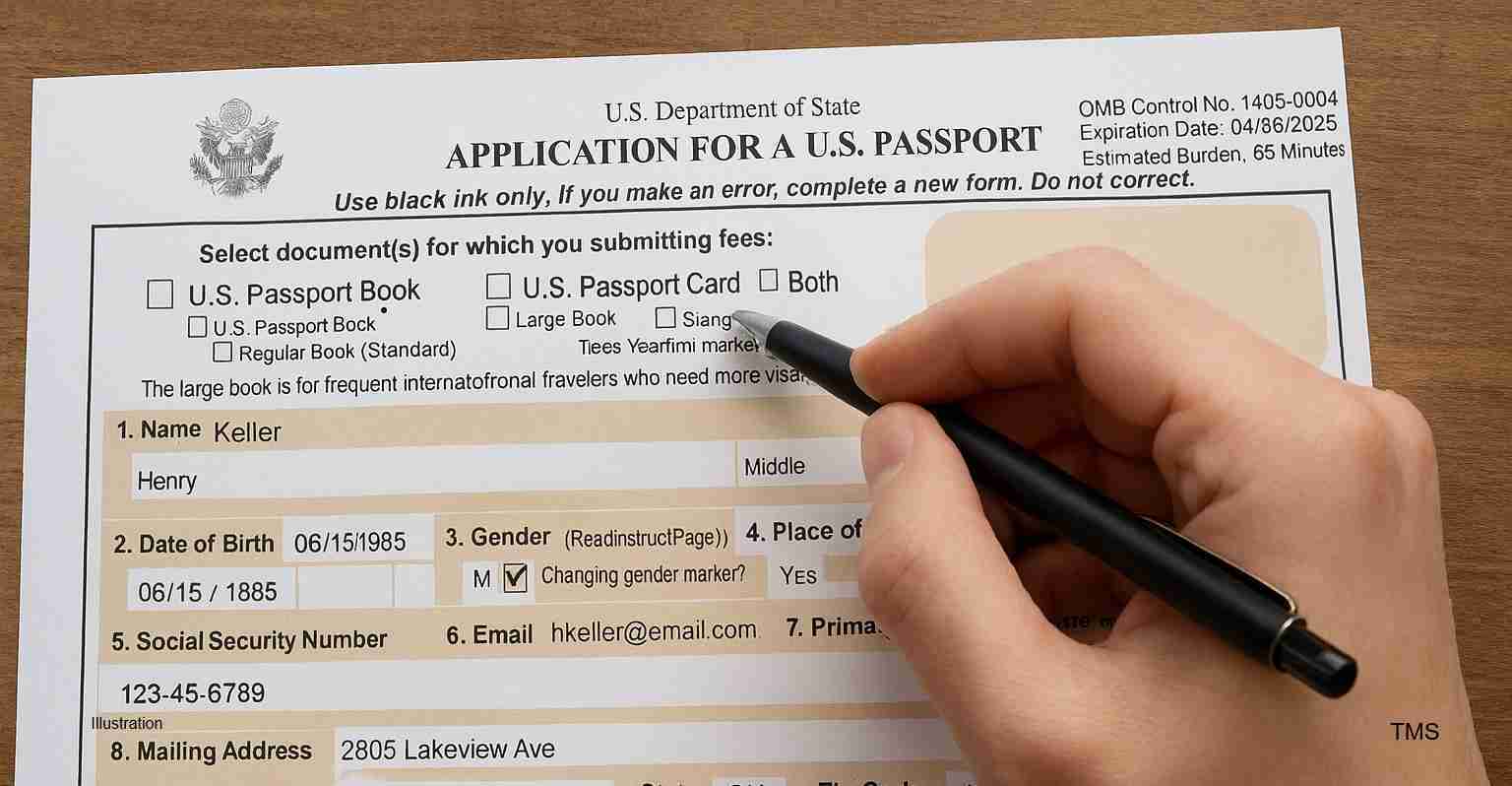
Supreme Court lets Trump-era passport gender policy take effect, ending option for transgender and nonbinary markers
The U.S. Supreme Court has allowed a Trump-era rule requiring passports to list sex assigned at birth, blocking self-identified markers such as “X” for transgender and nonbinary Americans while lower-court litigation continues and sparking advocacy concern.
- Court action: The Supreme Court permitted enforcement of a policy requiring passport sex markers to match the sex on birth certificates while related lawsuits proceed (Supreme Court order, Politico).
- No more self-ID or “X”: New U.S. passports issued under the rule must list the sex on a person’s birth certificate; self-identified markers including “X” are barred while the policy is enforced (Lambda Legal).
- Safety concerns: Civil-rights groups warn that the change raises risks of harassment, detention and discrimination for transgender and nonbinary travelers (ACLU press release).
- Temporary, not final: The order is procedural — it allows enforcement while lower courts continue to consider constitutional challenges and related litigation proceeds (Politico).
Background: policy origins and recent changes
The policy follows a January 2025 executive order directing the federal government to “recognize two sexes, male and female” based on birth certificates and what the order described as biological classification. The State Department revised passport rules to remove options that had permitted changing a sex marker based on gender identity or selecting an “X” marker (ABC7NY, Supreme Court order).
Historical context
Passports began showing sex markers in the mid-1970s. Rules evolved in the early 1990s to allow updates with medical documentation. In 2021, the State Department removed medical-documentation requirements and added an “X” option for nonbinary applicants under the Biden administration (ABC7NY).
Legal battle and Supreme Court action
Transgender and nonbinary people, along with advocacy groups, sued to block the Trump administration’s rule. Plaintiffs argue that listing sex solely based on birth certificates forces many people to carry identification that does not match their gender presentation, increasing the risk of harassment, discrimination and physical danger and impeding travel and everyday activities (ACLU press release).
The Supreme Court’s action: On Nov. 6, 2025, the court’s conservative majority granted the administration’s request to enforce the policy while the underlying legal challenge continues in lower courts (Politico, KESQ/CNN).
The court’s unsigned order compared listing a person’s sex on a passport to listing factual information such as country of birth, framing sex as a historical fact rather than a trait subject to change.
Dissent: Justice Ketanji Brown Jackson wrote for the court’s liberal justices calling the move a “senseless sidestepping” that inflicts avoidable harm on vulnerable people (Supreme Court order).
Arguments from both sides
Supporters argue passports should reflect immutable biological facts and that using birth certificates preserves consistency, identity verification and security in foreign travel (ABC7NY, Economic Times).
Opponents counter that modern passports rely on photos and biometric chips for security, and that forcing birth-certificate–based sex markers creates practical problems for travelers whose gender presentation does not match the passport. Civil-rights groups call the policy discriminatory and warn of increased risks of violence, detention and denial of service (Lambda Legal, ACLU press release).
What the ruling changes now
Because of the Supreme Court’s order, newly issued U.S. passports must list the sex assigned at birth. Nonbinary “X” markers and passport sex changes based on self-identification are not permitted while the policy is in effect. The decision is procedural — it allows enforcement while lawsuits continue in lower courts and does not resolve the policy’s ultimate legality (Lambda Legal, Politico).
Impact on travelers and safety concerns
Advocates warn the change will make international travel harder and more dangerous for many transgender and nonbinary Americans. People whose appearance does not match the sex listed on a passport may face prolonged questioning, denial of boarding, detainment by foreign authorities or harassment during domestic ID checks (ACLU press release).
Rights groups note the rule could compound other federal limits on gender-affirming documentation and create conflicts between federal passports and state IDs or medical records. Lambda Legal has published guidance about how the policy may affect travel and services (Lambda Legal guidance).
Implications for Fresno, California
Economic impact: Fresno relies on travel for business, education and family ties. Universities, agricultural exporters and small businesses that send staff abroad could see extra paperwork, delays and costs if employees cannot obtain passports matching their gender presentation.
Political consequences: Local leaders may face pressure to respond — from resolutions to coordinating legal aid. Fresno’s mixed political landscape increases demand for practical steps to protect residents’ safety and civil rights.
Social effects: LGBTQ+ residents may experience higher stress and safety concerns. Community centers, schools and health clinics could see added demand for counseling and legal help.
Practical advice: Fresno-area travelers should review passport applications carefully and contact local civil-rights groups, community health clinics, campus centers or national organizations for guidance (ACLU, Lambda Legal).
Who is responding locally
National groups including the ACLU and Lambda Legal have condemned the move and are preparing further legal actions (ACLU press release, Lambda Legal). Local Fresno advocacy groups, clinics and campus LGBTQ+ centers are likely to expand advice and document-help services.
What to watch next
The Supreme Court order permits enforcement but is not a final decision on constitutionality. Lower courts will continue hearings, advocates plan additional legal challenges, and officials may track incidents of harassment tied to mismatched ID. State and local lawmakers may consider measures to support residents.
Sources and further reading
- Supreme Court order
- Politico coverage
- ABC7NY
- KESQ / CNN reporting
- Economic Times
- Lambda Legal guidance
- ACLU press release: enforcement allowed
- ACLU press release: ask Supreme Court to reject
For Fresno residents: Contact local LGBTQ+ centers, student support offices at Fresno State, community legal clinics, or national groups above for travel, documentation and legal help. The legal fight continues in the courts and may change as lawsuits proceed.



