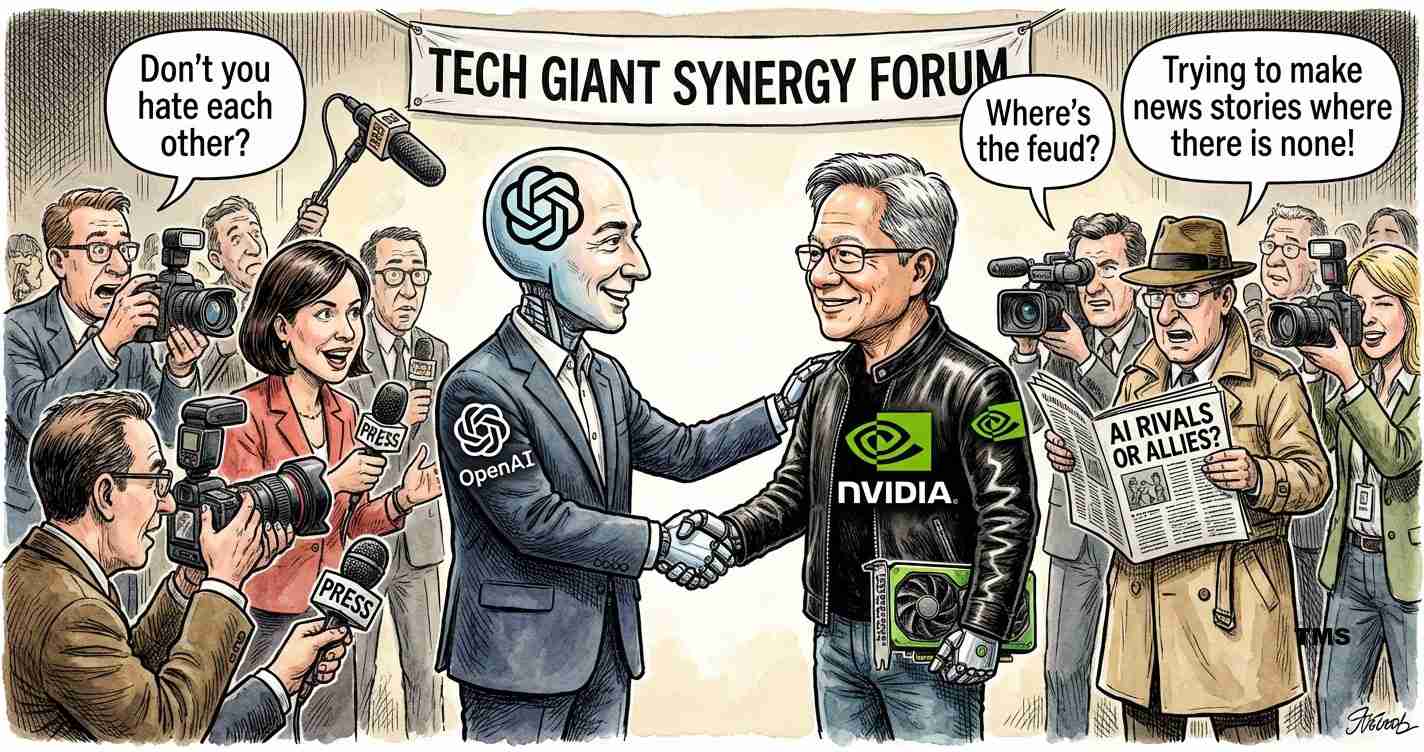
Nvidia Says It Will Make a “Huge” OpenAI Investment, Denies Talks Have Stalled
Nvidia CEO Jensen Huang on January 31, 2026 in Taipei denied reports that talks with OpenAI had stalled, saying Nvidia will make a “huge” investment and will “definitely participate” in the company’s latest funding round.
- Huang pushed back on reports of internal friction and called claims he was unhappy with OpenAI “nonsense.”
- Nvidia reaffirmed its prior letter-of-intent framework to deploy at least 10 GW and potentially invest up to $100 billion progressively.
- Deal remains non‑binding in public filings and reporting; final terms, timetable and commitment levels are still unclear.
- Local impacts: Fresno could see supply-chain, jobs and agricultural-tech benefits — but will face energy, permitting and workforce questions.
Background
Why this matters: The proposed Nvidia–OpenAI arrangement would be one of the largest compute and infrastructure partnerships in AI, with consequences for data‑center siting, energy use and vendor concentration.
What Nvidia announced last year
In September 2025 Nvidia and OpenAI unveiled a strategic partnership to support next‑generation models, intending to deploy at least 10 gigawatts of Nvidia systems. Nvidia’s investor statement framed a progressive commitment of up to $100 billion tied to deployments and milestone triggers. See the Nvidia investor release for the original terms and risk language.
What the Wall Street Journal story said
A Wall Street Journal report published January 30 suggested the plan had run into internal questions at Nvidia. Reporting summarized elsewhere noted executives flagged the $100 billion framework as non‑binding and discussed the scale and structure of any equity commitment. Additional coverage indicated Nvidia had considered a smaller equity stake in the tens of billions range rather than the full $100 billion. See coverage at TechCrunch and discussion at MLQ.ai.
Huang’s response in Taipei
Speaking to reporters in Taipei on January 31, Huang called the reports of friction “nonsense” and said Nvidia would “definitely participate” in OpenAI’s latest funding round. He described the opportunity as “such a good investment,” praised OpenAI’s work as “incredible,” and called the company “one of the most consequential companies of our time,” while declining to specify a final dollar figure and leaving details to OpenAI’s announcement. (Source: TechCrunch.)
OpenAI’s broader funding push
Public reports in late 2025 said OpenAI sought a large funding round, reportedly targeting roughly $100 billion to scale compute and research. That effort drew interest from several major tech and finance players, with Nvidia positioned as a central compute partner as talks continued. An OpenAI spokesperson said companies were “actively working through the details.” For reporting on the broader funding interest and status, see TechCrunch.
Why the debate matters
Ten gigawatts of AI compute represents an enormous commitment of servers, power and cooling. If realized, the partnership would:
- Reinforce Nvidia’s market position as a preferred supplier of compute and networking for hyperscale AI.
- Raise questions about concentration of infrastructure and vendor risk for customers and partners.
- Depend on many contingencies: economic conditions, supply chains, regulatory factors and milestone‑based deployments.
What remains unclear
Neither company has published a final, binding agreement detailing the full financial terms, timetable or mechanics beyond the September 2025 letter of intent. The $100 billion figure was framed as a progressive commitment tied to deployments, and public reporting of internal deliberations suggests negotiations have been provisional. Huang’s January 31 comments aim to reduce uncertainty, but they did not confirm final sums or a timeline. See Nvidia’s investor materials and contemporaneous reporting: Nvidia investor release and TechCrunch.
Implications for Fresno, California
A large Nvidia–OpenAI investment could ripple into Fresno’s economy, politics and society. Below are potential impacts, practical applications and local priorities leaders should watch.
Economic impact
- Supply and services: Increased demand for construction, electrical work, trucking and parts if data‑center projects expand near the Central Valley.
- Jobs and skills: Local training programs could prepare technicians and data‑center operators, though high‑end AI engineering will likely remain concentrated in major tech hubs.
- Agritech benefits: Enhanced AI models could speed development of precision agriculture tools—irrigation scheduling, pest detection and yield forecasting—for Fresno’s farming economy.
Political consequences
- Permitting and grid capacity: Officials may face decisions on siting, incentives and grid upgrades to support high‑power data centers.
- Workforce and oversight: Elected leaders could push workforce development funding while demanding transparency on how public resources support large projects.
Social effects
- Workforce shifts: Some roles may be automated; re‑training investments will help displaced workers transition to tech‑adjacent roles.
- Access and equity: Community leaders should work to ensure AI benefits are accessible to small businesses, schools and health providers.
Cultural relevance
Fresno’s agricultural identity may shape how residents view AI: pragmatically, as a tool for farm efficiency, but also cautiously, given potential changes to labor practices and community norms.
Practical applications for residents
- Farmers: Better crop planning and water management tools tied to larger models.
- City services: Pilot programs could use AI for traffic planning, permitting and emergency response.
- Education: Fresno State, trade schools and nonprofits might partner with firms for internships and certifications.
What Fresno leaders should watch
- Energy and environment: Assess grid readiness, cooling needs and environmental impacts.
- Workforce programs: Explore certifications for data‑center operations, cloud deployment and AI tooling.
- Procurement and access: Consider procurement strategies that give small businesses and public services access while managing vendor risk.
Reporting notes and sources
This article draws on Nvidia’s September 2025 investor release and subsequent reporting summarizing internal discussions and pauses in talks. Primary sources and coverage include the Nvidia investor release, reporting at TechCrunch, and coverage noting pauses or rethinking of terms at MLQ.ai.
Who to watch next
- Nvidia and OpenAI for any formal finalized investment announcements and timetables.
- California energy and planning officials for guidance on data‑center siting and power planning.
- Fresno colleges and employers for workforce initiatives tied to AI infrastructure growth.