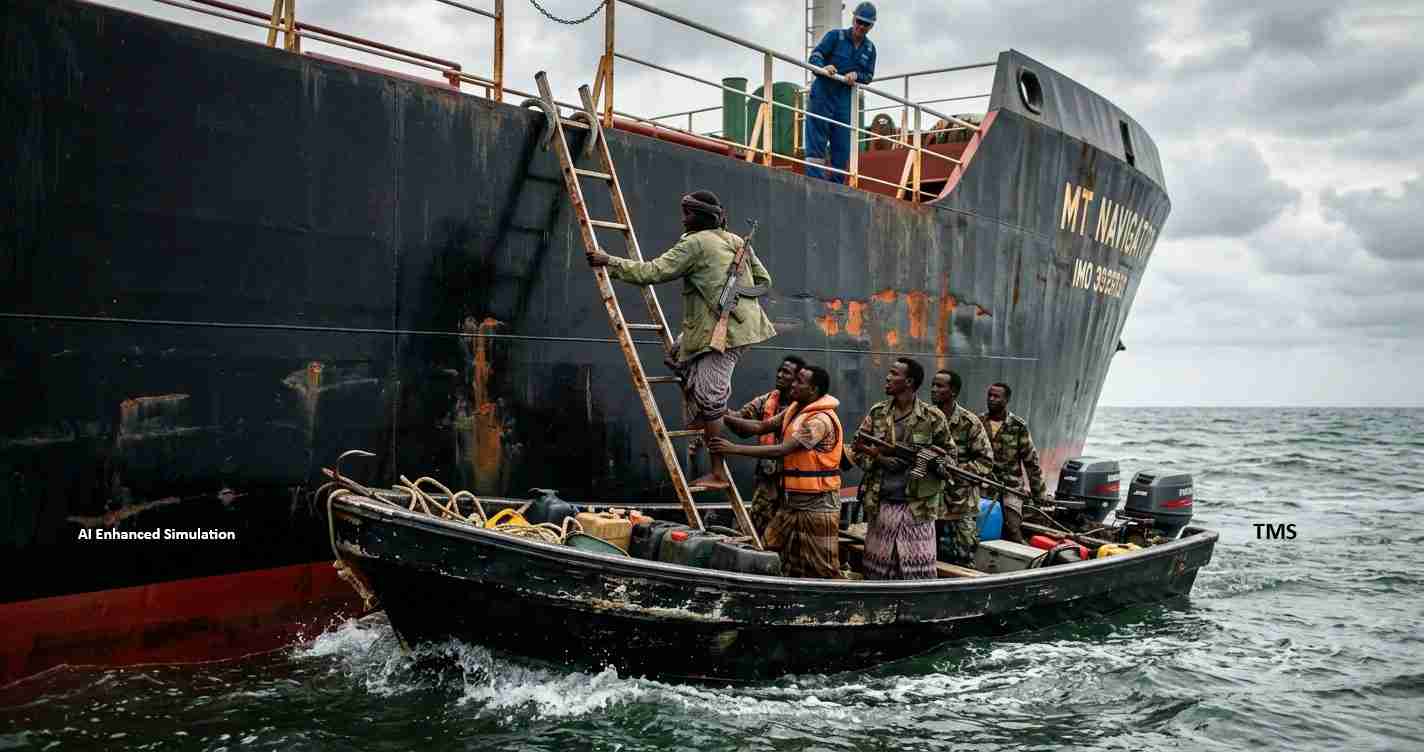
Somali piracy, Houthi alliance fuels fears of a widening Red Sea security vacuum as hijackings surge
A new, dangerous alliance between Somali pirates and Iran-backed Houthi groups has sparked a wave of coordinated hijackings in the Red Sea and Gulf of Aden, threatening oil routes, global trade, and maritime security amid shifting energy flows.
- Revived hijack model: Analysts warn the return of a full-vessel “Somali model” where pirates seize ships, crews and cargo, leveraging Houthi surveillance to pick high-value targets (Fox News).
- Spike in incidents: Multiple seizures and redirects since April 21 prompted maritime risk services to raise threat levels to “substantial” (Windward AI; UKMTO).
- Strategic vulnerability: Rerouted energy flows into the Red Sea and higher oil prices have created a “target-rich” environment that amplifies criminal incentives (Fox News).
What analysts say about the Somali piracy–Houthi alliance
Ido Shalev, chief operating officer at RTCOM Defense and a former Israeli naval officer, describes a transactional partnership where each side has a clear role: Houthis supply geopolitical cover and enhanced GPS/surveillance, while Somali groups provide skiffs, crews and local boarding know‑how. Shalev characterizes this as a return to the “Somali model” — whole-vessel hijackings demanding a single, high-value ransom (Fox News).
Security experts emphasize the coordination advantage: better surveillance lets skiffs close with larger commercial ships more safely and select the most valuable targets. This scale of coordination has not been widely observed in roughly a decade, analysts say (Fox News).
Recent incidents and the surge in attacks
A string of incidents beginning on April 21 prompted the heightened warnings. Reported events include:
- April 21 — a Somali‑flagged fishing boat was reportedly seized.
- April 25 — the Palau‑flagged tanker Honour 25 was taken.
- April 26 — a general cargo ship was redirected to Garacad.
- May 2 — Yemen’s coast guard reported an oil tanker hijacked off Shabwa and steered toward the Gulf of Aden; Reuters later reported the vessel was located and recovery efforts were underway.
Monitors counted at least three hijackings or attempted seizures in a short span, leading maritime risk services to raise the threat level in Somali waters to “substantial” (Windward AI; UKMTO).
Why the Red Sea and nearby waters are attractive now
Energy-routing shifts — prompted by instability in the Strait of Hormuz and Persian Gulf threats from Iran‑backed groups — have moved large crude flows through the Red Sea, including Saudi diversion via the East‑West pipeline to Yanbu. That creates a renewed target field for hijackers seeking loaded tankers.
Higher oil prices increase the payoff: with Brent nearing roughly $115 a barrel this quarter at times, a loaded tanker can be worth tens of millions, making successful seizures far more lucrative and enticing to risk‑tolerant criminal actors (Fox News).
The maritime security vacuum
Analysts warn a security vacuum is emerging as many international naval assets are redeployed to counter missile, drone and other threats across the wider Red Sea and Persian Gulf. That leaves the Horn of Africa approaches with reduced patrol intensity.
“You cannot ‘patrol’ your way out of this; you have to see the threat before it ever reaches the ship,” Ido Shalev told reporters, urging stronger surveillance and early detection in place of patrol‑only strategies (Fox News).
After 2013, sustained multinational patrols and improved onboard defenses largely ended mass Somali piracy. Experts note that success depends on continued international focus; when that focus shifts, old tactics can return as seen in late 2023 and again this spring (ModernGhana; Wikipedia).
Tactics and technology: how the playbook evolved
The pattern blends low‑tech skiffs with high‑tech surveillance. Small, fast boats remain the method for boarding, while Houthi‑linked tools — improved GPS, drones and reconnaissance — help attackers select and time assaults more effectively. The combination increases capability and resilience beyond what either side could achieve alone (Fox News).
Risk firms recommend shipping companies increase vigilance, harden defenses and consider route adjustments — though rerouting around the Cape of Good Hope adds weeks and millions in costs, a difficult tradeoff for commercial operators (YouTube discussion).
Implications for shipping, trade and security
The Red Sea carries roughly 12–15% of global trade and about 30% of container traffic, moving more than $1 trillion in goods annually. Disruptions can raise transport costs, delay shipments and push insurers to raise premiums. A sustained Somali piracy–Houthi threat could force costly rerouting or heavier armed protection, straining supply chains and energy markets (Windward AI; UKMTO).
Implications for Fresno, California
- Economic ripple effects: Higher shipping costs and delays could raise prices for farm inputs, machinery and goods affecting Fresno businesses and consumers.
- Energy prices: Sustained crude price increases may push gasoline and diesel higher locally, raising operating costs for trucking and agriculture.
- Supply chains: Local manufacturers relying on imported parts should review inventories and contingency plans for longer lead times.
- Security & humanitarian concerns: Local immigrant and refugee communities may follow regional instability closely, with possible humanitarian implications.
- Practical steps: County and city planners and businesses should monitor maritime alerts from UKMTO and risk firms like Windward AI, and brief supply‑chain stakeholders on contingency planning.
Sources and further reading
Reporting and analysis for this article referenced maritime alerts, expert commentary and multiple regional sources:
- Fox News — “Somali pirate, Houthi alliance targets $1T oil trade route; revived hijack tactics”
- ModernGhana — background on recent hijackings
- Wikipedia — “Piracy off the coast of Somalia”
- Windward AI — maritime risk monitoring
- UKMTO — U.K. Maritime Trade Operations alerts
- YouTube — discussion on rerouting and shipping choices
- Reuters — reporting on May 2 Yemen coast guard hijacking and follow‑up
Reporting included synthesis of security assessments, interviews reported by regional sources, expert commentary from Ido Shalev of RTCOM Defense, and tracking of maritime alerts and hijacking reports.