
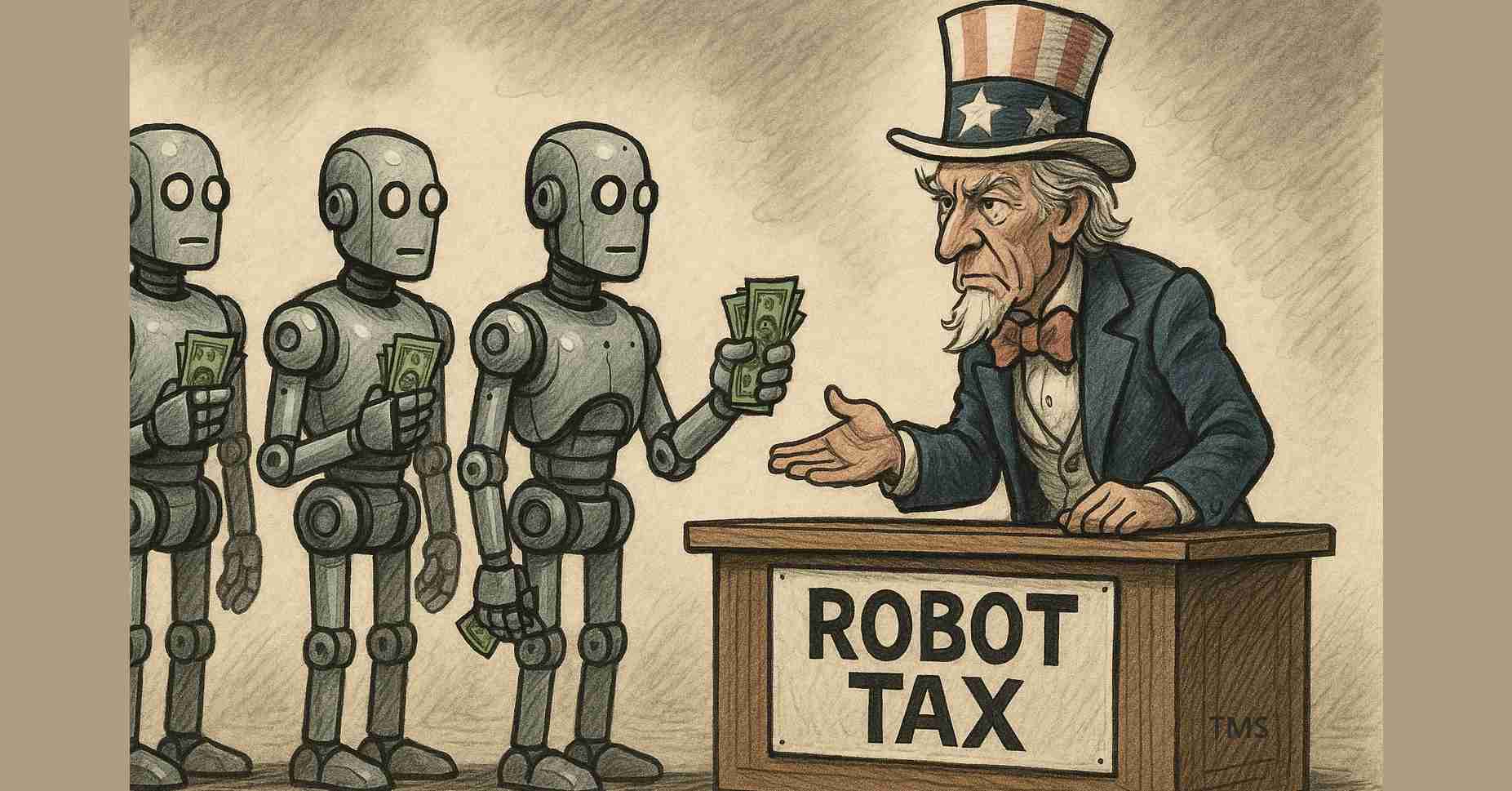
Democrats push “robot tax” as new Senate report warns AI could wipe out nearly 100 million U.S. jobs
A Senate report warns artificial intelligence and automation could eliminate nearly 100 million U.S. jobs within a decade, with fast food roles facing an estimated 89% loss. Democrats, led by Sen. Bernie Sanders, propose a “robot tax”.
- Mass displacement risk: A HELP Committee staff analysis estimates up to ~100 million U.S. jobs could be automated in 10 years.
- Highest-risk roles: Fast food and counter workers face an estimated 89% job loss; many service and repetitive-task jobs are most vulnerable.
- Policy response: Democrats, led by Sen. Bernie Sanders, propose a levy on companies that replace human jobs with machines to fund retraining and supports.
- Debate: Supporters call it fair; critics warn it could slow innovation and complicate enforcement.
What the Senate report found
The Senate Health, Education, Labor and Pensions (HELP) Committee staff combined labor data with machine-assisted analysis to estimate automation risk across 20 major workforce sectors. The analysis concluded that 15 of 20 sectors could see a majority of positions automated within a decade, with the greatest exposure in repetitive, predictable tasks (Fox Business; Yahoo).
Selected sector risks (report highlights)
- Fast food and counter workers: 89% projected job loss — about 3 million jobs at risk (Fox Business; Yahoo; Mitrade).
- Customer service representatives: 83% automation risk (Yahoo).
- Laborers and freight/material movers: 81% risk (Yahoo).
- Secretaries and executive assistants: 80% risk (excluding highly specialized legal, medical, executive roles) (Yahoo).
- Truck drivers: 47% risk (Yahoo).
- Registered nurses: 40% risk — lower than many service roles but still material (Tech.co).
The committee noted that jobs dependent on repetitive tasks and rule-based work show the highest vulnerability, while roles requiring emotional intelligence, complex judgment, or unpredictable physical work remain comparatively resilient. The methodology included machine-assisted classification tools — even leveraging ChatGPT — to help identify susceptible tasks (Fox Business; Yahoo).
The “robot tax” proposal
Leading Democrats, most visibly Sen. Bernie Sanders, propose a levy on companies that replace human labor with machines or AI systems. Under the broad concept, firms would pay a fee for each job displaced; proceeds would fund retraining, temporary income support and other transition programs (Fox Business; Mitrade; Mexc).
“When companies capture productivity gains and higher profits through automation, society should not be left to pay the social costs,” proponents argue, framing the levy as a way to finance a managed transition.
Opponents and economic concerns
Critics — including many economists and tech advocates — warn a robot tax could have negative side effects: slowing innovation, reducing competitiveness, and discouraging investments that create new industries and roles. They argue policy should prioritize education, retraining and portable benefits rather than directly taxing productivity-enhancing tools (Reason; AOL).
Practical design questions remain: how to count software substitutions, how to treat hybrid human-AI teams, which firms and sectors are covered, and how to administer payments so they reach displaced workers effectively.
Other Democratic policy ideas
Beyond a robot tax, Democrats have proposed a menu of policies to share automation gains and protect workers: a 32-hour workweek pilot, corporate profit-sharing, worker representation on corporate boards, and expanded retraining through public institutions (MeriTalk).
How the report was put together
The HELP Committee staff merged labor statistics with machine-assisted tools to classify tasks and estimate susceptibility to automation. This approach aligns with other studies that correlate task repetitiveness and predictability to higher automation risk, while human-centric roles show lower vulnerability (Fox Business; Yahoo; Tech.co).
Policy trade-offs and public debate
The magnitude of the projection — nearly 100 million jobs — has sharpened the national debate. Supporters argue bold action is necessary to prevent lasting inequality; opponents caution that blunt taxes could backfire. Ultimately, the debate will hinge on implementation details:
- Which companies and technologies are covered;
- How displaced workers are identified and supported;
- Which training and benefit programs receive funding;
- How to balance innovation incentives with social protections.
Implications for Fresno, California
Economic impact: Fresno and the San Joaquin Valley rely heavily on low-wage service, food service, agricultural processing and logistics work — sectors flagged as highly vulnerable. An 89% risk for fast food roles threatens many entry-level positions that sustain local households (Fox Business; Yahoo; Mitrade).
Political consequences: Local leaders may face pressure to secure retraining funds, lobby for federal aid, or design incentives to preserve human employment. The debate could divide business owners, labor groups, and residents.
Social and cultural effects: Displacement would disproportionately affect lower-income, immigrant and working-class communities. Work in the Central Valley ties to identity and daily life; rapid automation could strain social fabric and alter career expectations for younger residents.
Practical applications and next steps
Local workforce boards, community colleges and employers will be central to any transition. Fresno-area institutions could seek federal funds generated by a robot tax or other programs to expand retraining for in-demand roles (healthcare, advanced manufacturing, technology support for automation).
Potential actions include:
- Short-term certificates and apprenticeships aligned with local demand;
- Bilingual training and support to reach immigrant workers;
- Employer partnerships for on-the-job upskilling so workers can operate alongside AI systems rather than be displaced.
Sources and further reading
Prominent voices have also weighed in: business leaders such as Bill Gates have urged that firms profiting from automation should help fund transition costs (Mitrade; Mexc).



