Scientists say Easter Island Moai walked — new study cracks Moai statues transport mystery
A new study in the Journal of Archaeological Science shows Easter Island’s Moai were transported upright by a controlled “walking” method, matching Rapa Nui oral tradition and solving a centuries-old transport mystery with mapping, models and field tests.
- Upright, walking transport: Researchers show Moai were moved upright and rocked forward in a controlled walk, consistent with Rapa Nui accounts and experimental demonstration (ScienceDaily, Live Science).
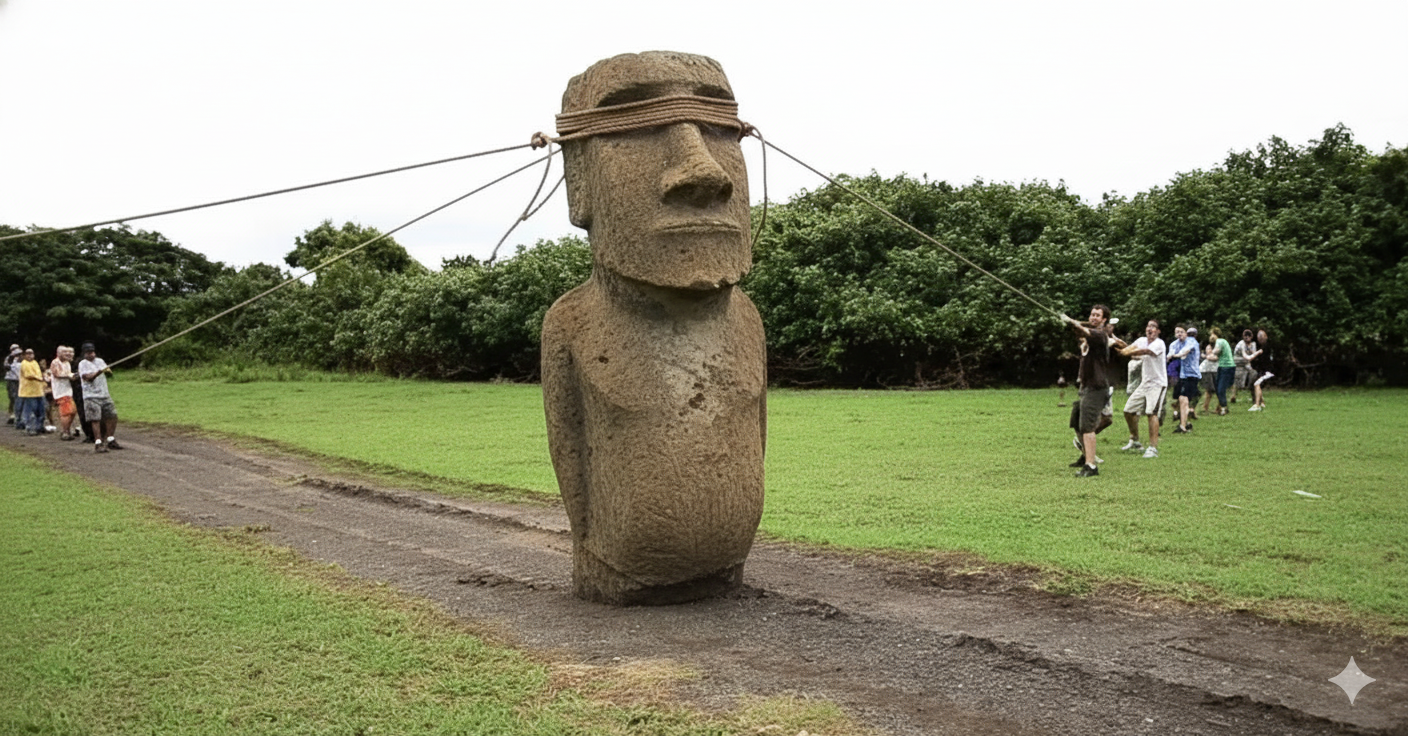
- Data and experiments: Study analyzed 962 Moai and island roads and tested a 4.35‑metric‑ton replica moved ~328 ft in 40 minutes with ~18 people, supporting a pendulum-like rock-walk technique.
- Environmental implication: Findings reduce the need for large-scale deforestation theories and highlight the Rapa Nui’s efficient engineering and planning.
Research findings and evidence
Overview: The paper combines 3D modelling, statistical mapping, field surveys and hands-on experiments to test a hypothesis long preserved in oral tradition. Researchers conclude physical evidence, roads and experiments align with a pendulum-like rock-walk method.
What the study examined
Researchers surveyed 962 Moai across Easter Island, including those along ancient paths and at quarry sites. Many statues display a D-shaped base and a forward tilt that would facilitate rocking and pivoting while upright — a design feature consistent with walking transport.
Rapa Nui oral tradition
Rapa Nui stories long stated the Moai “walked” to their locations. The new research treats those oral histories as data, finding a strong match between legend and measurable features on statues and roads, strengthening both the narrative and the science.
Field experiments and replica testing
To validate the method, scholars built a faithful 4.35‑metric‑ton replica with the same base shape and forward lean. Teams of roughly 18 people used ropes to rock the replica side to side, pivoting it forward in small steps — moving it ~100 meters (328 feet) in ~40 minutes. This practical test demonstrates the technique’s feasibility and efficiency compared with earlier dragging-on-logs theories.
The physics and technique
The study describes a pendulum-like or “rock-walk” technique: ropes attach near the statue’s head and sides, teams pull in rhythm to tilt the statue, then alternate sides to pivot it forward. Simulations indicate step lengths around 35 inches (89 cm) are possible, with the required crew size depending on statue mass; smaller steps and coordination reduce toppling risk.
Ancient roads and infrastructure
Archaeologists mapped roads from the quarry to ceremonial ahu. Many paths are ~4.5 meters wide with a concave cross-section — a likely stabilizing feature for upright transport. Road layouts suggest intentional planning to support walking movement, not only random dragging.
Labor, resources and environment
By showing smaller organized teams could move statues using ropes and engineered routes, the walking theory reduces the need for hypothesized island-wide deforestation and highlights the Rapa Nui people’s design and coordination skills.
Why this matters
Closure: Combining mapping, simulations and hands-on experiments yields a solution that fits statue geometry, road layouts and oral tradition. Researchers argue the walking Moai hypothesis now best matches the available evidence.
Implications for Fresno, California
Local institutions in Fresno can translate this discovery into educational, cultural and economic opportunities while emphasizing respect for Indigenous knowledge.
Economic impact
Fresno-area museums, tour groups and cultural centers may see increased interest in Pacific archaeology. The walking Moai narrative could inspire traveling exhibits, virtual programs and partnerships that attract visitors and funding to the region.
Political consequences
Local leaders supporting cultural education and tourism can use this discovery to expand international ties and consider funding programs that integrate Indigenous perspectives into schools and public planning.
Social effects
The finding elevates indigenous knowledge, demonstrating that oral tradition can preserve technical truth. Fresno schools, community centers and libraries can use the story to teach science, history and cultural respect.
Cultural relevance
Museums and cultural groups in Fresno should pair scientific exhibits with Indigenous voices to represent histories accurately — showing how tradition and evidence complement each other.
Practical applications
Engineering and anthropology programs at Fresno State can adopt the walking Moai as a case study in design, physics and community coordination. The method demonstrates problem-solving with limited resources and offers hands-on student projects and demonstrations.
Local partnerships and outreach
Fresno nonprofits and schools can reach out to Pacific cultural groups and researchers for joint programming. Virtual talks by study authors or Rapa Nui speakers could be hosted locally to strengthen ties and provide hands-on learning.
Reporting and next steps
Researchers plan further testing of additional statues and refined models. Fresno educators and cultural leaders may follow developments and emulate the research model that combines community knowledge with laboratory study.
Sources and further reading
Full reports and coverage are available from these sources for readers seeking technical details and original reporting:
- Local12 report
- Fox News travel coverage
- ScienceDaily summary
- Live Science explanation
- Sci.News analysis
- University paper and publication page (Arizona)
- SSRN paper abstract
“The match between physical evidence, roads and Rapa Nui oral traditions strengthens confidence that the walking method describes real transport practices.”