Trump unveils “Golden Fleet” of Navy battleships, vows rapid buildup of up to 25 ships
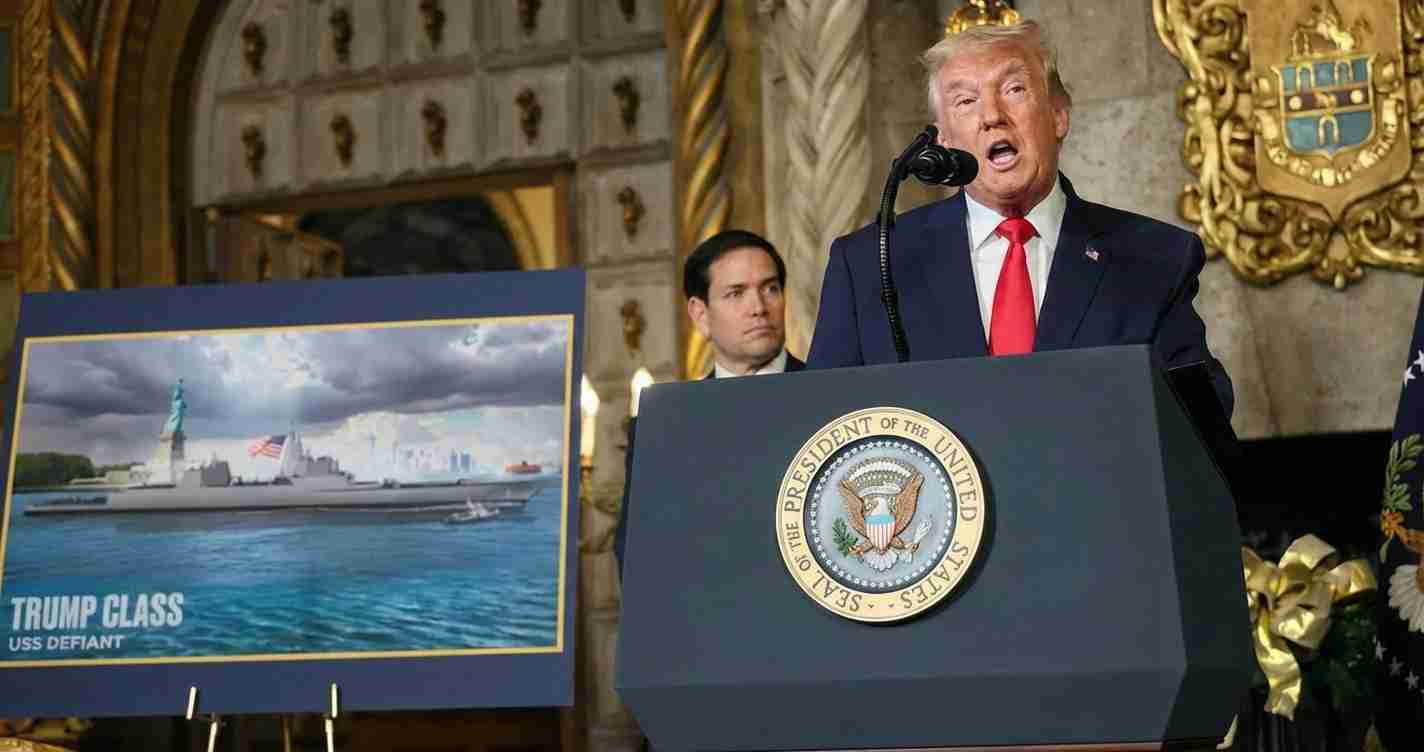
President Donald Trump unveiled the “Golden Fleet” on Dec. 22, 2025, announcing plans to build a new class of advanced Navy battleships, starting with two ships and aiming for 20 to 25 vessels to expand U.S. surface naval power.
Key takeaways
- Announcement: President Trump unveiled the Golden Fleet on Dec. 22, 2025, flanked by Pete Hegseth and John Phelan; see the announcement video.
- Scope: The class is described as more powerful than any previously built and among the most lethal surface ships short of submarines.
- Procurement plan: Immediate purchase of two ships, scale to 10, and ultimately 20–25 ships, with the first two due in roughly 2½ years.
- Gaps: The public unveiling included no detailed specs, cost estimates, funding pathway, or contractor and yard names.
What Trump announced
President Trump, joined by Secretary of War Pete Hegseth and Secretary of the Navy John Phelan, presented the Golden Fleet as a major expansion of U.S. surface naval power. The White House framed the program as a step to boost American naval strength and accelerate defense production.
The administration said it would immediately procure two ships, ramp production to about 10 ships, and eventually build 20 to 25 vessels. Officials emphasized speed, saying the first two ships could be delivered within roughly two and a half years. Available video shows the announcement remarks but lacks technical schematics or a formal fact sheet. See the announcement video for the full remarks.
What the public record does not show
- Technical specifications: No full design, armament lists, or performance metrics were released.
- Cost estimates: The unveiling included no per-ship or program cost figures.
- Funding path: The administration did not detail how it will pursue funding from Congress.
- Contractors and shipyards: No shipbuilder names, design partners, or yards were identified at the event.
- Political reaction: Early coverage is sparse; formal congressional responses and allied reactions were not included in immediate reporting.
Limited reporting so far
Early coverage is primarily video-based and has been reposted in short segments by outlets including FOX 5 New York and NewsNation. There is no full transcript, detailed policy paper, or formal Navy release publicly available in the immediate record. See related video coverage and the NewsNation brief linked in event coverage.
Why experts will watch closely
Large naval programs are complex and expensive. Rebuilding a class of battleships after a decades-long break typically requires:
- Extensive design work and engineering validation
- Industrial planning and shipyard capacity assessments
- Supply-chain expansion and long-lead part procurement
- Multi-agency oversight and congressional authorization
The administration’s timeline — two ships within 30 months and many more thereafter — raises feasibility questions about design freeze, shipyard capacity and parts sourcing.
Budget and oversight considerations
Any multi-ship program of this scale will require congressional appropriations. Expect the Golden Fleet plan to move into Capitol Hill hearings where lawmakers will weigh costs, strategic need, industrial benefits and trade-offs with other defense priorities. The administration has not yet specified when formal budget requests or oversight mechanisms will be filed.
Political dynamics and messaging
The announcement served both as a policy pitch and as political messaging. Naming high-profile officials such as Pete Hegseth and John Phelan framed the event as leadership-driven. The president’s claim that these ships will be “more powerful than any we have built” is likely to prompt partisan debate over strategic priorities and spending choices.
Implications for Fresno, California
Economic impact
Jobs and suppliers: Fresno is inland and has no shipyards, but a major naval build could boost work for California companies that supply parts, electronics and support services. Local manufacturers and defense suppliers could see new opportunities if California contractors win work.
Regional dollars: Increased defense spending in California could yield state and local tax revenue gains and indirect job creation if companies expand, supporting construction, manufacturing and service jobs across the Central Valley.
Political and civic effects
- Local officials: Fresno representatives will likely seek briefings from the Pentagon and Navy and press for contracts that benefit local industries and workers.
- Veterans and recruiting: A high-profile naval program can raise awareness of sea service careers and boost recruiting efforts in the region, where there is a sizable veteran population.
Practical community concerns
- Timeline skepticism: Community leaders will want clear timelines and contract commitments; ship programs often face delays.
- Workforce development: Local colleges and trade programs could partner to train workers for shipbuilding-related roles, but that requires planning and time.
What comes next
The announcement sets a political and strategic direction but leaves technical, financial and procedural steps to follow. Fresno-area businesses, public officials and civic groups will watch for Navy releases, budget requests to Congress and announcements naming contractors or shipyards. Fuller details should appear in formal Defense Department or Navy briefings and in congressional hearings to fund and authorize the program. See the announcement video, related video coverage, and the NewsNation brief.