
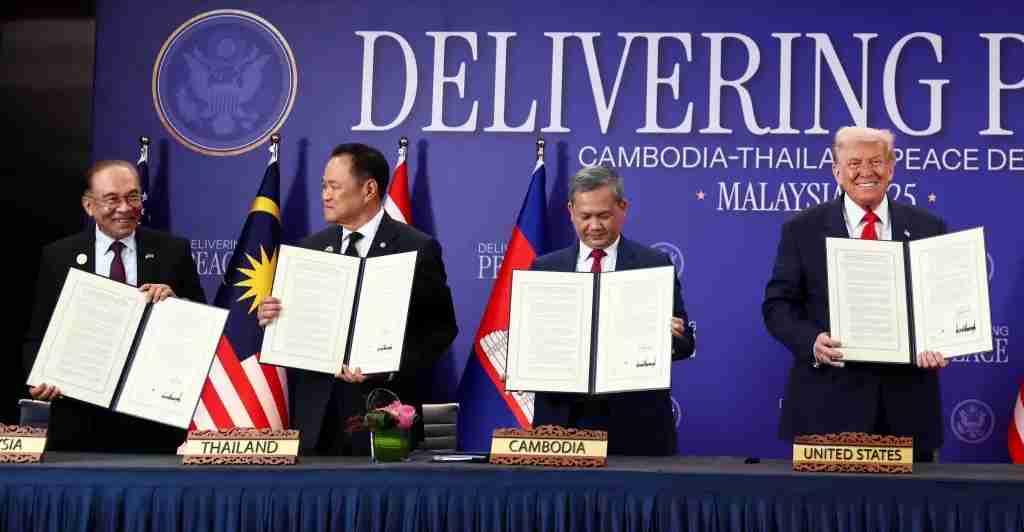
Trump witnesses Thailand, Cambodia sign expanded ceasefire — Kuala Lumpur Peace Accord aims to end border fighting
At the ASEAN Summit on Oct. 26, 2025, President Donald Trump witnessed Cambodia and Thailand sign the Kuala Lumpur Peace Accord, expanding a July ceasefire to end border hostilities, free detained soldiers and remove heavy weapons.
Key takeaways
- Kuala Lumpur Peace Accord: Signed Oct. 26, 2025, by Cambodian PM Hun Manet and Thai PM Anutin Charnvirakul, witnessed by U.S. President Donald Trump.
- Immediate measures: End to hostilities, release of 18 detained Cambodian soldiers, removal of heavy weapons, and talks on landmine clearance.
- Monitoring: Creation of an ASEAN Observer Team (AOT) to monitor implementation and compliance.
- U.S. role and incentives: The U.S. and Malaysia helped facilitate the deal; trade and tariff leverage were tied to continued peace and economic deals.
Main story
Background: how the border crisis escalated
Tensions trace back decades to a long-running border dispute between Cambodia and Thailand. In July 2025 the dispute erupted into open fighting, with reports saying the clashes left dozens dead and forced hundreds of thousands from their homes.
An initial July ceasefire, brokered with U.S. involvement, reduced violence but did not resolve the core territorial issues. The Kuala Lumpur Peace Accord builds on that July agreement to seek a fuller halt to hostilities and measures to rebuild trust.
What the Kuala Lumpur Peace Accord says
The joint declaration signed in Kuala Lumpur lays out practical steps to stop fighting and reduce risk to civilians:
- Cease of hostilities: Both governments pledged to end offensive operations and refrain from use of force along the disputed border immediately.
- Prisoner release: Thailand agreed to free 18 Cambodian soldiers detained during recent clashes as a confidence-building measure.
- Weapons and mine talks: Both sides will remove heavy weapons from forward positions and initiate talks on landmine and military machinery removal.
- ASEAN Observer Team: The accord establishes an AOT, with members from ASEAN states, including Malaysia, to monitor compliance and report on implementation.
“The pledge is immediate and binding under the accord’s terms,” the joint declaration says, spelling out concrete steps to lower the chance of renewed clashes.
Diplomacy and the U.S. role
Visible U.S. engagement: President Trump’s presence at the signing underscores renewed U.S. activism in Southeast Asia. According to reporting and official statements, the White House used a mix of incentives and pressure — including economic carrots and threats of higher tariffs — to bring both sides to the table.
Notable diplomatic dynamics: Malaysian Prime Minister Anwar Ibrahim helped facilitate talks and attended the ceremony alongside President Trump. Reports note that Chinese officials were not part of the ceremony, a detail observers say reflects shifting influence and diplomatic choices at the summit.
Trade links tied to peace
In remarks tied to the ceremony, President Trump linked further economic engagement to the stability of the agreement, announcing plans for a U.S.-Cambodia trade deal and a critical minerals agreement with Thailand — both conditioned on the accord holding. This represents a strategy of coupling security outcomes with trade incentives.
Monitoring and enforcement challenges
Analysts warn several steps are needed to make the accord durable: the ASEAN Observer Team must be resourced and granted full access to the border; heavy-weapon removals and mine clearance will take time and require on-the-ground verification; and longstanding territorial claims and nationalist politics could still spark flare-ups if implementation stalls.
Local voices and regional reaction
ASEAN response: Leaders in the bloc praised the accord as a positive move toward regional stability. Rights groups and humanitarian organizations will be watching the safe return of displaced civilians and the pace of mine clearance.
International media covered the signing live; a recording of the event and remarks has been posted online by official sources.
Implications for Fresno, California
Economic ties and trade policy: Fresno’s agriculture and food-processing industries could be affected if trade deals tied to the accord change market access or shift tariff regimes. Improved trade flows with Southeast Asian partners may steady export demand; conversely, short-term tariff moves could raise import costs for inputs.
Humanitarian and community effects: Fresno’s sizable Cambodian and Thai communities may see eased anxieties if violence declines. Local nonprofits that assist refugees and immigrants could see caseload changes and may refocus on integration and economic support if fewer people flee.
Supply chains and critical minerals: A U.S.-Thailand critical minerals deal could affect technology and clean-energy supply chains reaching California manufacturers and universities, reducing supply risk over time.
Political and civic implications: Local leaders and voters in Fresno may press for clarity on how national foreign and trade policy impacts jobs, exports and community support for families with ties to the region.
Practical takeaways for residents
- Farmers and exporters should monitor trade announcements tied to the accord for potential new markets or tariff changes.
- Community groups should track developments affecting immigration, remittances and family reunification.
- Local businesses that depend on imported parts or materials should assess how critical-minerals agreements might alter supply stability.
Sources
- Channel News Asia reporting on the signing and details
- Fox News coverage of Trump’s role and the expanded ceasefire
- White House joint declaration text
- Video of the signing event
- Background summary of the 2025 border crisis
(Reporting by Times Media Service)



