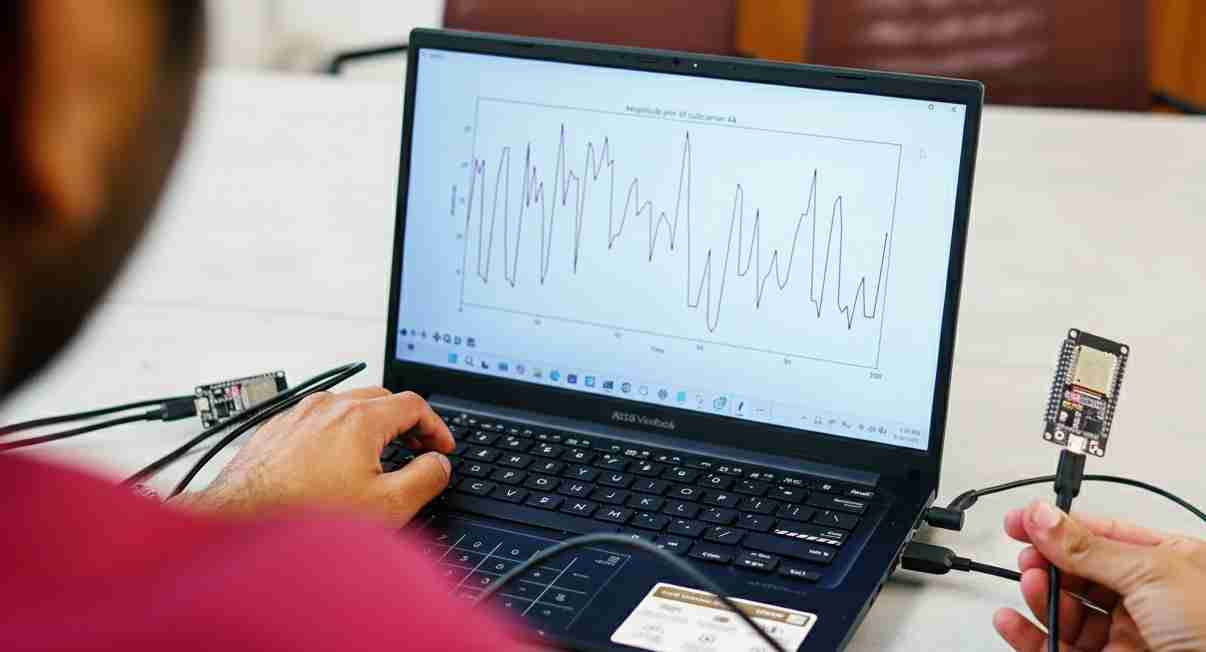
Wi‑Fi heartbeat detection: UCSC’s Pulse‑Fi system can read your pulse without wearables
Researchers at the University of California, Santa Cruz unveiled Pulse‑Fi, a system that uses standard Wi‑Fi signals to detect heartbeats without wearables, offering low‑cost, non‑contact monitoring from up to 10 feet away for home and clinical use.
Key takeaways
- Non‑contact heart monitoring: Pulse‑Fi uses ordinary Wi‑Fi transmitters and receivers to detect heartbeats with clinically relevant accuracy — see the UCSC news release on Pulse‑Fi.
- Works from a distance: The system detects tiny chest and vessel motions caused by each heartbeat from up to 10 feet away (coverage detailed by UCSC and Tom’s Hardware).
- Machine learning pulls signal from noise: Neural networks trained on paired Wi‑Fi and medical oximeter data extract heartbeat patterns from noisy RF readings (UCSC; Tom’s Hardware).
- Low‑cost hardware: Demonstrations used ESP32 chips and Raspberry Pi devices, signaling potential for cheap, wide deployment (Tom’s Hardware; UCSC).
How Pulse‑Fi works
Pulse‑Fi turns ordinary Wi‑Fi radio waves into a remote stethoscope. Wireless signals travel through and bounce off the body; each heartbeat causes the chest and blood vessels to move by tiny amounts, slightly changing the Wi‑Fi signal. Those minute changes are normally buried in noise, so the UCSC team collected synchronized medical pulse data with raw Wi‑Fi readings and trained neural networks to spot the heartbeat pattern inside the signals.
The researchers say the system can isolate a person’s pulse even as people shift posture and as common room activity changes. Supporting coverage and summaries are available from UCSC and Earth.com.
Accuracy and hardware
In lab tests, Pulse‑Fi estimated heart rate with an error as small as about half a beat per minute after five seconds of data collection. Accuracy improved with longer monitoring windows and with stronger or more sensitive receivers. The team describes that precision as clinically relevant, suggesting the approach could be useful for medical or home health uses pending broader validation.
Demonstrations used inexpensive, off‑the‑shelf components such as ESP32 chips (retailing under $10) and Raspberry Pi devices, which produced strong results. This suggests Pulse‑Fi could be integrated into consumer routers, smart home hubs, or low‑cost monitoring units (Tom’s Hardware; UCSC).
Beyond heart rate: breathing and sleep
The UCSC team is exploring whether the same RF + machine learning method can track breathing rate and detect sleep‑related breathing problems such as sleep apnea. Early, unpublished tests reportedly look promising; potential applications include sleep studies, infant monitoring, and continuous home checks for people with respiratory conditions (UCSC).
Advantages and possible uses
Pulse‑Fi offers several clear benefits:
- Non‑contact monitoring: eliminates wearables or adhesive sensors that can be uncomfortable for infants, older adults, or people with fragile skin (UCSC).
- Low cost and scalability: off‑the‑shelf hardware could allow deployment in clinics, nursing homes, and private homes, and in resource‑limited areas (UCSC; Earth.com).
- Robustness: machine learning models help the system function despite normal movement and different postures (Tom’s Hardware).
Limitations, validation and safety
While the research is a major step forward, the approach was tested in controlled settings and requires larger, independent clinical trials to confirm performance across ages, body types, medical conditions, and real‑world home environments. The team presented results at the 2025 IEEE International Conference on Distributed Computing in Smart Systems and the Internet of Things, providing early peer review; regulatory clearance would likely be required for any medical use (UCSC).
Privacy and ethical concerns
Contactless monitoring raises familiar questions about privacy, consent, and data governance. If routine Wi‑Fi can sense heart rate without a person wearing a device, stakeholders must define who can collect and use that data, where it is stored, and for how long. Policymakers, privacy experts, and healthcare providers will need to weigh benefits against risks as the technology develops; discussion and safeguards are likely to follow (ENN; Earth.com).
Research recognition and next steps
Pulse‑Fi was showcased at the 2025 IEEE conference on distributed computing in smart systems and IoT. The team plans to expand testing, explore breathing‑rate detection, refine models for real‑world deployment, and pursue wider studies and collaborations with medical centers to seek clinical approval and commercial products (UCSC).
Implications for Fresno, California
Economic impact: Fresno and the San Joaquin Valley could see local business opportunities if low‑cost Pulse‑Fi devices enter the market. Startups or manufacturers might assemble or program small monitoring units using ESP32 or Raspberry Pi parts. Fresno State and local incubators could pilot devices for elder care and home health, creating jobs in manufacturing, software, and support.
Political consequences: Local leaders may face calls to update privacy rules or health‑data protections. County supervisors and city councils could consider policies for home health technologies, and policymakers might be asked to fund trials or support broadband expansion to enable telehealth.
Social effects: Non‑contact monitoring could help families care for older relatives and monitor infants without intrusive wearables, reducing clinic visits for households with limited transport. Benefits will be uneven where reliable Wi‑Fi is lacking.
Cultural relevance: Fresno’s farmworker and low‑income communities may be wary of surveillance. Clear communication about consent and data use is essential; community groups and local health agencies should be included in pilot programs.
Practical applications: Hospitals, clinics, and eldercare providers could use Pulse‑Fi style systems for overnight monitoring or fall prevention once devices meet clinical standards. Telemedicine providers might pair contactless monitoring with remote consultations, improving access for patients far from specialists. Reliable home broadband will be a necessary enabler for many rural pockets.
Research sources and further reading
Primary and follow‑up coverage: