
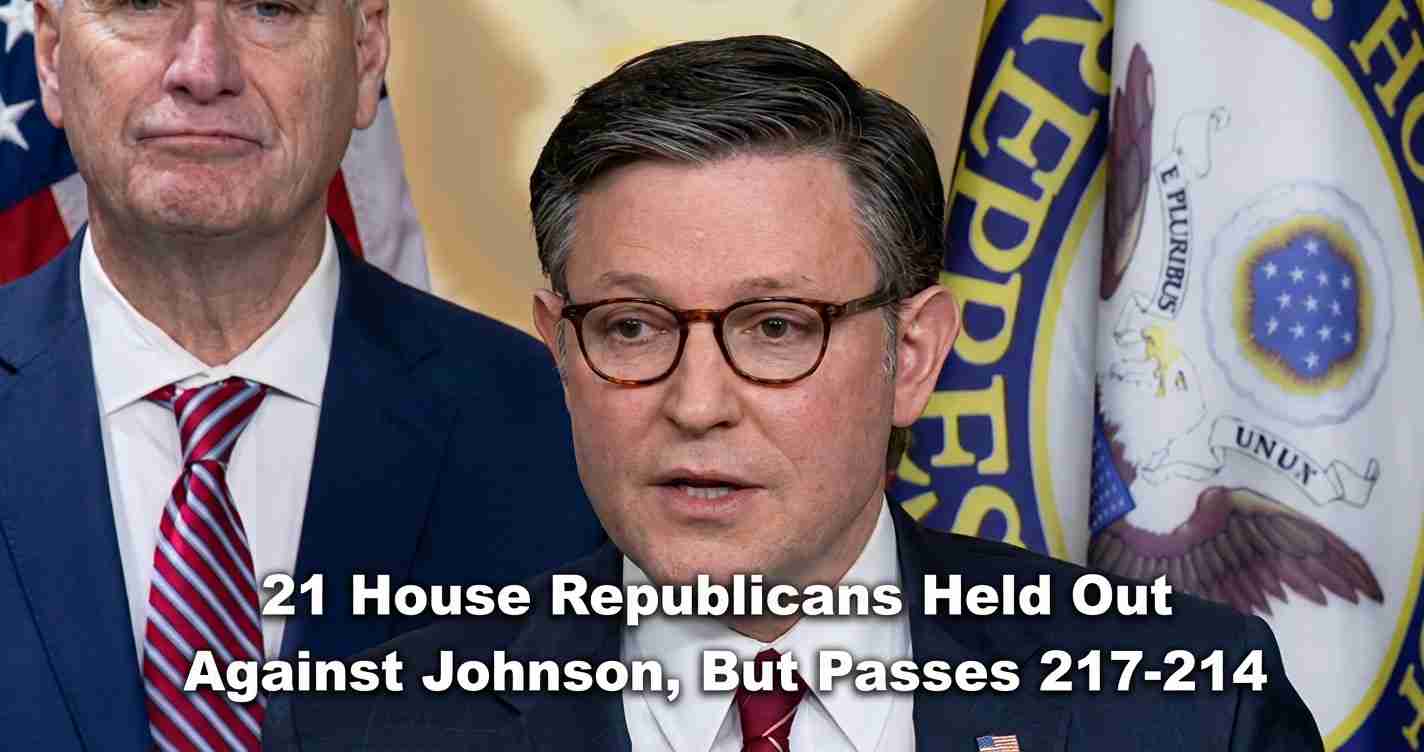
21 House Republicans Break With Trump, Johnson Over $1.2 Trillion Spending Bill, Citing Missing Election Integrity Provisions
Twenty-one House Republicans voted against a $1.2 trillion spending bill Tuesday night, breaking with President Trump and Speaker Mike Johnson over omitted election integrity measures, short DHS funding and earmarks, though the bipartisan package still passed 217–214.
Key takeaways
- Close vote: The House approved the $1.2 trillion spending bill 217–214 late Tuesday.
- GOP dissent: Twenty-one Republicans opposed the measure, citing missing election integrity provisions, only a short DHS extension, and Democrat-requested earmarks.
- Scope: The package funds departments including Defense, Education, Transportation, Housing and Urban Development, and Health and Human Services (source).
What the dissenters said
The 21 Republicans who voted no argued the bill failed to protect election integrity, did not secure the border through adequate Department of Homeland Security funding, and preserved earmarks requested by Democrats. They framed the vote as defending conservative priorities and forcing tougher negotiations.
Rep. Thomas Massie (R-Ky.) called the exclusion of election measures “a top priority for conservatives.”
Rep. Eric Burlison (R-Mo.) warned the short DHS stopgap was “a fool’s bet,” questioning whether Democrats would bargain in good faith. Rep. Lauren Boebert argued Republicans could and should demand stronger DHS funding for border security. Read the report.
Election integrity provisions and the SAVE Act
A central complaint was the omission of the Safeguard American Voter Eligibility (SAVE) Act, which would require photo identification to register voters in federal elections. Supporters say it prevents fraud; opponents call it potentially suppressive and burdensome to eligible voters.
Lawmakers like Massie described the SAVE Act as non-negotiable for conservatives. Its absence from the package helped drive the 21 “no” votes. Source
DHS funding: full year vs. a stopgap
Opponents objected that the bill provided only a brief, two-week funding extension for DHS rather than a full-year appropriation. They argued a short-term fix left homeland security issues unresolved and ceded leverage in negotiations.
Rep. Eric Burlison described relying on a short extension as risky, suggesting Democrats could avoid meaningful concessions by agreeing only to temporary measures. Supporters of the bipartisan package said the short DHS extension was part of a broader compromise to move funding across many departments. Details
Earmarks and Republican objections
Dissenting Republicans wanted earmarks requested by Democrats removed. Earmarks are direct spending requests tied to projects that benefit local constituencies. Conservatives argued that including those earmarks without Republican priority items undercut negotiating leverage and fiscal principles.
Critics said the package traded away conservative priorities for short-term stability, a point underscored by the narrow passage margin. Full report.
Who voted no
The 21 Republicans who opposed the legislation were: Andy Biggs (R-Ariz.); Lauren Boebert (R-Colo.); Josh Brecheen (R-Okla.); Tim Burchett (R-Tenn.); Eric Burlison (R-Mo.); Kat Cammack (R-Fla.); Eli Crane (R-Ariz.); Byron Donalds (R-Fla.); Randy Fine (R-Fla.); Brandon Gill (R-Texas); Anna Paulina Luna (R-Fla.); Thomas Massie (R-Ky.); Cory Mills (R-Fla.); Andy Ogles (R-Tenn.); Scott Perry (R-Pa.); Chip Roy (R-Texas); David Schweikert (R-Ariz.); Keith Self (R-Texas); Victoria Spartz (R-Ind.); Greg Steube (R-Fla.); and William Timmons (R-S.C.). Their votes reflected a bloc willing to break with leadership on policy and procedure. Source list
Legislative context and recent history
This vote marked the second time lawmakers considered the $1.2 trillion package. The bill previously faced Senate pushback in January over ICE-related concerns after deadly confrontations in Minnesota raised questions about agency safeguards. Renewed House consideration followed negotiations to keep the government funded and avoid a shutdown.
Supporters said the bill was necessary to prevent a shutdown and deliver funds for major federal departments; critics said it traded conservative priorities for near-term funding certainty. The 217–214 margin highlighted intra-GOP fractures. More
Partisan and practical stakes
For dissenting Republicans the vote was both policy-driven and tactical: push for election rules, border security, and tighter spending control. For other House Republicans and many Democrats, the immediate priority was keeping government agencies functioning and funding essential services.
The standoff illustrates a recurring tension in Congress between pursuing long-term policy wins and ensuring short-term funding certainty — an issue likely to reemerge during full-year appropriations talks and implementation of new funding levels. Context
Implications for Fresno, California
Economic impact
The bill funds agencies affecting Fresno-area programs. Funding for Health and Human Services, Education, Transportation, and Housing and Urban Development can support local hospitals, schools, roads and housing projects. Passage may prevent shutdown-related payment delays for agencies and contractors; lingering DHS disputes could inject uncertainty into public-safety and infrastructure planning. Local impact details
Political consequences
The vote highlights GOP divisions that may matter to Fresno voters and local officials. Central Valley leaders who interact with federal agencies will monitor DHS and appropriations negotiations for effects on immigration enforcement, border policy and federal grants. Local actors may push for or against priorities like election measures and earmarked projects.
Social effects and cultural relevance
Fresno’s diverse population includes many immigrant families reliant on federal services; changes to DHS funding and enforcement can affect community relations, trust in law enforcement and social-service delivery. Election-integrity debates—such as proposals like the SAVE Act requiring photo ID for federal registration—could spur local voter-education campaigns or concerns about access. Community implications
Practical applications for local leaders
Immediate benefits of passage include continued federal funding for payrolls, projects and services. But the narrow vote and ongoing disputes over DHS and riders mean Fresno officials should prepare for further negotiations that could shift timelines or program rules. Civic leaders and residents may see increased organizing around elections, immigration policy and federal grant priorities. Practical guidance



