Tiny, glowing “American pocket shark” discovered in Gulf of Mexico — Mollisquama mississippiensis identified as a new shark species
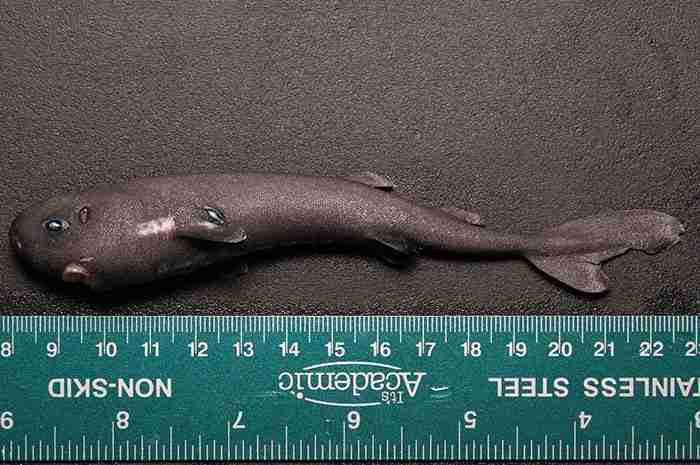
Scientists from NOAA and Tulane University have identified a new, tiny bioluminescent shark species in the Gulf of Mexico, Mollisquama mississippiensis, the American pocket shark, measuring about 14 centimeters and notable for luminous “pocket” glands.
- New species confirmed: Mollisquama mississippiensis — American pocket shark, found in the Gulf of Mexico (Tulane University; Wikipedia).
- Size and rarity: About 14 cm (5.5 in); one of only two pocket shark species ever recorded (Wikipedia).
- Unique adaptation: “Pocket” glands near the gills plus photophores — both associated with bioluminescence (Wikipedia; The Archaeologist).
Key information
Scientific name: Mollisquama mississippiensis — commonly called the American pocket shark. Sources: Tulane University, Wikipedia.
Location: Gulf of Mexico. Source: Tulane University.
Size: ~14 centimeters (5.5 inches), roughly the size of a human hand. Sources: Wikipedia, Tulane University.
Rarity: One of two pocket shark species recorded; the other, Mollisquama parini, was found off Chile in 1979. Sources: Wikipedia, Tulane University.
Unique features: Two “pocket” glands near the gills that can secrete a luminous fluid and clusters of photophores across the body. Sources: Wikipedia, The Archaeologist, Sophie Maycock (SharkSpeak).
How the American pocket shark was found and identified
The specimen was collected in 2010 during a Tulane-led study of sperm whale diets in the Gulf of Mexico. Researchers recovered a small shark from a net haul while investigating deep-sea prey brought up by whale foraging; the initial recovery is described by Tulane University.
For years the specimen remained in collections while scientists compared its anatomy to known species. Later, NOAA researchers recognized unique anatomical features; after high-resolution study and imaging, a formal description was published in 2019 in Zootaxa, confirming M. mississippiensis as a new species (Tulane University; Wikipedia).
“A tiny, rare specimen that required modern imaging and careful comparison to reveal a new branch of shark diversity.” — summary of research context
Physical description and bioluminescence
Appearance: Mollisquama mississippiensis is extremely small for a shark — about 14 cm long, with a bulbous head, cylindrical body, wide snout and a mouth positioned underneath the head. The body is gray with darker fins and cream-colored areas near the gills (Wikipedia).
Bioluminescent adaptations: The species has gland-like “pocket” organs near the gills that appear capable of secreting a luminous fluid, plus photophores scattered across the body. These features likely function in prey attraction, predator avoidance or communication, though the precise roles remain under investigation (Wikipedia; The Archaeologist).
Why imaging and modern tools mattered
Because only a single, tiny specimen was available, researchers relied on non-destructive, high-resolution methods — including CT scanning and synchrotron X-ray microscopy — to reveal skeletal and soft-tissue features. Those methods exposed diagnostic traits invisible in ordinary photos and were central to the formal species description (Tulane University).
Rarity and the other pocket shark
Pocket sharks are extraordinarily rare. Before this discovery, only Mollisquama parini — collected off Chile in 1979 — was known. That two species were found decades and oceans apart illustrates how much of the deep sea remains undocumented (Wikipedia; Tulane University).
Scientific significance and what it tells us about the deep sea
Discoveries like the American pocket shark highlight vast unknown biodiversity: some experts estimate large percentages of marine species remain undocumented. Pocket sharks offer insights into adaptations for darkness and pressure — such as miniature size, light organs and chemical secretions — informing evolutionary and ecological studies of deep-sea systems (The Archaeologist; Wikipedia).
Implications for Fresno, California
Although Fresno is inland, the discovery can have indirect local effects in five practical ways: education, funding, political advocacy, public engagement, and practical outreach. Below are concrete implications for the Central Valley.
Economic impact
Federal research funding and grant flows triggered by high-profile findings often benefit universities nationwide. Fresno-area institutions, like California State University, Fresno (Fresno State), could gain opportunities for outreach projects, internships and STEM workforce development tied to ocean science.
Political consequences
The find can be used as a talking point by local officials and moderate voters to support science funding and federal grants that help regional schools and colleges. Representatives may cite such discoveries when advocating for research budgets.
Social effects
A palm-sized, glowing shark provides an engaging story for classrooms, libraries and museums — useful for increasing science literacy and motivating students to pursue STEM paths through talks, field trips and curriculum materials.
Cultural relevance
Fresno’s emphasis on practical education makes the pocket shark a compelling hook for experiential learning and community events that tie biodiversity to local career pathways and stewardship values.
Practical applications for residents
Residents can benefit from outreach programs, virtual talks with NOAA or university scientists, and classroom visits that connect ocean research to inland concerns such as fisheries, food safety and climate impacts.
Ongoing questions and next steps
Key unknowns remain: the pocket shark’s distribution, population size, the chemical composition and ecological role of pocket secretions, and behavioral uses of bioluminescence. Addressing these questions will require coordinated deep-sea sampling, continued imaging work and cross-institution collaboration.
Sources and scientific reporting
- Tulane University news release
- Wikipedia: Mollisquama mississippiensis
- The Archaeologist: “Glow in the dark and smaller than your hand — meet the newly discovered pocket shark”
- Sophie Maycock (SharkSpeak): “A new species of glowing pocket shark”
Preserved facts and URLs are provided above as the primary sources for this report.