
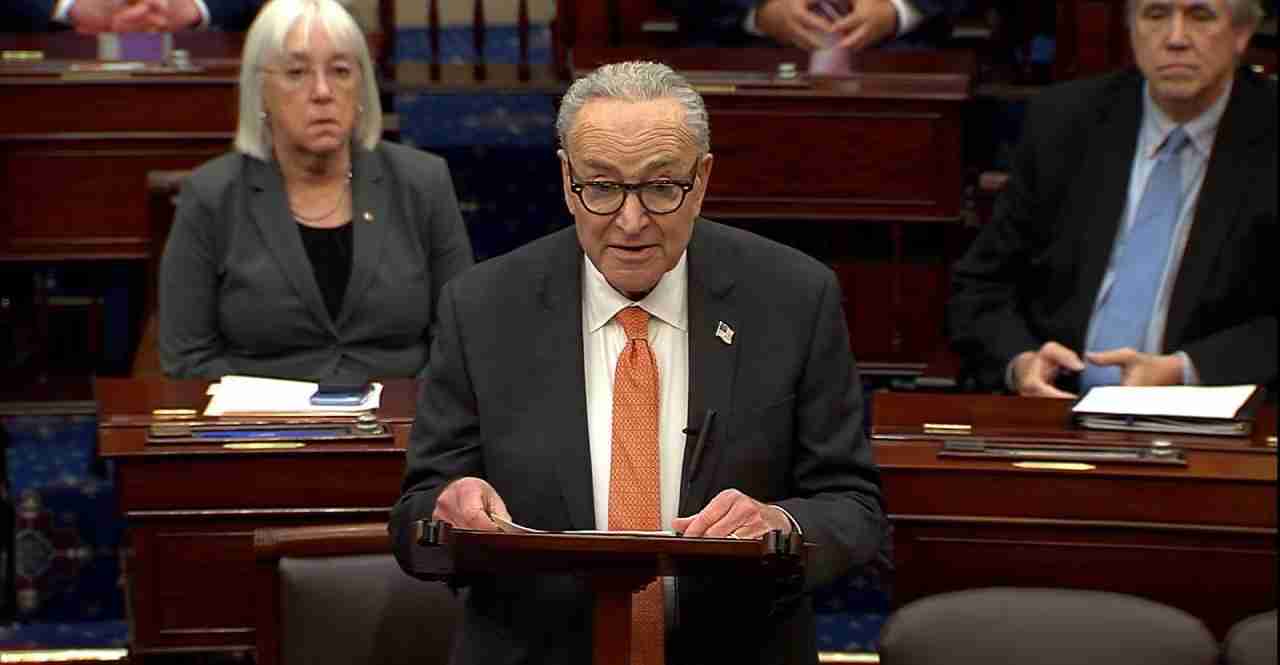
Schumer and Senate Democrats Unveil Government Funding Plan — Seeks One-Year Obamacare Subsidies Extension to Avert Huge ACA Premium Hikes
Senate Majority Leader Chuck Schumer and Senate Democrats unveiled a funding bill that would keep the government open and extend enhanced Obamacare premium subsidies for one year to avert steep ACA premium increases that could push many off marketplace coverage.
Key takeaways
- Stopgap bill: A Democratic-led continuing resolution would both keep federal agencies funded and extend enhanced premium tax credits for one year.
- Cost risk: Nonpartisan models show average annual out-of-pocket premiums for many marketplace enrollees could rise from roughly $888 to about $1,904 by 2026 if subsidies lapse.
- No change to immigrant eligibility: The proposal does not alter the federal rule barring undocumented immigrants from marketplace coverage or subsidies.
- Political choice: Schumer urged Republicans to “Just say yes.” The proposal aims to present a simple choice to avert a shutdown and protect coverage affordability.
Main story
What Schumer’s alternative government shutdown plan would do
Senate Majority Leader Chuck Schumer proposed a “clean” continuing resolution to maintain federal agency funding and avoid a lapse in services. Its central health-care feature is a one-year extension of the enhanced premium tax credits created by the American Rescue Plan and later continued in part by the Inflation Reduction Act. Schumer and Senate Democrats framed the move as a straightforward, bipartisan protection for working families that Republicans can support without attaching unrelated policy changes. See Senate Democrats’ statements.
Why Obamacare subsidies matter now
The enhanced subsidies have helped lower premiums and expand affordability since they were increased. They cap how much people pay of their income for benchmark plan premiums and expand eligibility for assistance. If those enhancements expire, analysts warn that many marketplace enrollees would face sharply higher costs and some could be forced off coverage or find plans unaffordable.
Nonpartisan organizations, including the KFF analysis and the CBO, have modeled scenarios showing substantial premium increases if the enhanced subsidies lapse. Those analyses estimate that for the typical subsidized enrollee average annual out-of-pocket premium costs could rise from roughly $888 to about $1,904 by 2026.
How the math works: higher premiums, tighter budgets
Marketplace premiums reflect insurers’ expected costs and enrollee mix. Subsidies reduce the share consumers pay. If federal payments stop, insurers’ base prices would remain but consumers would lose the added federal help, creating a gap that shows up as higher out-of-pocket payments. That increase could prompt some to drop coverage.
“If the federal government stops paying the enhanced amounts, consumers would no longer receive the added federal help.”
Advocates warn of broader ripple effects: hospitals and clinics may see more uncompensated care, state budgets could feel strain if more people enroll in Medicaid, and businesses and workers who depend on stable coverage face uncertainty.
Coverage gap for undocumented immigrants remains unchanged
Neither the Democratic proposal nor GOP funding plans change the longstanding federal rule barring undocumented immigrants from receiving marketplace coverage or premium tax credits. That exclusion is an ongoing policy debate; advocates urge targeted options, but such changes would require separate, often contentious legislation. See Background on ACA eligibility.
Political stakes and messaging
Schumer presented the proposal as a choice: back short-term funding and keep ACA help, or risk a shutdown and higher health costs for millions. He publicly told Republicans to “just say yes.” House Republicans have pushed a different approach—tying funding to conservative priorities and seeking changes Democrats oppose—making passage uncertain as the funding deadline approaches.
Related reporting: Reuters, AP, CNN.
Implications for federal budgets and insurers
Extending subsidies for a year would increase near-term federal spending compared with allowing enhanced credits to expire. Democrats argue the spending stabilizes the individual market and protects families; opponents say it raises federal costs and that Congress should consider longer-term reforms. Insurers and state marketplaces warn that uncertainty complicates planning for 2025 and 2026 plan years, including setting premiums and provider networks.
Source attribution and reporting notes
This article draws on public statements from Senate Democratic leadership, nonpartisan analyses of ACA subsidy effects, and policy background on the American Rescue Plan and the Inflation Reduction Act fact sheet. For detailed analyses, see the KFF analysis and the CBO.
Implications for Fresno, California
Economic impact
- Household costs: Higher ACA premiums would directly affect Fresno residents who buy marketplace coverage; many families could face steeper monthly payments or be priced out.
- Local health systems: Increased uncompensated care may push up costs for Fresno hospitals, clinics, and community providers.
- Public budgets: Local budgets could feel pressure if more residents enroll in safety-net programs or seek emergency care instead of preventive services.
Political consequences
Fresno-area voters are likely to view the subsidy debate through pocketbook concerns. Lawmakers representing the Central Valley could face pressure to support measures preserving affordability; the split between Senate Democrats and House Republicans may complicate messaging for local representatives who must explain their votes to constituents.
Social effects
Families already stretched by living costs could be forced to choose between health coverage and essentials such as rent, food, or childcare, increasing unmet medical needs and worsening chronic conditions. Community health centers and charity programs may see greater demand.
Cultural relevance
Health care access and affordability are major concerns in Fresno’s diverse communities—including farmworker families, immigrants, and older adults. Rising ACA premium costs resonate in a region where many depend on affordable coverage and safety-net services.
Practical applications for local residents
- Review marketplace plan options during open enrollment and verify current subsidy eligibility.
- Seek assistance from local community clinics and county health offices to understand options and deadlines.
- Monitor congressional votes and local lawmakers’ statements to learn whether the one-year subsidies extension becomes law and how it affects 2025–2026 premiums.
Reporting and next steps
The Senate proposal will face negotiation as lawmakers work against funding deadlines. If bipartisan agreement fails, alternative short-term fixes may be needed. Local officials and health providers in Fresno will be watching for changes that affect coverage affordability and health system stability. For continued updates on the federal funding debate and ACA premium costs, consult the KFF analysis, the CBO, and official congressional communications.



